
Scroll breakdown
In this guide, we’ll cover:
Trust Gap
Why insurance buyers need proof, clarity and reassurance before they are ready to book a call.
Lead Capture
Where guides, checklists, calculators or quizzes turn cold interest into a warmer prospect.
Nurture System
How email, SMS and retargeting keep the agent visible while the prospect builds confidence.
Booked Call
What the funnel should prove before the consultation: fit, credibility, next step and timing.
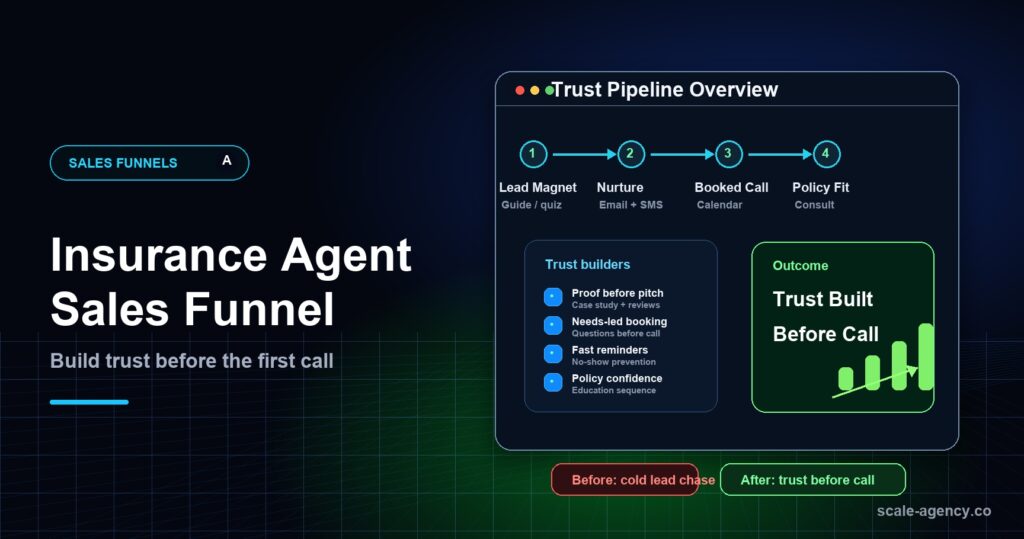
“An insurance agent sales funnel works best when it builds trust before the first call, so the consultation starts with confidence instead of resistance.”
If you are asking how an insurance agent sales funnel builds trust before the first call, the real issue is whether your prospects feel safe enough to speak to you before they compare price. Insurance is a high-trust sale. The funnel has to educate, reassure and qualify before the consultation starts.
For the full revenue-system view, use this insurance agent sales funnel guide to see how trust, booking, follow-up and renewal logic turn into reliable policy sales month after month.
Most agents lose leads because the journey jumps from cold traffic to “book a call” too quickly. A stronger funnel gives prospects useful proof first, then uses follow-up, reminders and booking context to make the call feel like the natural next step.
For insurance and local-service funnels using GoHighLevel, use the GoHighLevel expert checklist to pressure-test CRM routing, follow-up and attribution before scaling traffic. SCALE builds GoHighLevel CRM, funnel, and automation systems for businesses that need better lead quality, faster follow-up, and clearer attribution.
If you want SCALE to show you where your current funnel and follow-up process are leaking trust, book a free Growth Systems Audit and we will map the fixes that improve lead quality, show-up rate and booked calls.
For related funnel strategy, see our guides on building funnels that attract better clients and using marketing funnels with Facebook Ads.
Why Traditional Lead Generation Fails Insurance Agents
Buying leads from aggregators or relying solely on referrals creates an unpredictable pipeline. Purchased leads are often shared with multiple agents, meaning you’re competing on price and speed rather than trust. Referrals are valuable but inconsistent, and they don’t scale without a system behind them.
The core problem is that most agents treat lead generation as a one-step process: get contact information, then call. But insurance is a high-consideration purchase. People need time, information, and proof before they’re ready to engage.
A sales funnel changes the dynamic entirely. Instead of chasing cold contacts, you attract prospects who are already pre-qualified and warmed up through content, automation, and strategic follow-up.
The Four Stages of an Effective Insurance Agent Sales Funnel
Every high-performing funnel for insurance agents follows a similar structure, though the execution will vary based on your niche, market, and offer.
Stage 1: Awareness and Lead Capture
This is where prospects first encounter your brand. The goal here is not to sell insurance but to offer something valuable in exchange for contact information. This could be a guide, calculator, checklist, or quiz that addresses a specific pain point.
Examples that work well for insurance agents include:
- A life insurance needs calculator that estimates coverage based on income and dependents
- A downloadable PDF guide on common Medicare mistakes
- A short quiz that helps business owners identify gaps in their liability coverage
- A checklist for new parents navigating life and health insurance decisions
The lead magnet should be specific, immediately useful, and relevant to the type of insurance you sell. Avoid generic content like “10 Tips for Choosing Insurance” — it’s too broad and doesn’t demonstrate expertise.
Traffic to this stage typically comes from paid ads, SEO-optimised content, social media, or referral partnerships. The landing page should have one clear call to action and remove distractions that prevent conversion.
Stage 2: Nurture and Education
Once someone opts in, the nurture sequence begins. This is where most agents either over-sell too quickly or go silent entirely. Neither works.
Your goal in this stage is to deliver on the promise of your lead magnet, provide additional value, and begin positioning yourself as a trusted advisor. Email automation is the backbone here, but SMS and retargeting ads can reinforce your message.
A strong nurture sequence for an insurance agent might look like this:
- Immediate delivery of the lead magnet with a welcome message
- Day 2: Educational email addressing a common misconception in your niche
- Day 4: Case example or story showing how the right coverage made a difference
- Day 6: Soft invitation to book a consultation with clear next steps
- Day 9: FAQ-style email that handles objections before they’re voiced
- Day 12: Final call-to-action with urgency or scarcity if appropriate
Each email should feel personal, relevant, and focused on the prospect’s needs rather than your credentials. The tone should be conversational but professional, and every message should have a single clear purpose.
Stage 3: Conversion and Appointment Booking
This is the bridge between interest and action. By now, your prospect understands their problem, sees you as credible, and is considering whether to move forward.
The conversion mechanism is typically a booking page where prospects can schedule a consultation, quote call, or needs analysis. The page should reinforce why this call is valuable, what will be covered, and how long it will take.
Remove friction by using calendar automation tools that sync with your availability and send confirmations and reminders automatically. No-shows drop significantly when reminders go out via email and SMS 24 hours and one hour before the appointment.
Some agents add a short application or questionnaire before the booking is confirmed. This serves two purposes: it pre-qualifies the lead and gives you context before the call, making the conversation more productive.
Stage 4: Follow-Up and Retention
The funnel doesn’t end when someone books a call. In fact, the period between booking and the actual appointment is critical. This is when buyer’s remorse or distraction can cause cancellations.
Automated follow-up should include confirmation messages, preparation instructions, and value-building content that reinforces their decision to take the call. After the consultation, whether they buy immediately or not, the funnel continues with post-call sequences tailored to their decision stage.
For clients who purchase, onboarding sequences ensure they understand their policy, know how to reach you, and feel confident in their choice. For those who don’t buy yet, a long-term nurture campaign keeps you top of mind until their situation changes.
Building Your Insurance Agent Sales Funnel: What You Actually Need
You don’t need a complicated tech stack to get started, but you do need the right tools working together. At minimum, a functional insurance sales funnel requires:
- A landing page builder for lead capture
- Email and SMS automation platform
- Calendar scheduling tool with reminders
- CRM to track leads and manage follow-up
- Analytics to measure conversion rates at each stage
Platforms like GoHighLevel consolidate these functions into one system, which simplifies management and ensures nothing falls through the cracks. The key is integration — your funnel should operate as a connected system, not a patchwork of disconnected tools.
Common Mistakes That Kill Insurance Sales Funnels
Even well-intentioned funnels fail when certain mistakes aren’t avoided. Here are the most common issues that prevent insurance agents from seeing results:
Asking for too much too soon. If your first touchpoint is “book a call,” you’re skipping the trust-building phase entirely. Prospects need a reason to give you their time and attention before they’re ready to talk.
Generic messaging. If your emails and landing pages could apply to any agent in any market, they won’t resonate. Specificity builds credibility. Speak directly to the concerns of your ideal client.
No follow-up after the opt-in. Capturing a lead means nothing if you don’t have a plan to nurture it. Automation should handle the heavy lifting so no lead goes cold due to manual oversight.
Ignoring no-shows and non-buyers. Just because someone didn’t book or didn’t buy the first time doesn’t mean they’re a dead lead. Long-term nurture campaigns turn cold prospects into future clients when their circumstances change.
Not tracking funnel performance. If you don’t know your opt-in rate, email open rate, booking rate, and show-up rate, you can’t improve. Measure each stage and optimise the weakest links first.
How to Optimise Your Funnel Over Time
A sales funnel is never truly finished. The best-performing funnels are constantly tested and refined based on real data.
Start by identifying where prospects drop off. If your landing page gets traffic but few opt-ins, test your headline, offer, or form length. If people opt in but don’t open emails, your subject lines need work. If they open emails but don’t book, your call-to-action or value proposition may be unclear.
Small improvements compound. A landing page that converts at 30% instead of 20% can double your lead volume with the same traffic. An email sequence that books 15% of leads instead of 10% means more revenue without spending more on ads.
Run one test at a time so you know what’s actually driving the change. A/B test headlines, email copy, booking page layouts, and follow-up timing. Let data guide your decisions rather than assumptions.
Why Automation Matters More for Insurance Agents Than Most Industries
Insurance sales cycles can be long. Someone researching life insurance in January might not be ready to buy until March. A business owner exploring liability coverage may need to consult with a partner or accountant before moving forward.
Without automation, staying in front of these prospects consistently is nearly impossible. Manual follow-up doesn’t scale, and it’s easy for leads to slip through the cracks when you’re juggling calls, quotes, and client service.
Automation ensures every lead gets the same high-quality experience regardless of when they enter your funnel or how busy you are. It frees you to focus on conversations that matter while the system handles nurture, reminders, and re-engagement.
Integrating Paid Traffic and SEO Into Your Funnel Strategy
A funnel is only as good as the traffic flowing into it. Organic search and paid ads serve different but complementary roles.
SEO-driven content attracts prospects actively searching for answers. Blog posts, guides, and comparison pages that rank for terms like “how much life insurance do I need” or “best business insurance for contractors” bring in high-intent traffic over time without ongoing ad spend.
Paid ads on Google and Facebook allow you to target specific demographics, locations, and behaviours with precision. They deliver faster results and let you test offers and messaging quickly. The trade-off is cost, but when your funnel converts well, paid traffic becomes profitable rather than expensive.
The best approach uses both. SEO builds a foundation of consistent inbound leads while paid ads scale volume and fill gaps in your organic reach.
Conclusion
An insurance agent sales funnel isn’t just a nice-to-have marketing asset. It’s the infrastructure that turns sporadic interest into predictable revenue. By building trust before the first call, automating follow-up, and optimising each stage based on data, you create a system that works whether you’re actively prospecting or not.
The agents who win in today’s market aren’t necessarily the ones with the best products or the lowest prices. They’re the ones who show up consistently, provide value upfront, and make it easy for prospects to take the next step. That’s what a well-built funnel does.
Want to learn more about this?
Watch the video below:
