
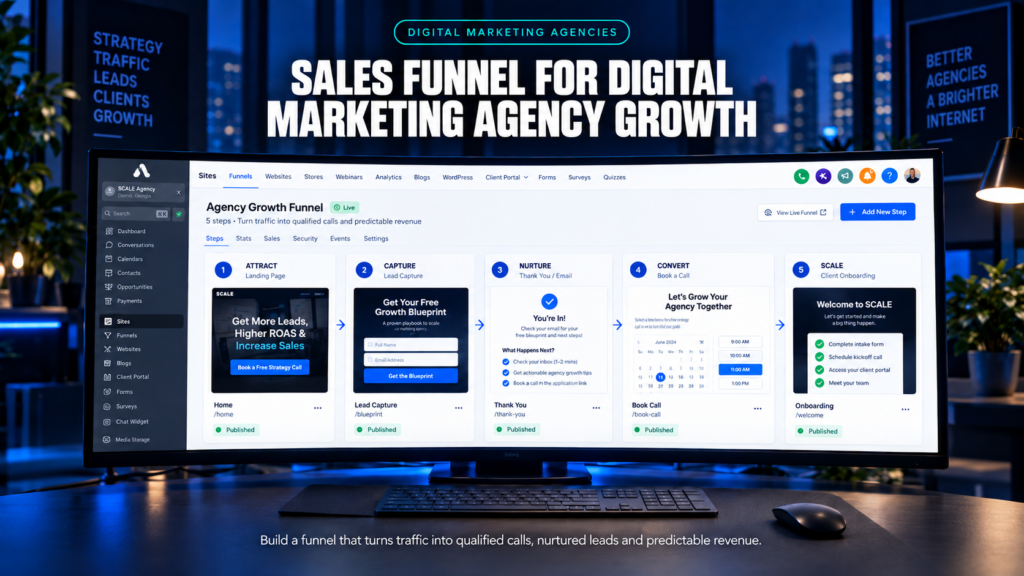
Quick Answer: What Should A Digital Marketing Agency Funnel Do?
A sales funnel for digital marketing agency growth should turn traffic into qualified enquiries, booked calls and measurable revenue. It needs a specific offer, relevant proof, a qualification path, booking, follow-up and CRM reporting. Treat the landing page as the front door—not the whole system. Every enquiry needs a named owner and a clear next step.
TL;DR
- Start with one specific client problem, not a generic “grow your business” promise.
- Use proof that explains the process and context behind the result.
- Ask qualification questions that change fit, routing or the next conversation.
- Connect every form, booking and follow-up step to a CRM owner and status.
- Measure qualified conversations and revenue outcomes—not raw lead volume alone.
What You Will Learn
Connect the offer, proof, booking and follow-up so an interested visitor becomes a sales conversation your team can act on.
The Funnel Starts With A Specific Problem
Make it clear who you help, what needs to change and what the buyer gets from taking the next step.
Case Context Beats Generic Claims
Show the work, the constraints and the relevant evidence. Let prospects understand how the agency thinks.
Qualification Protects The Calendar
Collect useful context, choose a sensible route and make sure someone owns the enquiry before the call.
Keep The Next Step Visible
Give non-bookers useful follow-up and connect the eventual outcome to the original source and offer.
Ready To Turn This Into A Working System?
Let us custom-build a conversion system for you, or install our top 5 performing GHL systems yourself, completely free.
Install Our Top 5 GHL Systems (FREE) Have SCALE Build It For You, Done For You.
Compare five sales funnel agency examples when choosing a model. For the separate fit-assessment process, use the agency lead qualification guide.
Why Agency Funnels Need More Than A Contact Form
A digital marketing agency is often selling trust before it sells a service. A basic contact form does not give the buyer enough clarity, and it does not give the agency enough context. The funnel should show the problem, explain the process and guide the prospect toward the right next step.
A digital marketing agency funnel becomes commercially useful when every stage has a clear job, owner and measurable next action. A polished page cannot fix an unanswered enquiry or a sales team that cannot see what the prospect requested.
Start with the journey your own agency can reliably deliver. Decide which offer you want to sell, which businesses it fits and who will respond. Then build the page, form and follow-up around those decisions.
Digital Agency Funnel Decision Table
Use this as a build brief. Each component should remove a specific uncertainty for the buyer or the team handling the enquiry.
| Funnel Part | Weak Version | What To Build Instead |
|---|---|---|
| Offer | A broad marketing promise | A specific buyer problem, service scope and next step |
| Proof | A logo strip without context | A relevant example explaining the work, conditions and outcome |
| Qualification | A long form nobody uses | Questions that change fit, routing or call preparation |
| Booking | A calendar link with no handoff | The right calendar, a named owner and visible enquiry context |
| Follow-up | One confirmation email | Useful messages suited to the prospect’s actual status |
| Measurement | A count of form submissions | Connected source, stage, appointment and revenue records |
How An Enquiry Growth Funnel Works For An Agency
An enquiry growth funnel connects the message that attracts a prospect with the conversation your team can act on. For an agency, that means carrying the offer, buyer context and next step from the first visit through to a sales decision.
Give ready buyers a clear route to a relevant conversation. Give people still comparing approaches a useful example or guide. Then test both paths: can the person handling the enquiry see what was requested, where it came from and who owns the response? Does booking a call stop the non-booker follow-up? Those handoffs matter more than collecting another form submission.
How To Build The Funnel As A Revenue System

The workspace above is a demonstration, not a screenshot of client results. Its useful principle is simple: the person handling the enquiry should not have to reconstruct the buyer’s journey from separate tools.
1. Define The Offer And Buyer Fit
Name the specific problem, the type of business the agency helps and the outcome the engagement is designed to create. A stronger funnel focuses on one buyer pain: inconsistent leads, poor booking rates, weak follow-up or unclear reporting.
Illustrative offer: an agency serving clinics could offer a review of the enquiry-to-appointment journey. The page would explain what gets reviewed, what the clinic receives and who the review is for. That is more useful than promising to “scale any business” without describing the work.
Keep the traffic message and page promise aligned. Someone clicking an ad about missed enquiries should arrive at a page about that problem, not a catalogue of every service the agency sells.
2. The Three-Page Agency Funnel Behind $1M+ In Open Contract Value
Before SCALE, I co-owned an agency called Funnels & Conversions. We used Proposify to send clients contracts, and our archived register records more than US$1 million in open proposal and contract value. The three-page enquiry growth funnel below was the journey we used to generate and qualify sales opportunities for our digital marketing agency. The screenshot below shows a screenshot of some of our Proposify contracts

Each page had one clear job:
- Opt-in page: introduce the service, create interest and move the right prospect to the next step. We were selling funnel builds, automations, advertising support and lead follow-up.
- VSL and application page: explain how the partnership worked, show relevant proof, answer the main buying questions and qualify prospects before inviting them to book a call.
- Booked-call confirmation page: prepare the prospect for the conversation, explain what would happen next and encourage them to confirm and attend the appointment.
The part most people miss is not the individual pages. It is how each page hands the prospect to the next one.
The opt-in created interest. The VSL built context, trust and belief while the application qualified the opportunity. The confirmation page prepared and pre-sold the prospect on our offer ready for the call.
A landing page connected to a calendar is not automatically a sales funnel. The offer, qualification, messaging and follow-up all need to support the same journey.
3. Design The Qualification Path
Qualification is about helping the agency spend time with prospects who match the offer and are ready for the next step. Ask only for information that changes routing, readiness or the quality of the sales conversation.
Useful starting questions cover business type, the problem to solve, current acquisition and sales process, timing, and who owns the decision. Ask about budget when it genuinely changes the route. For every field, name the decision it informs; remove fields that nobody uses.
Define what happens to an unclear or unsuitable enquiry as well as a strong fit. A manual review, an educational resource or a polite decline can be more appropriate than immediate calendar access. The detailed qualification framework covers evidence and scoring; this guide focuses on connecting that decision to the wider funnel.
4. Connect Booking To A Real Handoff
Route suitable prospects to the right calendar or owner and acknowledge the enquiry. Tell the prospect what happens next and set a response expectation the team can actually meet. An automated receipt is not the same as a meaningful human response.
The confirmation should repeat the purpose of the call, provide the correct time and timezone, explain any preparation, and make rescheduling straightforward. The owner should receive the original source, offer and qualification answers before the meeting.
Test the paths around the booking, not just the successful submission: no available slot, duplicate enquiry, reschedule, cancellation and no-show. Each needs a status and next action so it does not disappear from view.
5. Build Useful Follow-Up For Non-Bookers
Many good prospects do not book on the first visit. A useful nurture path keeps the agency visible while the buyer compares options. Point to relevant case studies, process guides and decision checklists rather than sending the same booking request repeatedly.
Separate an enquiry that never booked from a cancelled appointment or an active sales conversation. For example, an eligible non-booker might receive a helpful explanation of the next step, followed by a relevant proof example. Someone already speaking to sales should not remain in that same sequence.
Set explicit stop conditions when a prospect replies, books, opts out or becomes a client. Keep the contact’s permission and preferences visible; a form submission should not silently enrol everyone in every campaign.
6. Map CRM Stages And Revenue Outcomes
Record source, offer, qualification result, appointment status, opportunity stage and revenue outcome so the agency can improve the system rather than guess. Choose stage names the team can apply consistently and give every active opportunity an owner and a dated next action.
Distinguish a scheduled call from an attended call, and a proposal sent from a deal won. Keep lost reasons and “not now” decisions visible rather than deleting inconvenient records. Where the original source cannot be established, record it as unknown instead of assigning a channel by assumption.
Use the GoHighLevel marketing automation and lead-tracking guide for the implementation detail. If your team needs help with routing, access and handover, the GoHighLevel expert hiring checklist can help define the scope before you hire.
Connect The Page To The Follow-Up
Want to configure your own agency funnel? Start with the free five-system GoHighLevel snapshot, choose the relevant route, and adapt the offer, qualification questions and follow-up to your business. Connect your accounts and test the complete journey before sending traffic.
Agency Funnel Problems, Revenue Risk And Fixes

A weak conversion rate is a signal to investigate, not a diagnosis on its own. Check the evidence below before changing the page or increasing traffic.
| Where It Stalls | Check First | Practical Next Step |
|---|---|---|
| Traffic, few enquiries | Traffic relevance, offer clarity and whether the form works | Match the page to the buyer’s problem and test the submission path |
| Enquiries, weak calls | Source quality, fit questions and the promise attracting the lead | Clarify eligibility and route unsuitable enquiries away from sales |
| Bookings, low attendance | Timezone, reminders, call expectations and rescheduling | Repair the confirmation and pre-call handoff |
| Good leads go quiet | Response ownership, message relevance and current status | Assign a useful next action and stop conflicting sequences |
| Revenue cannot be traced | Missing source data, duplicate records and stage definitions | Connect opportunities to source and record won/lost outcomes consistently |
Measure The Handoffs, Not Just The Leads
Use a consistent reporting period and define the denominator for each rate. A “booking rate” based on all visitors answers a different question from one based on qualified enquiries. Keep the underlying counts beside the percentage, especially when volumes are small.
- Qualified enquiry rate: qualified enquiries divided by relevant landing-page visits. Check whether the page attracts the intended buyer.
- Qualified booking rate: booked qualified enquiries divided by all qualified enquiries. Check the booking handoff.
- Show rate: attended appointments divided by appointments due in that period. Define how reschedules and cancellations are treated.
- Opportunity-to-client rate: won clients divided by qualified opportunities from the same tracked group, allowing time for those opportunities to close.
- Revenue by source and offer: revenue recorded against the originating source and offer. Keep cash collected separate from proposal value or expected pipeline.
Illustrative calculation, not a benchmark: if 20 qualified enquiries produce 8 bookings, the qualified booking rate is 40%. That number alone does not say whether the offer is profitable. You still need attendance, sales outcomes, delivery costs and a reliable source record.
Compare like with like before drawing a conclusion. A change in traffic mix, offer or sales-cycle length can affect the result. Improve one identified handoff, keep a dated change log and review the downstream outcome—not only the first metric that moves.
Find The Weakest Handoff In Your Funnel
Want this built around your agency’s offer? SCALE can connect your funnel, CRM, qualification, follow-up and booking into one sales system. Book a call to map the right build for your business.
Before You Send More Traffic
Run one test enquiry through the whole journey. Do not stop when the form displays a success message.
- Submit on mobile: confirm the page, fields, error messages and confirmation work.
- Inspect the CRM record: check source, offer, qualification answers, owner and next action.
- Book and reschedule: verify the calendar, timezone, confirmation and owner notification.
- Trigger a reply and an opt-out: confirm the appropriate follow-up stops.
- Close the test opportunity: verify that its outcome appears correctly without treating test data as real revenue.
Record the faults, fix the route and repeat the failed steps. For alternative architectures, see the three agency funnel systems guide. Keep this page as the operating plan for your own agency’s growth journey.
Conclusion
A sales funnel for digital marketing agency growth should make the right buyer, next step and sales context clearer. Connect a specific offer, credible proof, qualification, booking, nurture and CRM measurement into one journey. Start with the handoff where suitable prospects are being lost, assign an owner and test the complete route before buying more attention.
Frequently Asked Questions
What Should A Digital Marketing Agency Funnel Include?
Include a focused offer page, relevant proof, qualification form, calendar or review step, CRM routing, follow-up and reporting. Every active enquiry should have an owner and a next action.
Should Agencies Use A Lead Magnet?
A lead magnet can help when prospects need education before a sales conversation. It should answer a problem relevant to the paid service and lead to a clear next step. If buyers already understand the problem and want help, a direct application or consultation route may be more appropriate.
How Do Agencies Qualify Leads?
Ask about business type, goals, current marketing, budget where relevant, timing and the decision-maker. Use the answers to choose an appropriate route. Keep detailed fit scoring separate from the wider funnel and do not collect fields that nobody uses.
What Is The Best Funnel Metric?
There is no single metric that describes the whole funnel. Review qualified enquiries, bookings, attendance, won opportunities and revenue together. Define each denominator and keep the counts visible so a better-looking percentage does not hide fewer useful conversations.
What Should Happen After Someone Submits A Form?
Acknowledge the request, retain the source and answers, assign an owner and explain the next step. Route the prospect to booking, review or an appropriate follow-up path, and confirm the handoff is visible in the CRM.
