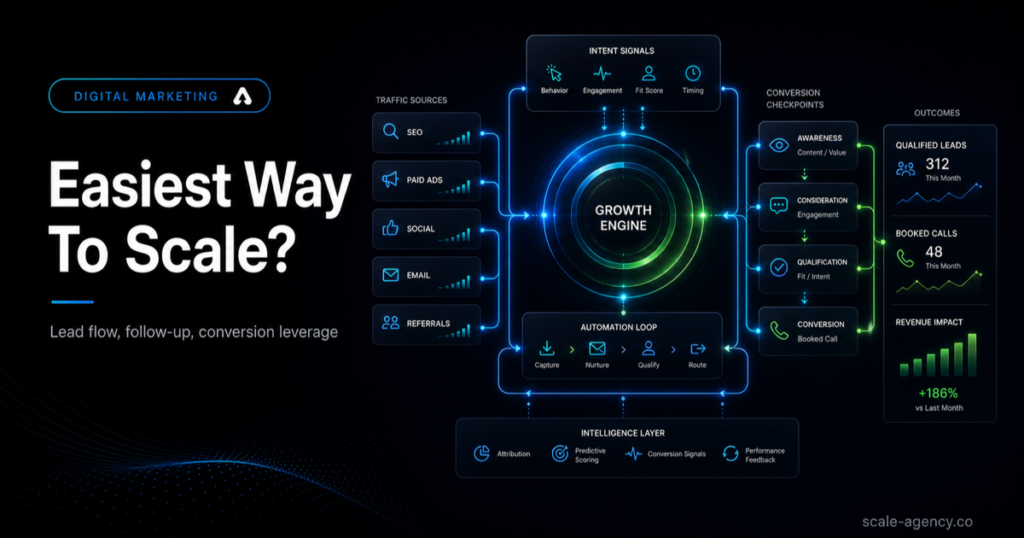
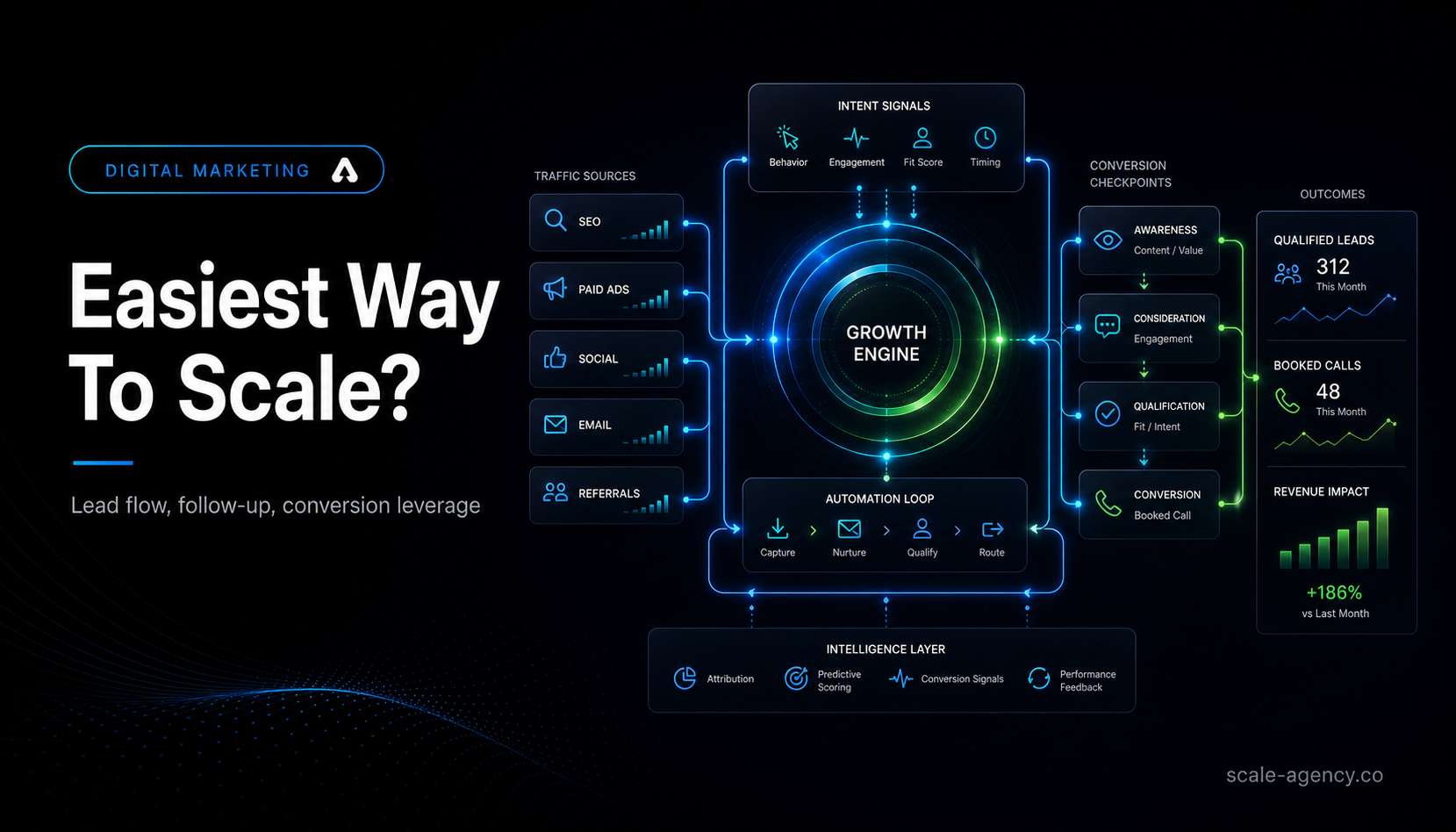
If you are asking whether a sales funnel in digital marketing is the easiest way to scale without working more, the real question is whether your business has a system that improves lead quality, automates follow-up and moves prospects toward revenue without your team manually stitching every step together.
When the funnel depends on CRM automation, speed-to-lead and attribution, compare the build against an expert GoHighLevel setup before adding more campaigns. SCALE builds GoHighLevel CRM, funnel, and automation systems for businesses that need better lead quality, faster follow-up, and clearer attribution.
If you want SCALE to show you where your current traffic, funnel and follow-up process are still leaking revenue, book a free Growth Systems Audit and we will map the fixes that create more growth without adding more busywork.
What Is a Sales Funnel in Digital Marketing?
A sales funnel in digital marketing is a multi-stage system designed to guide prospects from initial awareness through to purchase and beyond. Unlike traditional marketing that broadcasts messages and hopes for results, a funnel is intentional. It anticipates where someone is in their buying journey and delivers the right message, offer, or content at the right time.
The funnel metaphor exists because you start wide at the top with many prospects, and as people move through each stage, only the most qualified and interested remain. By the bottom, you’re left with buyers who are ready to commit.
If you need a neutral baseline before you tailor the model to your own business, HubSpot’s conversion funnel overview is still a useful reference.
Most businesses operate without a funnel. They run ads, post content, send emails, but none of it connects. A funnel ties these activities together into a coherent system where each step has a purpose and a next action.
That is exactly why these sales funnel in digital marketing examples are useful: they show how structure beats activity for its own sake. If you want to see what that looks like when funnel pages, CRM logic and follow-up are unified inside one stack, these GoHighLevel sales funnel systems are the most relevant comparison.
The Core Stages of a Digital Marketing Sales Funnel
While funnel models vary, the most effective ones follow a clear progression. Here’s how a well-structured funnel typically works:
- Awareness: A prospect discovers your business through paid ads, SEO, social media, or referrals. The goal here is visibility and capturing attention with content that speaks to a problem they recognise.
- Interest: Once aware, they engage further by consuming content, visiting your website, or joining your email list. You’re building trust and demonstrating expertise.
- Consideration: The prospect evaluates whether your solution fits their needs. This is where case studies, testimonials, product demos, and comparison content become critical.
- Conversion: They make a purchase or commit to working with you. The friction here should be minimal, with clear calls to action and a seamless buying process.
- Retention: Post-purchase, the funnel continues. You deliver value, encourage repeat business, and turn customers into advocates who refer others.
Each stage requires different messaging, content, and tactics. Trying to sell too early or nurture too long both kill momentum. The funnel structure ensures you’re always moving people forward at the right pace.
Why a Sales Funnel in Digital Marketing Scales Better Than Manual Effort
The reason a sales funnel allows you to scale without working more comes down to automation and leverage. Once built, the funnel does the heavy lifting. It qualifies leads, educates prospects, handles objections, and moves people toward a decision while you focus on delivery and strategy.
Without a funnel, growth requires more of your time. More sales calls. More follow-ups. More content creation. You become the bottleneck. With a funnel, you build the system once and it runs repeatedly. Traffic enters at the top, and revenue comes out at the bottom.
This doesn’t mean funnels are set-and-forget. They require monitoring, testing, and optimisation. But the work you do improves the system itself, not just individual transactions. You’re building an asset, not trading time for money.
For a more operational view of that payoff, see how sales funnels in digital marketing produce consistent leads without burnout.
What Makes a Sales Funnel Actually Work
Not all funnels perform. Many businesses build something that looks like a funnel but doesn’t convert. Here’s what separates effective funnels from the ones that waste ad spend:
- Clear targeting: The funnel starts with the right audience. If your ads or content attract the wrong people, no amount of funnel optimisation will fix it.
- Compelling offers at each stage: Every step should have a reason for someone to take the next action. Lead magnets, tripwires, core offers, and upsells all need to deliver value and create momentum.
- Seamless transitions: Friction kills conversions. If someone has to search for the next step, re-enter information, or wait too long, they drop off.
- Automated follow-up: Email sequences, retargeting ads, and SMS campaigns keep prospects engaged even when they don’t convert immediately.
- Data and tracking: You need to know where people enter, where they drop off, and what converts. Without tracking, you’re guessing.
The best funnels feel effortless to the prospect. They get what they need, when they need it, without confusion or pressure. Behind the scenes, every element is intentional and optimised.
How to Build a Sales Funnel That Drives Revenue
Building a funnel doesn’t require a massive budget or a technical team, but it does require clarity and structure. Here’s the process:
Start with the Offer
Before you build traffic or create content, define what you’re selling and to whom. What problem does it solve? What result does it deliver? What makes it different? Your offer determines everything else in the funnel.
Map the Customer Journey
Understand how someone goes from unaware to buyer. What questions do they have? What objections come up? What proof do they need? Map this out in stages and identify what content or touchpoint belongs at each step.
Choose Your Funnel Type
Different business models require different funnels. A lead generation funnel for high-ticket services looks different from an ecommerce funnel or a webinar funnel. Match the structure to your sales process.
If you sell services, compare that against a marketing agency sales funnel before copying a structure built for ecommerce.
Build the Funnel Infrastructure
This includes landing pages, email sequences, payment processing, CRM integration, and automation. Platforms like GoHighLevel consolidate these tools into one system, making it easier to manage and scale.
If you want the KPI side of that setup, review how GoHighLevel sales funnels tighten tracking, follow-up and conversion visibility.
Drive Targeted Traffic
A funnel without traffic is just a plan. Use paid ads, SEO, content marketing, partnerships, or social media to bring the right people into the top of your funnel. Quality of traffic matters more than quantity.
Test and Optimise
Launch, measure, and improve. Test headlines, offers, email copy, ad creatives, and page layouts. Small improvements in conversion rates compound into significant revenue gains over time.
Common Mistakes That Kill Funnel Performance
Even well-intentioned funnels fail when certain mistakes creep in. Here are the most common:
Overcomplicating the funnel with too many steps or offers confuses prospects and increases drop-off. Simplicity usually wins.
Ignoring the post-purchase experience means you’re leaving money on the table. Retention and upsells often generate more profit than the initial sale.
Failing to segment your audience treats everyone the same. Different prospects have different needs, and your funnel should reflect that with tailored messaging.
Not following up quickly enough. Speed matters. The faster you respond to a lead or deliver on a promise, the higher your conversion rate.
Relying solely on paid traffic without building owned channels like email lists or organic search makes your funnel fragile and expensive.
The Role of Automation in Scaling Your Funnel
Automation is what transforms a sales funnel from a manual process into a scalable system. Email sequences nurture leads while you sleep. CRM workflows assign tasks and trigger follow-ups. Retargeting ads bring back visitors who didn’t convert the first time.
The goal isn’t to remove the human element entirely. It’s to remove repetitive tasks so you can focus on strategy, relationships, and delivery. Automation handles the predictable, freeing you to handle the exceptional.
Tools like GoHighLevel, ActiveCampaign, and HubSpot make this possible without needing a developer. You can build sophisticated workflows that respond to behaviour, segment audiences, and personalise messaging at scale.
When to Invest in a Sales Funnel
If you’re still validating your offer or figuring out your market, a complex funnel might be premature. But if you have product-market fit, consistent demand, and you’re turning away business or working unsustainable hours, a funnel is overdue.
The right time to build a funnel is when you’re ready to shift from hustle to system. When you want growth that doesn’t require proportional increases in effort. When you’re tired of starting from zero every month.
A sales funnel in digital marketing isn’t a luxury or a nice-to-have. For businesses serious about scaling, it’s infrastructure.
Want SCALE to build and optimise this for you?
Book a free Growth Systems Audit and we will show you where your funnel, follow-up and sales process are still leaking revenue: https://scale-agency.co/
Disclosure: We may earn a commission from GoHighLevel if you sign up through the link below. It does not increase your price. If you use our link, we will unlock SCALE’s exclusive bonuses for you at no extra cost.
Start your 14-day free trial here and unlock exclusive free bonuses from SCALE that are not available anywhere else: Try GoHighLevel
Conclusion
A sales funnel in digital marketing is the difference between working harder and working smarter. It’s the system that allows you to scale revenue predictably without burning out or hiring a massive team. When built with clarity, tested with data, and optimised over time, it becomes the most valuable asset in your business. The question isn’t whether you need one. It’s whether you’re ready to stop trading time for growth and start building a system that works without you.
Learn more:
