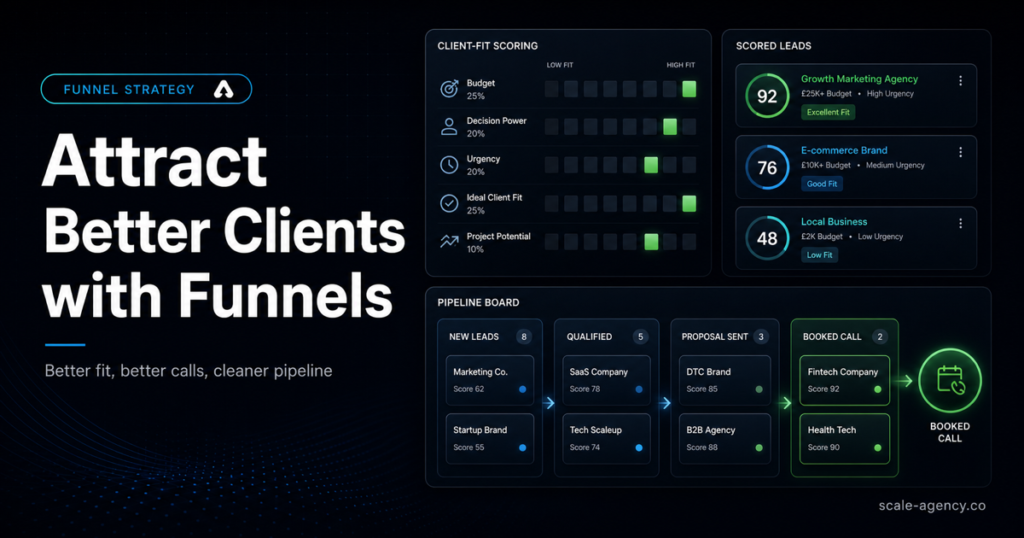
In this guide, we’ll cover:
The practical pieces that decide whether this funnel becomes a useful revenue system or another disconnected marketing asset.
QUALIFY
Better Clients Need A Filter
The funnel should screen intent before a prospect reaches your calendar.
NURTURE
Education Does The Heavy Lifting
Strong nurture answers objections before sales has to chase them manually.
CALENDAR
Booked Calls Need Better Context
CRM stages and reminders protect the handoff from interest to appointment.
SCALE
A Funnel Becomes An Asset
Every conversion improvement compounds across future traffic and offers.
A marketing agency funnel works when it filters demand, not when it simply creates more names in the CRM.
Quick Answer
A marketing agency funnel is usually the easiest way to attract better clients when it qualifies prospects before they reach your calendar. It should educate, filter and frame the offer so sales calls start with better context, stronger intent and fewer poor-fit conversations.
TL;DR
- A funnel should improve client quality, not just lead volume.
- The strongest funnels qualify prospects before the calendar.
- Nurture content reduces wasted calls and makes the offer easier to buy.
- CRM stages and follow-up are what turn opt-ins into booked opportunities.
- A GoHighLevel expert build helps when the agency needs the full system connected.
Client Quality Decision Table
| Acquisition model | Lead quality | Operational risk | When it fits |
|---|---|---|---|
| Referrals only | Often high, but unpredictable | Pipeline inconsistency | Useful when capacity is limited and growth can stay slow |
| Lead form without nurture | Mixed and often low context | Wasted sales calls | Only works for simple offers and warm audiences |
| Structured marketing agency funnel | Higher intent and better fit | Requires CRM and follow-up discipline | Best when the agency wants predictable booked calls |
What This Means Before You Build
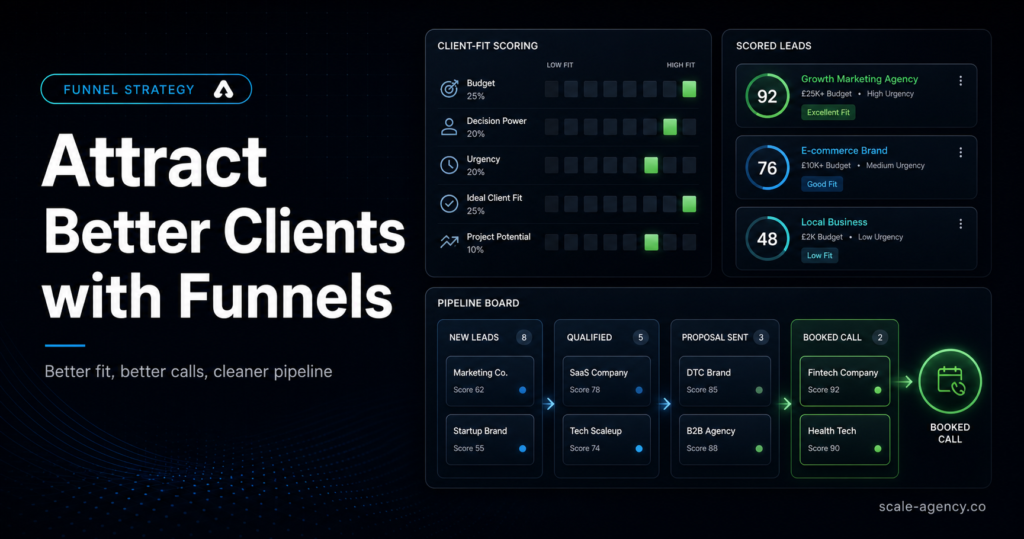
If you are asking whether a marketing agency funnel is the easiest way to attract better clients, the real question is whether your agency has a system that qualifies leads before they ever reach your calendar. The strongest funnels do not just generate more conversations. They improve lead quality, reduce wasted calls and make your offer easier to buy.
If you want SCALE to show you where your current funnel is leaking revenue, book a free Growth Systems Audit and we will map what needs tightening across traffic, qualification and close.
A marketing agency funnel is a structured system that guides potential clients from initial awareness through to booking a consultation or signing a contract. It typically combines content, automation and strategic touchpoints to filter out tyre-kickers and position your agency as the obvious choice for serious buyers.
The core difference between a funnel and traditional marketing is intentionality. Instead of hoping someone sees your LinkedIn post or remembers your name when they need help, you’re building a predictable path that educates, qualifies, and converts prospects without requiring you to manually chase every lead.
For stronger context, compare this with whether a marketing agency sales funnel will grow your business, marketing agency sales funnel examples and the systems that improve funnel KPIs.
Why Most Marketing Agencies Struggle Without a Funnel
Most agencies rely on a mix of referrals, cold outreach, and inconsistent content. While referrals are valuable, they’re unpredictable. Cold outreach can work, but it’s time-intensive and often positions you as a commodity. Without a funnel, you’re constantly reacting instead of attracting.
Here’s what typically happens without a structured funnel in place:
- Leads come in sporadically with no clear pattern or source
- You spend hours on discovery calls with people who can’t afford your services
- Prospects ghost after the first conversation because they weren’t properly warmed up
- You’re competing on price because you haven’t demonstrated unique value upfront
- Revenue is unpredictable, making it hard to scale your team or invest in growth
A marketing agency funnel solves these problems by creating a repeatable system that attracts, educates, and qualifies leads before they ever speak to you.
What Makes a Marketing Agency Funnel Actually Work
Not all funnels are created equal. A high-performing marketing agency funnel isn’t just a landing page with a form. It’s a multi-stage system designed around how your ideal clients actually make buying decisions.
Stage 1: Awareness and Lead Capture
This is where you attract cold traffic through paid ads, SEO, or organic content. The goal isn’t to sell immediately but to offer something valuable in exchange for contact information. For agencies, this might be a free audit, a strategy guide, or access to a case study breakdown.
The key is specificity. A generic “free consultation” won’t cut it. Your offer needs to speak directly to a pain point your ideal client is actively experiencing, like “How to Scale Paid Ads Without Burning Budget” or “The 5 Funnel Mistakes Costing You Clients.”
Stage 2: Nurture and Education
Once someone enters your funnel, you need to build trust and demonstrate expertise. This happens through email sequences, video content, or automated follow-ups that address objections and showcase your methodology.
The best agency funnels don’t just send generic tips. They walk prospects through your process, share real examples of how you’ve solved similar problems, and make it clear why your approach is different. This is where automation tools like GoHighLevel become invaluable, allowing you to deliver personalised experiences at scale.
Stage 3: Qualification and Conversion
Not everyone who enters your funnel should get a sales call. The final stage filters prospects based on budget, fit, and readiness. This might involve a qualification survey, a paid strategy session, or a tiered offer that segments leads by commitment level.
By the time someone books a call, they should already understand your pricing range, your process, and why you’re the right choice. This dramatically increases show-up rates and close rates while reducing time wasted on unqualified leads.
How to Build a Marketing Agency Funnel That Converts
Building an effective funnel doesn’t require a massive budget or complex tech stack, but it does require strategic thinking. Here’s a practical framework you can follow:
- Define your ideal client profile: Get specific about who you serve best, what problems they’re facing, and what objections they typically have. Your funnel messaging should speak directly to this person.
- Create a high-value lead magnet: Develop an offer that solves a specific problem or delivers immediate value. This could be a template, audit, training, or diagnostic tool.
- Build your landing page: Keep it focused on one goal with clear copy that addresses the problem, presents your solution, and removes friction from the opt-in process.
- Set up your nurture sequence: Write a series of emails or messages that educate, build trust, and guide prospects toward booking a call. Include social proof, case examples, and clear next steps.
- Implement qualification mechanisms: Use surveys, application forms, or tiered offers to filter leads before they reach your calendar. This protects your time and improves conversion quality.
- Drive traffic strategically: Use paid ads, SEO content, or organic social to get your ideal clients into the top of your funnel. Test channels based on where your audience actually spends time.
- Measure and optimise: Track conversion rates at each stage, identify drop-off points, and continuously test improvements to copy, offers, and flow.
Common Mistakes That Kill Agency Funnel Performance
Even well-intentioned funnels fail when agencies make these critical errors:
Being too broad with targeting. A funnel that tries to appeal to everyone converts no one. Your messaging needs to be specific enough that your ideal client feels like you’re speaking directly to them.
Asking for too much too soon. If your first touchpoint is “book a call,” you’re asking cold traffic to make a high-commitment decision before they trust you. Lead with value, not a sales pitch.
Neglecting follow-up. Most conversions don’t happen on the first interaction. If you’re not nurturing leads with consistent, valuable touchpoints, you’re leaving money on the table.
Ignoring the data. Without tracking metrics like opt-in rate, email open rate, and booking conversion rate, you’re flying blind. Every stage of your funnel should be measurable and improvable.
Overcomplicating the tech. You don’t need a dozen tools to build an effective funnel. Platforms like GoHighLevel can handle landing pages, email automation, CRM, and booking in one place, reducing complexity and cost.
Why Marketing Agency Funnels Work Better Than Traditional Lead Gen
Traditional lead generation for agencies often means networking events, cold email campaigns, or hoping your content goes viral. These methods can work, but they’re inconsistent and hard to scale.
A marketing agency funnel flips the script. Instead of chasing prospects, you’re creating a system that attracts them, educates them on your value, and qualifies them before you invest time in a conversation. This means:
- Higher quality leads who already understand and value your services
- Predictable pipeline that you can scale with paid traffic or content
- Better use of your time since you’re only speaking with qualified prospects
- Stronger positioning because you’ve demonstrated expertise before the sales call
- More consistent revenue that isn’t dependent on referrals or luck
The agencies that grow fastest aren’t necessarily the ones with the best creative or the biggest teams. They’re the ones with systems that consistently generate qualified opportunities.
Integrating Your Marketing Agency Funnel With Your Sales Process
A funnel isn’t a replacement for sales conversations. It’s a force multiplier that makes those conversations more effective. When a prospect enters a call already educated on your process, familiar with your results, and pre-qualified on budget, your close rate skyrockets.
The best approach is to design your funnel and sales process as one continuous experience. Your nurture emails should set expectations for the call. Your booking page should reinforce what they’ll get from the conversation. Your sales script should reference the content they’ve already consumed.
This level of integration requires alignment between your marketing and sales functions, but the payoff is substantial. You’ll spend less time educating and more time closing, while prospects feel like they’re moving through a professional, well-thought-out experience.
Scaling Your Agency With a Funnel-First Approach
Once your marketing agency funnel is converting consistently, scaling becomes a matter of increasing traffic and optimising conversion rates. This is fundamentally different from scaling through hustle or hiring more salespeople.
With a funnel-first approach, you can test new traffic sources, experiment with different offers, and refine your messaging based on data rather than guesswork. You can also segment your funnel to serve different client types or service offerings without diluting your core message.
The agencies that build strong funnels early gain a compounding advantage. Every improvement to conversion rate multiplies across all future traffic. Every piece of nurture content continues working long after it’s created. The system becomes an asset that grows in value over time.
Conclusion
A marketing agency funnel is right for your business when referrals, outbound and content are no longer producing enough predictable qualified opportunities. The goal is not a complicated funnel. It is a repeatable path from interest to booked sales conversation.
SCALE’s perspective is that the funnel only works commercially when CRM, follow-up and qualification rules are built into the process. Otherwise, better traffic still turns into inconsistent pipeline.
FAQs
What is a marketing agency funnel?
It is a structured path that moves a prospect from awareness to education, qualification and booked call. It usually includes content, lead capture, nurture and sales handoff.
Does a funnel replace referrals?
No. A good funnel supports referrals by making the offer clearer and creating a predictable path for non-referral prospects.
What makes a funnel attract better clients?
Better clients come from stronger positioning, qualification questions, proof and follow-up. The funnel should filter poor-fit leads before they reach sales.
Where does GoHighLevel help?
GoHighLevel can connect forms, calendars, CRM stages, automations, reminders and reporting so the funnel does not rely on manual chasing.
When should SCALE build it?
SCALE should build it when the offer is high-ticket, the sales process has multiple steps, or missed follow-up is costing revenue.
