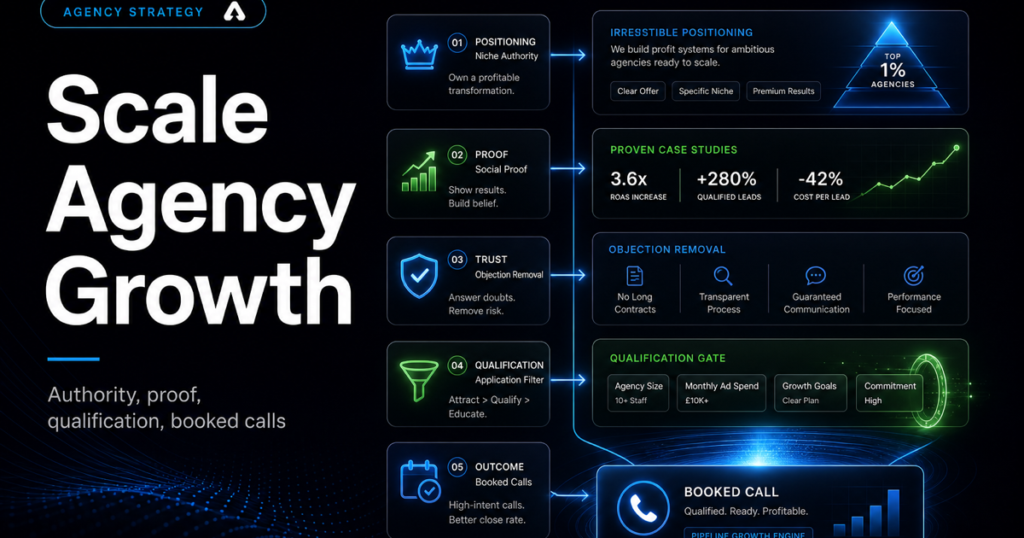
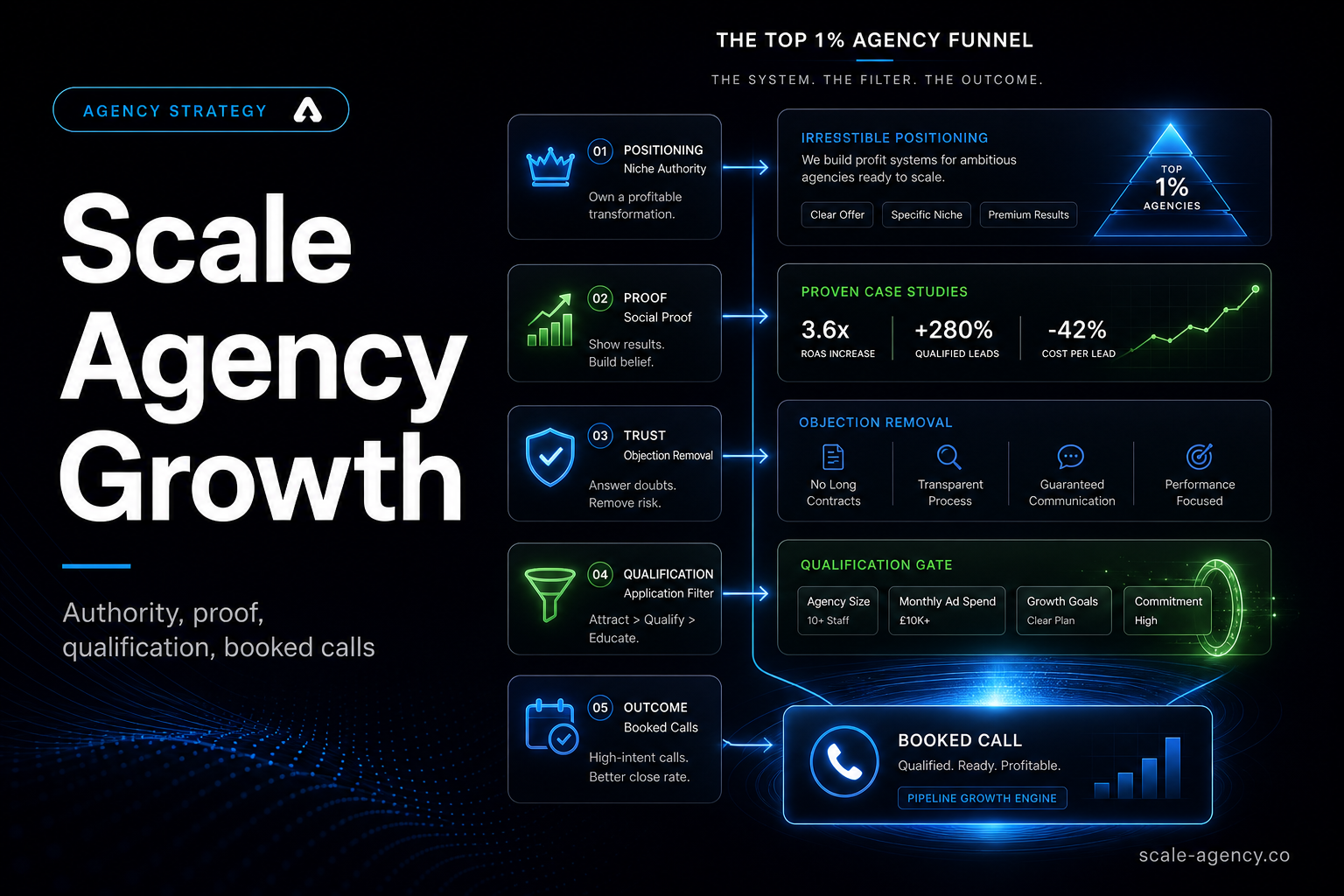
If you are asking what sales funnel for marketing agencies the top 1% actually use, the real question is not whether they have a funnel. The real question is whether their funnel filters bad-fit leads, builds authority before the call and moves qualified prospects into a cleaner sales process without your team manually chasing every opportunity.
For agencies that use GoHighLevel to manage calls, pipelines and client onboarding, the GoHighLevel expert guide is the parent checklist for deciding whether the backend is strong enough to support a serious funnel.
SCALE builds GoHighLevel CRM, funnel, and automation systems for businesses that need better lead quality, faster follow-up, and clearer attribution.
If you want SCALE to show you where your current agency funnel is leaking trust, lead quality or booked calls, book a free Growth Systems Audit and we will map the fixes that create more leverage without adding more noise.
Why Most Agency Sales Funnels Fail
Most agencies treat their own funnel as an afterthought. They’ll spend weeks perfecting a client’s funnel architecture, then rely on referrals and cold outreach for their own pipeline. The problem isn’t effort—it’s structure.
Agency services are high-consideration purchases. Prospects need to understand your process, trust your expertise, and believe you can deliver results before they’ll book a call. A funnel designed for a $47 product or a local service business won’t create that trust at scale.
The agencies that grow past seven figures use funnels built specifically for complex, high-ticket service sales. They automate qualification, demonstrate authority, and pre-frame the sale before a human ever gets involved.
If you want to compare formats, these sales funnel for marketing agencies examples show how top agencies remove objections before the call even starts. For agencies consolidating funnel logic, CRM and follow-up into one platform, these GoHighLevel sales funnel systems are the clearest benchmark for how the backend should actually work.
The Core Structure of a Sales Funnel for Marketing Agencies
The best agency funnels follow a clear progression: attract attention with a specific promise, deliver immediate value, qualify intent, and convert on a call. Here’s how that breaks down in practice.
Stage 1: Targeted Traffic with a Specific Hook
Top agencies don’t cast a wide net. They target a defined audience with a message that speaks directly to a known pain point. This might be through paid ads, SEO-optimised content, or outbound campaigns, but the hook is always specific.
Examples include:
- “Revenue-focused funnels for SaaS companies doing $500K–$5M ARR”
- “Done-for-you acquisition systems for coaching businesses”
- “GoHighLevel setup and automation for agencies tired of duct-tape tech stacks”
The specificity does two things: it filters out bad-fit leads early, and it makes qualified prospects feel like you’re speaking directly to them.
If your agency sells implementation-heavy systems, pairing that message with a GoHighLevel-based agency funnel usually gives you cleaner follow-up and better visibility from first click to booked call.
Stage 2: Value-First Lead Magnet or VSL
Once someone clicks, they land on a page designed to deliver value before asking for anything. This is typically a lead magnet, a video sales letter, or a case study breakdown.
The goal isn’t just to collect an email. It’s to demonstrate that you understand their problem and have a structured way to solve it. This is where you separate yourself from agencies that rely on generic “free consultations” and nothing else.
For a neutral baseline on how funnel stages work before you agency-tailor them, HubSpot’s sales funnel overview is still a useful reference.
Strong examples include:
- A breakdown of your exact funnel framework with real examples
- A recorded walkthrough of a client’s funnel and the results it produced
- A diagnostic tool or scorecard that helps them assess where their current funnel is leaking revenue
This stage builds authority and starts the qualification process. If someone doesn’t engage here, they weren’t going to convert anyway.
Stage 3: Automated Qualification and Nurture
After someone opts in, the funnel should automatically segment and qualify them. This is where automation platforms like GoHighLevel, HubSpot, or ActiveCampaign earn their keep.
Use a combination of:
This is also the stage where weaker agencies fall apart over time. If you are thinking about durability, compare your setup with whether a marketing agency sales funnel will survive AI over the next five years.
- Email sequences that educate and pre-frame your process
- Behavioural tracking to identify high-intent actions
- Application forms or questionnaires that filter out tyre-kickers
- SMS or retargeting to re-engage warm leads
The best agency funnels don’t just nurture—they disqualify. If someone isn’t a fit, the funnel should make that clear early. This protects your sales team’s time and keeps your pipeline clean.
Stage 4: The Sales Call (Framed as Strategy, Not Pitch)
By the time someone books a call, they should already understand what you do, how you do it, and roughly what it costs. The call itself is a strategy session, not a discovery call.
Top agencies use booking pages that set expectations clearly:
- What will be covered on the call
- What information the prospect should prepare
- What happens if they’re not a fit
This frames the conversation as collaborative, not salesy. It also ensures that only serious prospects make it onto your calendar.
What Makes an Agency Funnel Different from a Standard Lead Gen Funnel
If you’ve built funnels for e-commerce or lead gen clients, you might be tempted to replicate that structure for your agency. That’s a mistake.
Agency sales require more trust, longer consideration cycles, and higher price points. Here’s what changes:
- Longer nurture sequences: Expect 7–14 emails instead of 3–5. Prospects need time to evaluate whether your approach fits their business.
- Authority content over urgency tactics: Countdown timers and scarcity don’t work as well. Case studies, frameworks, and process breakdowns do.
- Qualification over volume: A standard funnel optimises for conversions. An agency funnel optimises for fit. You want fewer, better leads.
- Human touchpoints: Even the most automated funnel should include opportunities for human interaction—whether that’s a Loom video, a Slack community, or a live Q&A.
How to Build Your Agency’s Sales Funnel (Step-by-Step)
If you’re building or rebuilding your agency’s funnel, here’s the sequence that works.
- Define your ideal client profile: Get specific. Industry, revenue range, current challenges, and what success looks like.
- Create a high-value lead magnet: This should showcase your methodology, not just collect emails. Think frameworks, audits, or recorded strategy sessions.
- Build a landing page with a single goal: No navigation, no distractions. Just the offer and the opt-in.
- Set up your email and SMS sequences: Educate, qualify, and invite them to book. Use behavioural triggers to personalise the journey.
- Create a framed booking page: Set expectations, ask qualifying questions, and make it clear what happens next.
- Optimise your sales process: Track where leads drop off, what objections come up, and which messaging converts. Refine continuously.
Common Mistakes Agencies Make with Their Own Funnels
Even experienced agency owners make predictable mistakes when building their own sales systems.
Trying to serve everyone: A funnel that targets “small businesses” or “anyone who needs marketing” will underperform every time. Narrow your focus.
Skipping the nurture phase: Sending traffic straight to a booking page works for low-ticket offers. For agency services, you need to build trust first.
Over-complicating the tech: You don’t need 12 tools. A solid CRM, email platform, and landing page builder are enough to start. GoHighLevel consolidates most of this into one system.
Not tracking the right metrics: Conversion rate matters, but so does lead quality. If your funnel brings in 50 unqualified leads, it’s worse than 10 perfect-fit prospects.
Why the Top 1% of Agencies Obsess Over Funnel Optimisation
The agencies that scale past seven figures don’t just have a funnel—they treat it as a core asset. They test, refine, and rebuild it constantly.
They know that a dialled-in sales funnel for marketing agencies is the difference between feast-or-famine months and predictable growth. It’s what allows them to scale paid acquisition profitably, hire salespeople with confidence, and stop relying on referrals alone.
More importantly, it gives them leverage. When your funnel consistently delivers qualified leads, you control your growth. You’re not waiting for the phone to ring—you’re deciding how fast to scale.
Want SCALE to build and optimise this for you?
Book a free Growth Systems Audit and we will show you where your funnel, follow-up and sales process are still leaking revenue: https://scale-agency.co/
Disclosure: We may earn a commission from GoHighLevel if you sign up through the link below. It does not increase your price. If you use our link, we will unlock SCALE’s exclusive bonuses for you at no extra cost.
Start your 14-day free trial here and unlock exclusive free bonuses from SCALE that are not available anywhere else: Try GoHighLevel
Conclusion
Building a sales funnel for marketing agencies isn’t about copying what works for product businesses or local services. It’s about creating a system that qualifies, educates, and converts high-ticket clients at scale. The top agencies use funnels that filter aggressively, build authority through value, and frame the sales conversation before it even starts. If your agency is still relying on referrals or inconsistent outreach, building a structured funnel is the highest-leverage move you can make.
Learn more:
