
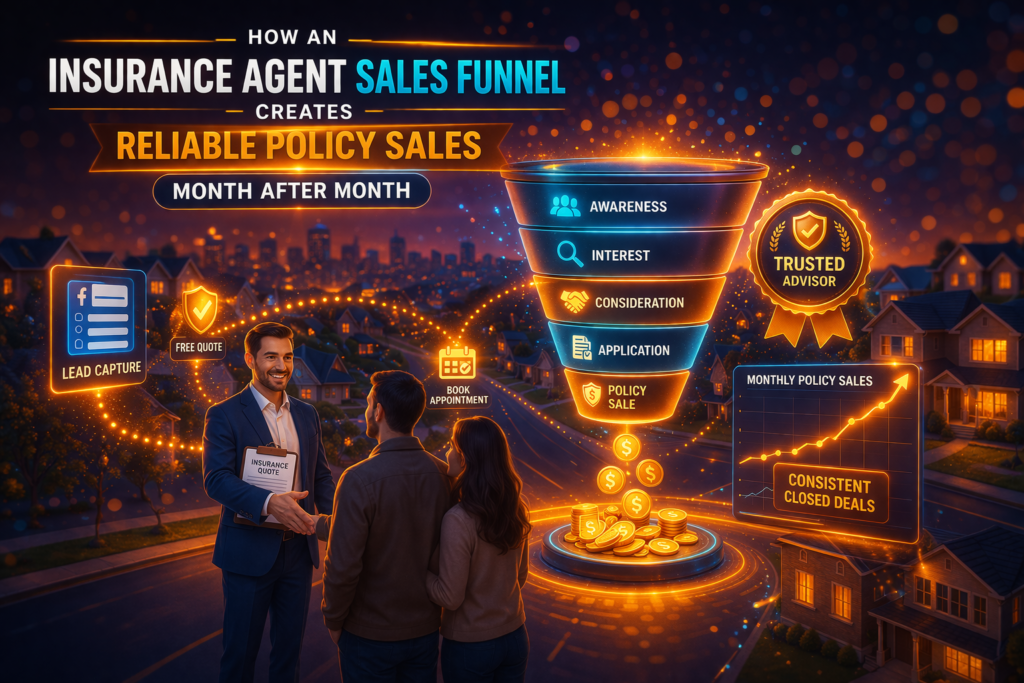
In this guide, we’ll cover:
A practical view of how an insurance agent sales funnel turns attention into qualified conversations, trusted advice, quoted opportunities and reliable policy sales.
Where Are The Best Prospects Slipping Away?
Most insurance funnels lose buyers before a conversation starts because the form, source, owner and follow-up path are not connected.
Can Prospects Trust You Before They Speak To You?
Insurance buyers are risk-aware, so the funnel has to educate, pre-frame and reduce doubt before asking for a consultation.
Who Reaches The Buyer Before A Competitor Does?
Every quote request needs a clear owner, calendar path and response rule so qualified buyers do not wait while competitors reply first.
What Happens When The Buyer Is Not Ready Yet?
The money is often in the follow-up window, where education, reminders and retargeting keep the agent trusted until the timing is right.
Can You Follow Each Quote Back To A Policy?
A serious funnel does not stop at leads; it tracks booked calls, quotes, policy sales and renewal opportunities by source.
“A strong insurance funnel should make trust, speed and policy revenue easier to measure, not just create another lead source.”
Quick Answer
An insurance agent sales funnel is a structured system for capturing insurance prospects, qualifying intent, following up quickly, booking conversations and tracking which leads become policies. The best funnels combine education, trust-building, speed-to-lead and CRM visibility so agents can stop relying only on referrals, cold outreach or purchased leads.
TL;DR
- An insurance funnel should qualify prospects before the calendar, not just collect quote requests.
- Speed-to-lead matters because insurance shoppers often contact multiple agents at the same time.
- Nurture content builds trust for buyers who are researching, comparing cover options or waiting for timing to improve.
- CRM stages should track lead source, consultation, quote, policy sale and renewal opportunity.
- A strong funnel makes policy sales measurable by source, not just lead volume.
Insurance Funnel Decision Table
| Funnel Layer | What It Should Do | What To Check | Revenue Risk |
|---|---|---|---|
| Lead Capture | Turn traffic into a named prospect with source and intent data. | Form friction, source tracking, consent and coverage type. | High lead volume but low useful conversations. |
| Qualification | Separate serious policy buyers from low-fit enquiries. | Coverage need, location, timeline, budget and eligibility. | Agent time gets spent on prospects who cannot buy. |
| Follow-Up | Respond quickly and keep prospects moving toward a call or quote. | Owner assignment, SMS/email timing, reminders and stop rules. | Competitors win because they reply faster. |
| Policy Tracking | Show which leads became quotes, policies and renewals. | Pipeline stages, source fields, quote status and closed-won data. | Marketing decisions are made from lead counts, not revenue. |
Why An Insurance Agent Sales Funnel Needs More Than A Quote Form
Most insurance buyers are not making a casual purchase. They are comparing risk, price, trust, cover quality and speed of response. A basic quote form can capture demand, but it rarely controls what happens after the lead arrives.
The funnel has to answer four commercial questions: where did the lead come from, what cover do they need, who follows up, and did the conversation turn into a policy? Without those answers, lead generation becomes noisy rather than predictable.
The Core Funnel Stages That Create Policy Sales
The strongest insurance funnels work like a revenue system. Each stage has one job, one owner and one measurable outcome.
Capture The Right Lead
Start with a focused entry point for one customer type or policy need. A landing page for small business liability, life insurance for new parents, or home cover reviews will usually outperform a generic quote page because the message matches the buyer’s situation.
Qualify Before The Calendar
Use the form to collect enough context to route the lead without creating friction. Coverage type, location, timing and basic eligibility are usually more useful than asking for every detail before trust has been earned.
Follow Up Before Competitors Do
Insurance shoppers often speak to more than one agent. The first useful response has an advantage. Automations should confirm the request, assign an owner, create a task and offer the next step within minutes.
Convert Quotes Into Policies
A policy sale usually needs education, objection handling and clean next steps. The funnel should support the sales conversation with reminders, pre-call context, quote follow-up and clear status changes in the CRM.
Retain And Review
The funnel should continue after purchase. Renewal reminders, review prompts and life-event check-ins help protect retention and create natural cross-sell opportunities without relying on manual memory.
What To Build First
- Map the buying journey. Document each step from first click to policy sale, including who owns follow-up and what happens when a prospect goes quiet.
- Create one focused offer path. Build around one policy type or customer segment before trying to cover every insurance product.
- Connect source tracking to the CRM. Store lead source and campaign data on the contact and opportunity so policy revenue can be traced back later.
- Build the speed-to-lead workflow. Assign an owner, send a useful first response, create a task and trigger escalation if nobody acts.
- Measure quote and policy outcomes. Track lead-to-call, call-to-quote and quote-to-policy conversion before increasing traffic spend.
Common Problems And How To Fix Them
| Problem | What It Usually Means | Commercial Risk | Fix |
|---|---|---|---|
| Lots of leads, few policies | The funnel is optimised for form fills, not buyer intent. | Spend increases while close rate stays flat. | Add qualification fields and measure quote-to-policy conversion. |
| Prospects go quiet | Follow-up is too slow, generic or manually dependent. | Competitors win the conversation first. | Create immediate SMS/email, owner tasks and a short nurture sequence. |
| Unknown source dominates reports | UTMs or source fields are missing or overwritten. | You cannot scale the channels producing policy revenue. | Capture first-touch source and persist it into opportunity reporting. |
| Agents waste time on poor-fit calls | The form does not screen by policy need, location or eligibility. | Calendar capacity gets used on leads that cannot buy. | Add low-friction qualification before booking. |
How To Measure A Policy Sales Funnel
Do not judge the funnel only by cost per lead. Insurance revenue depends on the quality of the conversation and the policy outcome.
- Lead source: which channel created the enquiry?
- Contact rate: how quickly did the team reach the prospect?
- Booked-call rate: how many qualified leads agreed to speak?
- Quote rate: how many conversations became serious quote opportunities?
- Policy sales: which sources created closed-won revenue?
Once those numbers are visible, the right optimisation becomes obvious. You can tighten the landing page, adjust qualification, speed up follow-up or reallocate budget toward the channels that produce actual policy sales.
Conclusion
An insurance agent sales funnel is not just a landing page or a quote form. It is the operating path that turns attention into trust, trust into conversations, conversations into quotes, and quotes into policies.
SCALE’s perspective is simple: the funnel only becomes commercially useful when it connects to CRM ownership, follow-up automation and source-to-policy reporting. That is what turns inconsistent lead generation into a system you can improve every week.
- Use focused entry points so buyers feel the page was built for their situation.
- Follow up fast enough that qualified prospects do not shop around unanswered.
- Track policy revenue, not just leads, so scaling decisions are grounded in data.
FAQs
What is an insurance agent sales funnel?
It is a structured path that captures insurance prospects, qualifies their need, follows up quickly, books conversations and tracks which opportunities become quotes and policies.
Why do insurance agents need a funnel?
A funnel gives agents a repeatable system for lead capture, nurture, booking and policy tracking instead of relying only on referrals, cold outreach or purchased leads.
What should the first insurance funnel include?
Start with one focused landing page, a short qualification form, source tracking, instant follow-up, calendar booking and a CRM pipeline for quote and policy outcomes.
Should insurance agents use GoHighLevel?
GoHighLevel can work well when the agent needs landing pages, CRM, calendar booking, SMS/email follow-up and pipeline reporting in one system.
What metric matters most?
Policy revenue by source matters more than raw lead volume. Cost per lead only helps when you can also see booked calls, quotes and closed policies.
