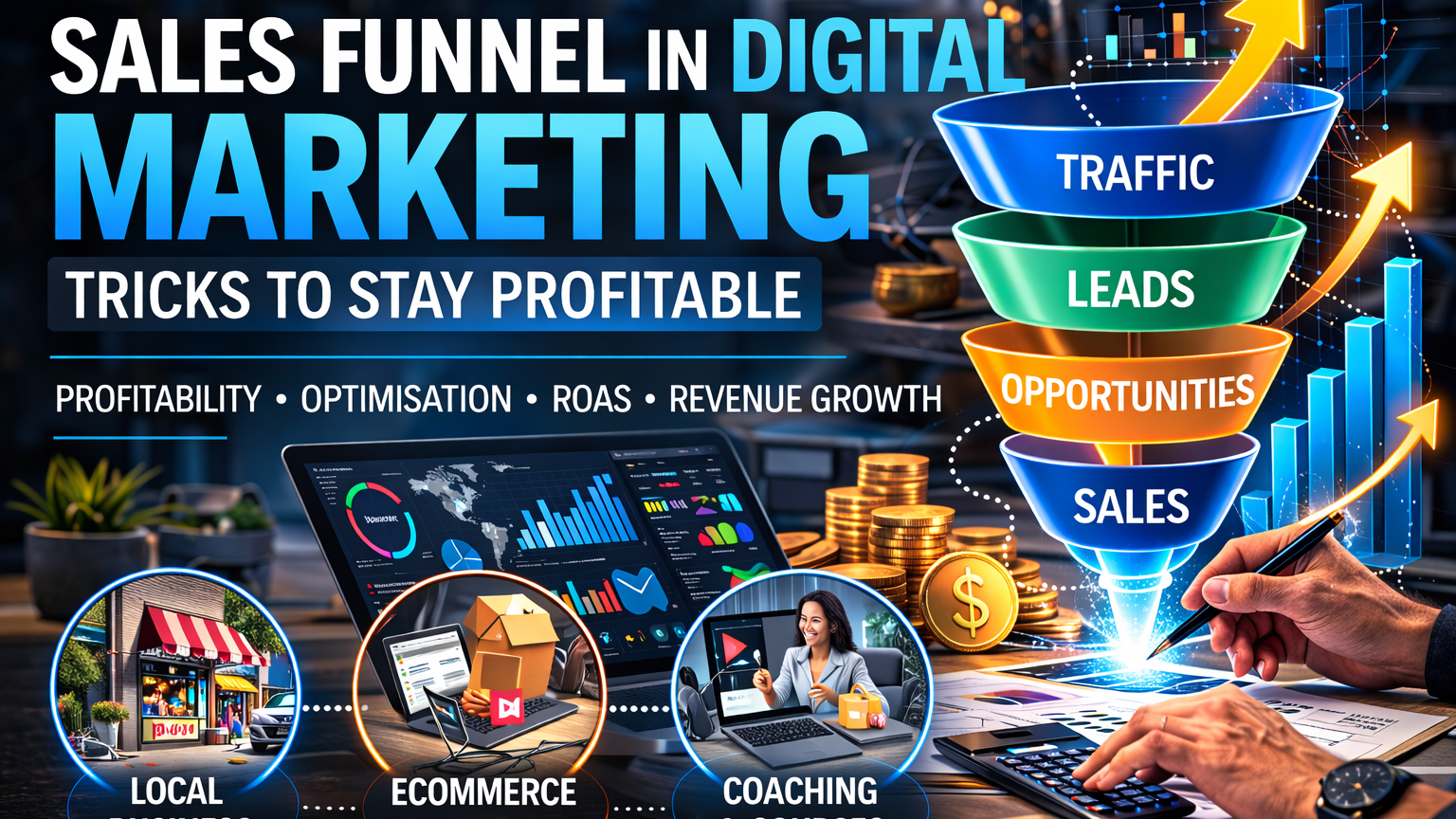
A strong sales funnel in digital marketing is less about theory and more about commercial control. The brands that stay profitable usually win because their funnel is designed to improve lead quality, reduce waste and make each stage easier to optimise, not just because they publish more content.
When profitability depends on cleaner handoffs, the next step is often an owned CRM build; the GoHighLevel expert checklist shows what to verify before a consultant or agency touches the system.
If you want SCALE to pressure-test that funnel for your business, book a free Growth Systems Audit and we will show you where traffic, conversion and follow-up are costing you margin.
What Is a Sales Funnel in Digital Marketing?
A sales funnel is a visual representation of the customer journey from the first interaction with your brand to the final purchase and beyond. Think of it as a roadmap that maps out every step a potential customer takes before becoming a loyal buyer. The funnel shape reflects how a large number of prospects enter at the top, but only a qualified subset moves through to conversion at the bottom.
Understanding this concept is crucial because it allows brands to identify where potential customers drop off and optimize each stage for maximum profitability.
The Four Essential Stages of a Digital Marketing Sales Funnel
Most effective sales funnels follow a four-stage model, commonly known as the AIDA framework:
- Awareness: The prospect becomes aware of your brand or product through content marketing, social media, paid ads, or SEO.
- Interest: The potential customer shows interest by engaging with your content, signing up for newsletters, or following your social media accounts.
- Decision: The prospect evaluates your offering against competitors, reads reviews, and considers whether to make a purchase.
- Action: The customer completes the purchase and ideally becomes a repeat buyer or brand advocate.
The Online Tricks Brands Use at Each Funnel Stage
Awareness Stage Tactics
At the top of the funnel, brands deploy several strategies to capture attention:
- Search Engine Optimization (SEO): Creating valuable content that ranks high on search engines to attract organic traffic
- Social Media Marketing: Building presence on platforms where target audiences spend time
- Pay-Per-Click Advertising: Running targeted ads on Google, Facebook, Instagram, and other platforms
- Content Marketing: Publishing blogs, videos, infographics, and podcasts that address customer pain points
- Influencer Partnerships: Leveraging trusted voices to reach new audiences authentically
Interest Stage Strategies
Once awareness is established, brands use sophisticated techniques to nurture interest:
Lead magnets such as free ebooks, webinars, or exclusive discounts capture email addresses. Brands then implement email marketing campaigns with personalized content that educates prospects about their problems and positions the brand as the solution.
Retargeting ads follow visitors who’ve left your website, reminding them of products they viewed. Studies show that retargeting can increase conversion rates by up to 150%.
Decision Stage Techniques
At this critical juncture, brands employ conversion-focused tactics:
Social proof in the form of customer testimonials, case studies, and reviews builds trust and credibility. Displaying trust badges and security certifications alleviates purchase anxiety, especially for e-commerce transactions.
Comparison guides and demo videos help prospects understand why your solution is superior. Limited-time offers and scarcity tactics (like countdown timers or “only 3 left in stock” messages) create urgency that accelerates decision-making.
Action Stage Optimization
Even after a purchase, smart brands continue optimizing the funnel:
Streamlined checkout processes with multiple payment options reduce cart abandonment. Post-purchase email sequences thank customers, provide usage tips, and request reviews.
Loyalty programs and exclusive offers for existing customers turn one-time buyers into repeat customers and brand advocates who refer others—essentially feeding new prospects back into the top of the funnel.
Advanced Digital Marketing Funnel Strategies
Modern brands are taking sales funnels to the next level with these sophisticated approaches:
Marketing automation uses software to deliver personalized messages based on user behavior. If someone abandons their cart, they automatically receive a reminder email. If they download a whitepaper, they enter a nurture sequence tailored to that interest.
Artificial intelligence and chatbots provide instant customer service, answer questions, and guide prospects through the funnel 24/7 without human intervention.
Micro-funnels within the main funnel target specific segments with customized journeys. A B2B software company might have separate funnels for small businesses, enterprises, and individual professionals, each with tailored messaging and offers.
Measuring Sales Funnel Performance
What gets measured gets improved. Profitable brands obsessively track these key performance indicators (KPIs):
- Traffic sources and volume at the awareness stage
- Lead conversion rates from visitor to prospect
- Email open and click-through rates
- Sales conversion rates from prospect to customer
- Customer lifetime value (CLV)
- Return on ad spend (ROAS)
By analyzing these metrics, brands identify bottlenecks where prospects drop off and test improvements through A/B testing—comparing two versions of a webpage, email, or ad to see which performs better.
Common Sales Funnel Mistakes to Avoid
Even with the best strategies, many brands stumble by making these errors:
Focusing too heavily on the top of the funnel while neglecting nurturing and conversion stages creates leaky funnels where prospects slip away. Failing to segment audiences means sending generic messages that don’t resonate with anyone specifically.
Complicating the purchase process with too many form fields or checkout steps increases abandonment rates. Ignoring mobile optimization is particularly costly since over 50% of web traffic now comes from mobile devices.
The Future of Sales Funnels in Digital Marketing
As technology evolves, so do sales funnels. Personalization at scale through AI will deliver increasingly relevant experiences to each individual prospect. Voice search optimization will change how brands attract top-of-funnel traffic as smart speakers become ubiquitous.
The rise of conversational marketing through messaging apps and chatbots will make funnels more interactive and less linear. Privacy regulations like GDPR and the phasing out of third-party cookies will require brands to build first-party data strategies and earn customer trust more deliberately.
If you want to compare profitable funnel structures directly, review seven sales funnels in digital marketing used by market leaders and why strong sales funnel marketing agencies win online. Together they make the operational side of profitability much clearer.
Conclusion
The sales funnel in digital marketing isn’t just a theoretical concept—it’s a practical framework that the world’s most profitable brands use daily to systematically convert strangers into customers and customers into advocates. By understanding each stage of the funnel and implementing proven tactics at every step, your brand can create a predictable, scalable system for growth.
The key is to start simple, measure everything, and continuously optimize based on data. Whether you’re a solopreneur or leading a marketing team at a major corporation, mastering the digital marketing sales funnel is no longer optional. It is one of the clearest ways to protect margin as acquisition costs keep rising.
Remember, the most effective funnels aren’t about tricking customers; they’re about genuinely understanding your audience’s needs and guiding them toward solutions that improve their lives. When you get that right, profitability naturally follows.
Want SCALE to build this for your business?
Book a free Growth Systems Audit and we will show you where your funnel, CRM and follow-up system are leaking revenue: https://scale-agency.co/
Learn more below:
