
In today’s competitive digital landscape, understanding and implementing effective sales funnels can be the difference between business success and failure. Market leaders across industries have mastered the art of guiding potential customers through carefully designed journeys that convert browsers into buyers. This comprehensive guide explores seven proven sales funnels that top companies use to generate consistent revenue and build lasting customer relationships.
What is a Sales Funnel in Digital Marketing?
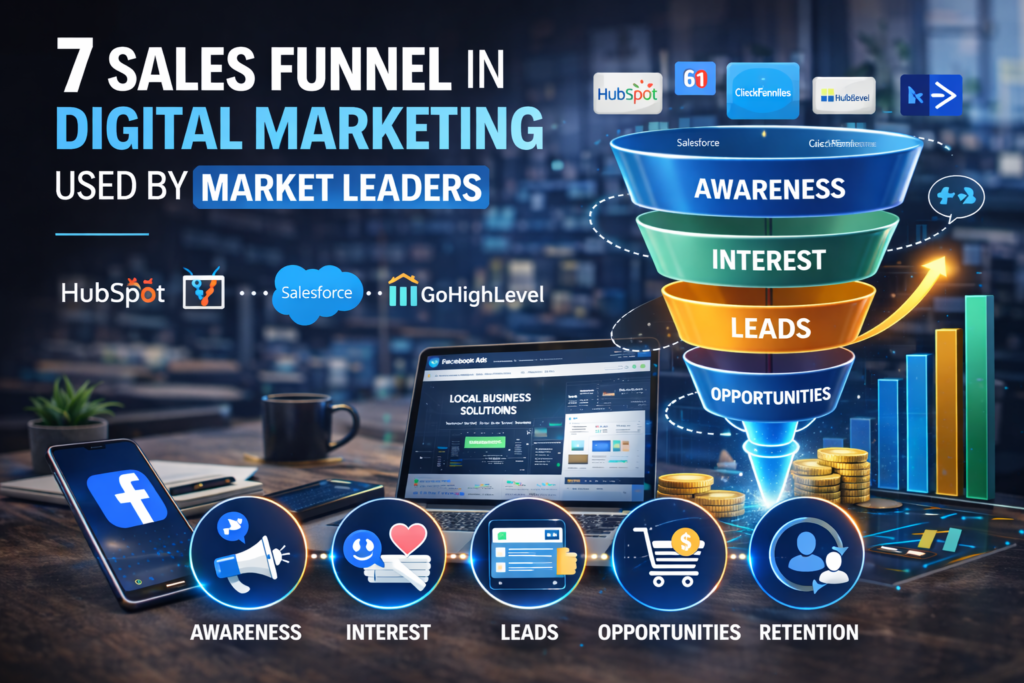
A sales funnel is a strategic model that maps the customer journey from initial awareness to final purchase and beyond. It’s called a “funnel” because it starts wide at the top—casting a broad net to attract many prospects—and narrows down as people move through each stage, ultimately converting a percentage into paying customers. Market leaders understand that effective sales funnels don’t just happen; they’re carefully crafted, tested, and optimized to maximize conversions at every stage.
1. The Lead Magnet Funnel
The lead magnet funnel is one of the most popular strategies used by market leaders to build their email lists and establish authority. This funnel offers something of value—typically a free resource—in exchange for a prospect’s contact information.
Here’s how leading companies structure this funnel:
- Awareness Stage: Prospects discover your lead magnet through social media, paid ads, or organic search
- Landing Page: A dedicated page highlights the benefits of your free offer with a clear call-to-action
- Opt-in Form: Visitors submit their email address to receive the resource
- Delivery Page: Immediate access to the promised resource builds trust
- Email Nurture Sequence: Automated emails provide additional value while introducing paid offerings
- Conversion: Subscribers become customers through targeted product recommendations
Companies like HubSpot and Neil Patel have mastered this funnel by offering high-quality ebooks, templates, and tools that genuinely help their audience while positioning their paid products as the natural next step.
2. The Webinar Funnel
The webinar funnel has become a powerhouse strategy for businesses selling high-ticket products or complex services. This approach allows market leaders to demonstrate expertise, build relationships, and address objections in real-time.
Successful webinar funnels typically follow this structure: prospects register for a free training session through a compelling registration page, receive reminder emails leading up to the event, attend the live or automated webinar where valuable content is delivered alongside a pitch for a paid product, and then receive follow-up emails for those who didn’t purchase during the webinar.
Companies like ClickFunnels and Russell Brunson have generated millions using webinar funnels. The key is providing genuine educational value for 60-80% of the presentation, then transitioning naturally into a product offer that solves the exact problem discussed.
3. The Tripwire Funnel
The tripwire funnel focuses on converting cold traffic into customers quickly by offering an irresistible, low-priced front-end product. Market leaders use this strategy to overcome the psychological barrier of that first purchase.
This funnel works because once someone has purchased from you—even something small—they’re significantly more likely to buy again. The tripwire offer is typically priced between $7-$47 and provides tremendous value for the price point. After the initial purchase, customers are immediately presented with upsells and order bumps, then nurtured through email marketing to introduce higher-priced products.
Amazon perfected this approach with their Kindle book strategy, offering low-priced or free books that introduce customers to their ecosystem, making them more comfortable with larger purchases later.
4. The Product Launch Funnel
Pioneered by Jeff Walker, the product launch funnel creates anticipation and excitement before a product becomes available. This strategy has helped market leaders generate millions in revenue within days of opening cart.
The typical product launch funnel includes several key phases:
- Pre-Pre-Launch: Building anticipation through social proof and teasing upcoming content
- Pre-Launch Content: Delivering three to four high-value video sequences that educate while creating desire
- Launch: Opening the cart with a compelling offer, often with bonuses or limited-time pricing
- Scarcity Phase: Creating urgency as the cart closing approaches
- Post-Launch: Following up with non-buyers and delivering to customers
Companies like Apple have mastered the art of the product launch, creating global anticipation for their new releases. Digital marketers adapt this same psychology to course launches, software releases, and membership site openings.
5. The Application Funnel
For businesses offering high-ticket services or coaching, the application funnel ensures that sales teams spend time only with qualified prospects. This approach flips the traditional sales script by making prospects “apply” to work with you.
This funnel starts with content that attracts ideal clients and establishes authority. Interested prospects complete a detailed application form that qualifies them based on budget, need, and fit. The sales team then reviews applications and schedules calls only with pre-qualified candidates. Finally, the sales conversation focuses on fit and outcomes rather than convincing someone to buy.
Market leaders like Tony Robbins and various consulting firms use application funnels to maintain exclusivity, improve close rates, and ensure they work only with clients who will achieve results.
6. The Membership Funnel
The membership funnel is designed to convert one-time buyers into recurring revenue through subscription-based products. This model has become increasingly popular as businesses recognize the value of predictable monthly income.
Successful membership funnels typically offer a free trial or low-cost first month to reduce entry barriers. The onboarding process is crucial—new members must experience quick wins to reduce churn. Ongoing content, community, and value keep members engaged and paying month after month. Strategic retention campaigns target members showing signs of potential cancellation.
Companies like Netflix, Spotify, and countless software-as-a-service businesses have built empires on the membership model. In the digital marketing space, platforms like Kajabi and MemberVault enable entrepreneurs to create their own membership funnels.
7. The Affiliate Funnel
The affiliate funnel allows market leaders to exponentially expand their reach by incentivizing others to promote their products. This strategy creates a win-win scenario where affiliates earn commissions while the product owner gains customers without upfront advertising costs.
An effective affiliate funnel includes several components: a compelling affiliate program with competitive commissions and reliable tracking, ready-made promotional materials that make it easy for affiliates to promote, a dedicated onboarding sequence that teaches affiliates how to succeed, and performance-based incentives like bonuses for top performers and contests to encourage promotion.
Amazon Associates revolutionized online affiliate marketing, but digital product creators have taken it further. Companies offering digital courses, software, and services often pay 30-50% commissions to affiliates, creating armies of motivated promoters.
Key Elements That Make These Funnels Work
While each funnel serves a different purpose, market leaders incorporate several common success factors across all their sales funnels:
- Clear Value Proposition: Every stage communicates specific benefits to the prospect
- Strategic Sequencing: Each step logically leads to the next, building trust and desire
- Multiple Touchpoints: Combining email, retargeting ads, and content to stay top-of-mind
- Continuous Testing: A/B testing headlines, offers, and designs to optimize conversion rates
- Customer-Centric Messaging: Focusing on customer problems and outcomes rather than product features
- Mobile Optimization: Ensuring seamless experiences across all devices
- Analytics and Tracking: Monitoring key metrics at each funnel stage to identify bottlenecks
Choosing the Right Funnel for Your Business
Market leaders don’t use all these funnels simultaneously. Instead, they strategically select and implement funnels based on their business model, target audience, and product offering.
Consider these factors when choosing your funnel strategy: the complexity and price point of your product or service, your current relationship with your audience, your available resources for content creation and funnel management, and your business goals—whether you’re focused on building a list, generating quick cash, or creating recurring revenue.
Many successful businesses start with a lead magnet funnel to build their audience, then layer in additional funnel types as they grow. Others might begin with a tripwire funnel to generate immediate revenue while building their list simultaneously.
Implementing Your Sales Funnel Strategy
Understanding these seven funnels is just the beginning. Implementation and optimization separate market leaders from everyone else. Start by selecting one funnel that aligns with your immediate business goals. Map out each stage in detail before building anything. Create high-quality assets for each funnel stage—landing pages, emails, and offers. Set up proper tracking to measure performance at each step. Launch with a test audience before scaling. Continuously optimize based on data and customer feedback.
Remember that even market leaders started with simple funnels and refined them over time. The key is to begin, measure results, and improve consistently.
Conclusion
The seven sales funnels used by market leaders—lead magnet, webinar, tripwire, product launch, application, membership, and affiliate funnels—represent proven strategies for guiding prospects through the customer journey. Each funnel serves a specific purpose and can be adapted to virtually any industry or business model.
Success doesn’t come from simply copying these funnels but from understanding the psychology behind them and adapting them to your unique audience and offerings. Market leaders continuously test, refine, and optimize their funnels based on real data and customer behavior.
By implementing even one of these funnel strategies with focus and consistency, you can dramatically improve your conversion rates, customer lifetime value, and overall business growth. The digital marketing landscape continues to evolve, but the fundamental principles of these sales funnels remain timeless: provide value, build trust, and guide prospects naturally toward solutions that genuinely help them.
Start with the funnel that best matches your current business stage and goals, commit to excellence in execution, and you’ll be well on your way to achieving the kind of results that market leaders experience every day.
Want us to set this up for your business?
Book a FREE call with us to see how we can help by visiting: https://scale-agency.co/
Learn more below:
