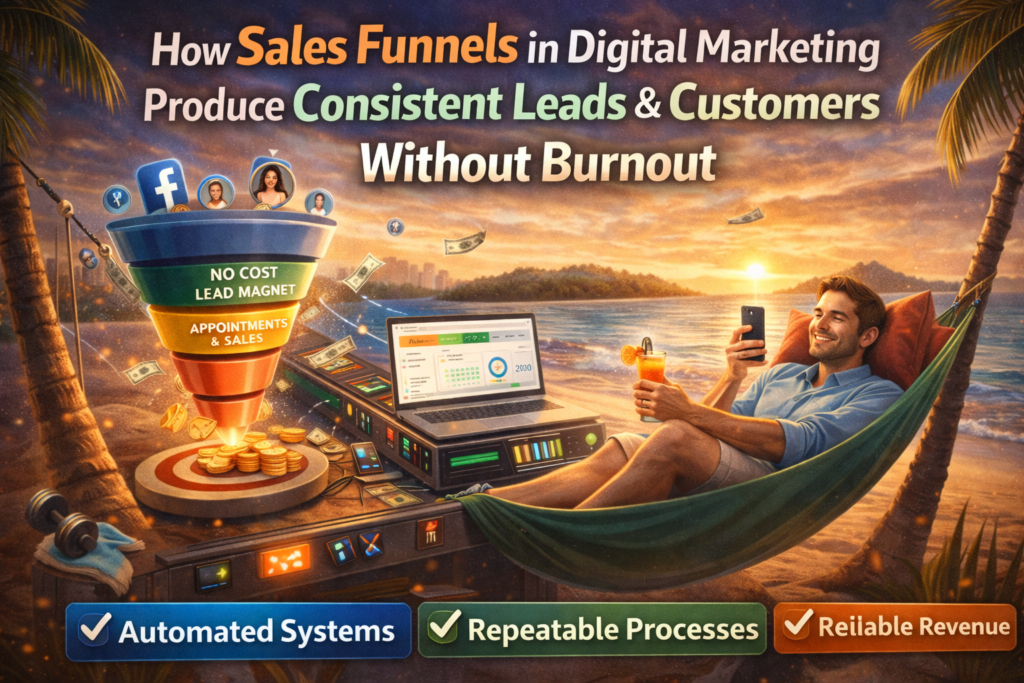
A practical sales funnel in digital marketing reduces burnout because it removes guesswork from lead generation. Instead of constantly inventing new campaigns, the business builds a repeatable journey that qualifies demand, automates follow-up and keeps revenue moving without heroic manual effort.
If you want SCALE to help build that kind of engine for your business, book a free Growth Systems Audit and we will show you where your funnel is creating extra work instead of leverage.
If that system is built inside GoHighLevel, expert GoHighLevel setup matters because the CRM needs pipeline ownership, follow-up rules and attribution before automation creates leverage. SCALE treats the CRM, funnel and automation layer as one revenue system rather than separate tools.
What Makes a Sales Funnel Different from General Marketing
Most businesses run marketing activities—social posts, ads, email campaigns—without connecting them into a coherent journey. A sales funnel in digital marketing differs because it maps the entire customer journey and assigns specific roles to each touchpoint.
The funnel metaphor reflects reality: many people enter at the top through awareness content or ads, fewer move to the consideration stage where they evaluate options, and a smaller percentage convert into customers. Rather than treating this attrition as failure, funnel-based marketing accepts it as natural and focuses on improving conversion rates at each transition point.
This approach creates three immediate advantages. First, you can identify exactly where prospects drop off and address those specific friction points. Second, you can measure return on investment at each stage rather than guessing which activities drive revenue. Third, you can automate much of the nurturing process so your team focuses on high-value interactions rather than repetitive follow-up.
The Core Stages of a Digital Marketing Sales Funnel
While terminology varies, effective sales funnels typically include these stages:
Awareness
At the top of the funnel, prospects become aware of their problem and your existence. Traffic sources include organic search, paid ads, social media, referrals, and content distribution. The goal is not immediate sales but qualified attention from people who match your ideal customer profile.
Awareness content answers questions, provides value, and positions your brand as credible without demanding commitment. Blog articles, videos, podcasts, and lead magnets work here because they attract people actively searching for solutions or passively consuming relevant content.
Consideration
Once prospects know you exist, they evaluate whether your solution fits their needs. This middle stage requires more specific content: case studies, comparison guides, webinars, product demos, and email sequences that address objections and demonstrate value.
The consideration stage separates browsers from serious buyers. Not everyone who downloads a lead magnet will purchase, but those who engage with multiple pieces of consideration content signal genuine interest worth sales attention.
Conversion
The conversion stage turns interested prospects into customers through sales calls, checkout pages, proposal acceptance, or contract signing. The specific mechanism depends on your business model, but the principle remains consistent: remove friction, address final objections, and make the transaction clear.
For lower-ticket offers, conversion might happen through an optimised landing page with social proof and a simple checkout. For complex B2B services, conversion typically requires human interaction but still benefits from supporting materials like ROI calculators, testimonials, and clear pricing information.
Retention and Expansion
The funnel does not end at first purchase. Retention activities—onboarding sequences, customer education, support, and upsell offers—increase customer lifetime value and generate referrals. Acquiring a customer costs significantly more than selling to an existing one, making this stage critical for profitable growth.
Why Sales Funnels in Digital Marketing Create Predictable Revenue
Predictability comes from measurement and optimisation. When you track conversion rates between each funnel stage, you can forecast revenue based on traffic volume and systematically improve weak points.
For example, if your funnel converts 2% of website visitors into leads, 10% of leads into sales calls, and 30% of calls into customers, you know exactly how much traffic you need to hit revenue targets. If results fall short, you can diagnose whether the problem lies in traffic quality, lead magnet appeal, nurture sequence effectiveness, or sales process execution.
This diagnostic capability eliminates guesswork. Instead of wondering why revenue dropped last month, you identify that lead-to-call conversion fell from 10% to 7% and investigate what changed in your email sequence or qualification process.
Automation amplifies this predictability. Email sequences, retargeting ads, chatbot qualification, and CRM workflows handle repetitive nurturing tasks consistently. While automation requires upfront setup, it runs continuously without proportional increases in labour cost, allowing you to scale lead volume without scaling headcount linearly.
Building a Sales Funnel That Actually Works
Effective funnel construction follows a logical sequence:
- Define your ideal customer and their journey. Understand what problems they face, what information they need at each stage, and what objections prevent purchase. Generic funnels fail because they do not address specific buyer concerns.
- Map existing touchpoints to funnel stages. Audit your current content, ads, emails, and sales processes to see what already exists and where gaps appear. Most businesses have scattered assets that need organisation rather than starting from zero.
- Create or optimise content for each stage. Fill gaps with targeted content that moves prospects forward. Awareness content attracts, consideration content educates and builds trust, conversion content removes final barriers.
- Implement tracking and automation. Use analytics, CRM systems, and marketing automation platforms to monitor movement between stages and automate repetitive tasks. Without tracking, you cannot optimise; without automation, you cannot scale.
- Test and refine conversion points. Systematically improve transition rates between stages through A/B testing, copy refinement, offer adjustment, and friction reduction. Small improvements compound across the entire funnel.
Common Sales Funnel Mistakes That Kill Conversion
Even well-intentioned funnels fail when they include these errors:
- Asking for too much too soon. Prospects at the awareness stage will not book sales calls or provide detailed information. Match your ask to their readiness level.
- Neglecting the middle of the funnel. Many businesses focus on traffic generation and closing tactics while ignoring nurture. Prospects who are not ready to buy immediately disappear because nothing keeps them engaged.
- Creating friction at conversion points. Complicated forms, unclear pricing, confusing checkout processes, and slow response times cost conversions. Every unnecessary step loses prospects.
- Ignoring mobile experience. Significant traffic comes from mobile devices. Funnels that do not work smoothly on phones lose conversions regardless of how compelling the offer is.
- Failing to follow up consistently. Most sales require multiple touchpoints. Prospects who do not convert immediately need systematic follow-up, not sporadic manual outreach that depends on someone remembering.
- Not segmenting by intent or behaviour. Treating all leads identically wastes resources and annoys prospects. Someone who downloaded a beginner guide needs different messaging than someone who requested a demo.
Integrating Paid and Organic Channels Into Your Funnel
Effective funnels combine multiple traffic sources rather than relying on a single channel. Organic search builds long-term asset value through content that ranks and attracts prospects continuously. Paid advertising provides immediate volume and precise targeting but requires ongoing investment.
The optimal approach uses paid channels to accelerate results while building organic assets that reduce acquisition costs over time. For example, run ads to high-intent keywords while simultaneously creating SEO content that will eventually rank for those terms. Use retargeting ads to re-engage people who found you organically but did not convert immediately.
Email marketing serves as the connective tissue, nurturing prospects regardless of how they entered the funnel. Someone who found you through organic search and someone who clicked a Facebook ad can both enter the same email sequence tailored to their funnel stage.
Tools and Systems That Power Modern Sales Funnels
Building and running a sales funnel requires integrated technology. At minimum, you need website analytics to track traffic and behaviour, a CRM to manage leads and customers, email marketing automation for nurture sequences, and landing page tools for conversion-focused pages.
Platforms like GoHighLevel consolidate these functions into unified systems designed specifically for funnel management. Integration matters because disconnected tools create data gaps, manual work, and missed follow-up opportunities. When your ad platform, landing pages, CRM, and email system communicate automatically, prospects move smoothly through stages without falling through cracks.
The specific tools matter less than ensuring they connect properly and that someone owns the responsibility for monitoring and optimising the system. Technology enables the funnel but does not replace strategic thinking about what prospects need at each stage.
Measuring What Actually Matters in Your Funnel
Vanity metrics like total website traffic or social media followers do not indicate funnel health. Focus on conversion rates between stages and customer acquisition cost relative to lifetime value.
Track these core metrics:
- Traffic-to-lead conversion rate
- Lead-to-opportunity conversion rate
- Opportunity-to-customer conversion rate
- Average time in each stage
- Customer acquisition cost by channel
- Customer lifetime value
- Return on ad spend for paid channels
These numbers reveal where your funnel performs well and where it leaks prospects. A strong top-of-funnel with weak conversion rates suggests messaging misalignment or poor lead quality. High lead volume with low sales conversion indicates problems in nurture sequences or sales process execution.
When to Build Versus Optimise Your Funnel
Businesses without a defined funnel should build one. Businesses with existing funnels should optimise before adding complexity.
If you lack systematic lead capture, nurture sequences, and conversion tracking, start with a basic funnel: one lead magnet, one email sequence, one clear conversion path. Get that working before adding multiple lead magnets, complex segmentation, or elaborate automation.
If you already have a funnel but results disappoint, resist the urge to rebuild from scratch. Identify the weakest conversion point and improve it first. Often, small changes to a single email, landing page headline, or qualification question produce significant results without requiring complete overhauls.
For a stronger commercial comparison, review how profitable digital marketing funnels stay efficient and how a funnel agency creates predictable revenue using Go High Level. Those pages show how consistency comes from system design, not more hustle.
Conclusion
A sales funnel in digital marketing transforms unpredictable marketing activity into a measurable system that generates consistent leads and customers. By mapping the customer journey, creating stage-appropriate content, implementing automation, and tracking conversion rates, businesses gain the diagnostic capability to identify problems and the leverage to scale without proportional increases in effort.
The funnel framework works because it acknowledges how people actually buy: gradually, through multiple touchpoints, with different information needs at different stages. Rather than hoping prospects remember you when they are ready to purchase, a properly built funnel stays present throughout their decision process and makes conversion the natural next step.
Want SCALE to build this for your business?
Book a free Growth Systems Audit and we will show you where your funnel, CRM and follow-up system are leaking revenue: https://scale-agency.co/
Learn more below:
