
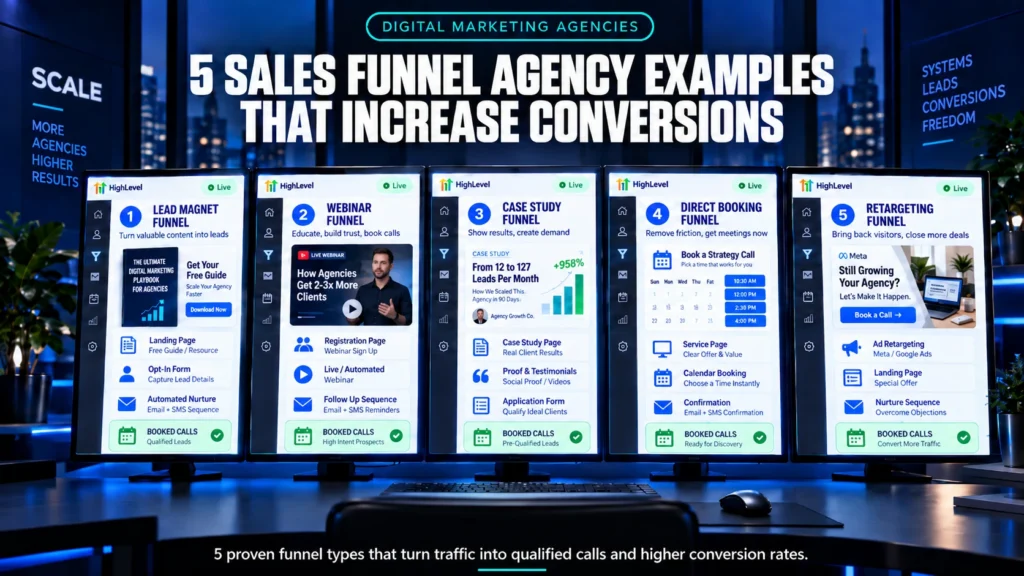
Quick Answer: What Are Five Useful Sales Funnel Agency Examples?
Five practical sales funnel agency examples are a lead magnet funnel, webinar funnel, case-study funnel, direct booking funnel and retargeting funnel. Each gives a different buyer a reason to take the next step: get a useful resource, learn an approach, examine evidence, book a conversation or return to an offer. Choose the format that matches what the buyer needs before committing—not simply the one with the most pages.
TLDR
- Lead magnet: offer a specific resource, deliver it immediately and connect it to a relevant service.
- Webinar: demonstrate an approach when a short page cannot explain the buying decision.
- Case study: let a comparable, documented project support the enquiry.
- Direct booking: give buyers who understand the offer a clear route to a useful call.
- Retargeting: address a relevant unanswered question when eligible previous visitors return.
- Compare business outcomes: a download, registration or booking is a step towards revenue, not revenue itself.
What You Will Learn
See how five funnel formats work through practical agency scenarios, then choose the one worth building first.
Lead Magnet Funnel
Make the first exchange useful and the next step relevant.
Webinar Funnel
Explain the work before asking someone to discuss a project.
Case-Study Funnel
Show a relevant project with enough context to judge its significance.
Direct Booking Funnel
Help ready buyers understand and arrange the call.
Retargeting Funnel
Match the return message to a specific interest or unanswered question.
Ready To Turn This Into A Working System?
Let us custom-build a conversion system for you, or install our top 5 performing GHL systems yourself, completely free.
Install Our Top 5 GHL Systems (FREE) Have SCALE Build It For You, Done For You.
For the wider acquisition-to-retention journey, use our digital marketing agency growth funnel guide. If your main problem is unproductive sales calls, compare the three funnel systems that reduce sales pressure.
Five Sales Funnel Agency Examples At A Glance
A funnel format describes the route a buyer takes. Traffic sources such as search, paid ads and referrals can feed several formats; they are not separate examples by themselves. The scenarios below are illustrative build examples, not claims of client results.
| Funnel Format | Buyer’s Immediate Need | Example Offer | Next Commercial Step |
|---|---|---|---|
| Lead magnet | A practical answer to a narrow problem | A landing-page review worksheet | Discuss the gaps the worksheet reveals |
| Webinar | To understand how the approach works | A walkthrough of an enquiry-to-appointment journey | Discuss applying it to their business |
| Case study | Evidence from relevant work | A documented booking-system rebuild | Enquire about a comparable project |
| Direct booking | A conversation about an understood service | A scoped implementation consultation | Attend the call and agree the next action |
| Retargeting | An answer that makes returning worthwhile | A breakdown of scope, process or evidence | Return to the relevant enquiry or booking route |
Use the comparison to choose an entry point. You do not need all five, and you should not make one prospect complete all five before speaking to you.
1. Lead Magnet Funnel: A Useful Resource With A Relevant Next Step

Imagine a paid-media agency whose prospects are unsure whether their landing pages are ready for more traffic. A focused review worksheet gives them something useful to do before discussing campaign management. A generic “complete marketing guide” would be a much looser match to that service.
The route: relevant ad or article → resource landing page → opt-in → immediate resource access → practical follow-up → optional consultation.
What The Pages And Messages Need To Do
The landing page should show what the worksheet contains and who it helps. Ask only for the information needed to deliver the resource. Explain any separate marketing follow-up, obtain any permission it requires and make it easy to stop. Requesting a download should not silently enrol someone in unrelated campaigns. The thank-you page should provide the resource, not hide it behind a compulsory sales appointment.
The first follow-up can explain how to interpret one part of the worksheet. A later message might ask which issue the reader found hardest to resolve. That creates a reason to talk connected to the resource they requested. If they reply, continue that conversation instead of sending the next generic pitch.
Where this example fails: the download attracts people interested in free resources but unrelated to the paid service. Make the resource narrower before adding more messages. A high opt-in rate is not useful if very few subscribers have the problem you solve.
What to measure: resource delivery, relevant replies and qualified conversations from that subscriber group. Compare the number of eventual customers with the cost of attracting and supporting those enquiries, not just the cost per download.
Watch: HighLevel’s “Saas Agency Lead Magnets That Convert” is an optional companion to this example.
2. Webinar Funnel: Demonstrate The Approach Before The Consultation

A CRM implementation agency may need to explain why enquiries are being lost between a form, an inbox and a calendar. A webinar can walk through one enquiry from submission to appointment, making the work easier to understand than a list of software features.
The route: focused invitation → registration → confirmation and reminders → live or on-demand demonstration → relevant replay or follow-up → implementation enquiry.
Give the session one clear teaching promise. For this example, that could be “See where an enquiry goes after someone submits your form.” Demonstrate the handoffs, show what an operator needs to see and leave time for the questions buyers actually ask. A disguised sales presentation with no useful explanation breaks that promise.
Separate Registration From Genuine Engagement
A registration confirms interest in attending; it does not establish that someone watched, understood or wants to buy. Use reliable attendance information where available, and avoid messages that tell a no-show “as you saw in the session”. A replay invitation and a follow-up to a specific question are different messages.
HighLevel documents live and on-demand webinar funnels, including registration, confirmation and broadcast pages, plus reminder and follow-up workflows. Choose the correct event type and test the registration time, access link and messages in the intended account.
What to measure: registrations, attendance using a defined signal, relevant enquiries and qualified attended consultations. If registrations are healthy but nobody reaches the session, fix access and expectations before rewriting the consultation offer.
Give Your Funnel A Working Foundation
Install our GHL systems, then adapt the pages, forms and follow-up to your chosen offer. Keep the resource or event promise consistent from the first click to the next conversation.
3. Case-Study Funnel: Let Relevant Evidence Support The Enquiry

Consider an agency offering booking-system improvements to service businesses. A relevant case-study page could explain a completed rebuild: the original booking problem, what the team changed, what was measured afterwards and what remained outside the project. The reader can then judge whether that work resembles their own situation.
The route: relevant story or ad → documented case-study page → comparable-project invitation → short enquiry → consultation.
Build The Story Around What You Can Substantiate
- Context: the type of business, starting problem and constraints, with permission to share.
- Work: the actual changes made and who was responsible for them.
- Evidence: supported observations or results, with dates, definitions and a fair comparison.
- Limits: other changes that could have affected the outcome and what the project did not establish.
- Next step: an invitation for businesses with a similar need, not a promise of the same result.
A screenshot of more bookings does not by itself show that a funnel caused the increase. Traffic, advertising spend, availability or the offer may also have changed. If you cannot substantiate a result, describe the verified work instead of filling the gap with an impressive number.
For examples of how delivered work can be presented, explore SCALE’s portfolio. Compare the project context and work shown with your own offer before choosing the evidence for your case-study funnel.
The enquiry form can ask which part of the case resembles the reader’s problem. That gives the subsequent call a useful starting point. Keep detailed scoring on your lead qualification process, rather than turning the story into a long application.
What to measure: relevant project enquiries, attended conversations and won work associated with the case-study route. If readers enquire about a service you do not provide, the story or invitation is setting the wrong expectation.
A Real Three-Page Agency Journey
Before SCALE, I co-owned Funnels & Conversions. The preserved agency funnel used an opt-in page, a VSL and application page, and a booked-call confirmation page. Each had a different job: create interest, explain and qualify the opportunity, then prepare the prospect for the conversation. The useful lesson is the handoff between the pages—not a promise that copying their design will reproduce the result. See the full agency funnel walkthrough for the preserved journey and evidence context.
4. Direct Booking Funnel: Make The Call Easy To Understand And Arrange

A business referred to an agency for a clearly defined CRM migration may already understand the service and want to discuss scope. Making that buyer download a guide or register for a webinar adds an unnecessary detour. A direct booking funnel lets the service page do enough explaining for the call to be worthwhile.
The route: referral or service-specific search → service page → booking details → available time → confirmation and preparation → attended consultation.
Before the calendar, explain who the consultation is for, what will be discussed, who will attend and whether any preparation is needed. “Book a call” is a weak instruction when the visitor cannot tell whether it is a sales pitch, technical support or a paid diagnostic session.
For the migration example, a few details about the existing platform, intended scope and timing can help the host prepare. Complex questions can wait for the conversation. If a request clearly needs another team or service, provide that route rather than allowing a misleading appointment.
The small details matter: show the correct timezone, confirm the appointment and provide a workable cancellation or rescheduling link. Keep reminders factual and useful. A booking should stop obsolete messages asking the same person to book again.
What to measure: completed bookings, attendance and appropriate next actions after the call. Review cancellation reasons and the quality of the conversations before assuming more calendar slots filled means a better funnel.
5. Retargeting Funnel: Give Previous Visitors A Reason To Return

Suppose an agency’s service page gets relevant visitors, but some leave before enquiring. A return message can answer a specific buying question: what is included, how delivery works or what comparable work looks like. Repeating “book now” without adding anything useful may leave the original hesitation unresolved.
The route: eligible previous visit → relevant return ad → matching explanation or evidence → enquiry or booking.
Match The Return Page To The Message
An ad about implementation scope should land on a useful scope explanation, not a generic homepage. A case-study ad should lead to the actual story. Where someone is already a customer or has completed the intended action, use appropriate exclusions instead of continuing to advertise the same first step.
Google Ads supports website-visitor segments based on actions and page rules. Audience eligibility, tracking and consent requirements still apply; a CRM record or page visit does not mean that every person can be reached with an ad. Before activation, check Google’s applicable advertising policies, including its EU user consent policy for users in the EEA, UK and Switzerland, and any requirements for the markets you serve.
What to measure: relevant return visits, enquiries and resulting sales, alongside spend and frequency. A platform-attributed conversion is not automatically an additional sale caused by retargeting. Where practical, compare against a suitably designed holdout or other controlled test before claiming incremental impact.
This format depends on a usable, eligible audience. If the service page barely receives relevant traffic, clarify the offer and acquisition route first. Retargeting cannot repair a service proposition people do not understand or want.
Which Funnel Should Your Agency Build First?
Look at the useful assets and buyer behaviour you already have. The best starting point is the format you can deliver credibly, not a funnel that requires evidence, content or traffic you have yet to create.
| You Already Have | Consider First | Resolve Before Building |
|---|---|---|
| A specific resource linked to your service | Lead magnet | How the resource leads to a relevant conversation |
| A useful demonstration and an audience to invite | Webinar | The teaching promise, access and follow-up |
| Documented work relevant to your target buyer | Case study | Permission, evidence and the limits of the result |
| Buyers already asking about a defined service | Direct booking | The call’s purpose, capacity and preparation |
| Eligible returning audiences and a clear offer | Retargeting | The unanswered question and matching destination |
Brief the build around one offer and one next action. Name the entry source, landing page, asset, form, follow-up and commercial outcome. Then make a controlled test submission and follow it through the complete route. For selecting a delivery partner, use the sales funnel agency hiring checklist.
Keep comparisons fair. Downloads and bookings represent different levels of commitment, so comparing their conversion rates alone can reward the easier action. Review qualified conversations, customers and acquisition cost over a consistent period, while keeping traffic sources and sales-cycle differences visible.
Build The Funnel That Fits Your Offer
Have SCALE connect the pages, CRM and follow-up around the example that makes sense for your business. Start with the buyer, the offer and the next action—not five disconnected templates.
Conclusion: Choose The Example You Can Deliver Well
A lead magnet offers immediate help. A webinar explains the approach. A case study provides relevant evidence. Direct booking serves a ready buyer, while retargeting creates a reason to return. Start with one credible route, deliver what its first page promises and measure what happens after the initial conversion. Add another format only when it serves a different buyer need.
FAQs
What are the five sales funnel agency examples in this guide?
Lead magnet, webinar, case study, direct booking and retargeting funnels. They differ in what the buyer receives before the commercial next step: a resource, demonstration, evidence, consultation or relevant return message.
Is paid advertising a separate funnel type?
Paid advertising is a traffic source. It can send people into a lead magnet, webinar, case study or booking funnel. Retargeting is included here as a return-visit route because its audience has already interacted with the business.
Should a new agency start with a case-study funnel?
Only if it has relevant work it can document honestly and has permission to share it. Otherwise, a useful resource, a clearly labelled demonstration or a straightforward service and booking page may be a more credible starting point.
Can a lead magnet and a webinar work together?
Yes, if the webinar helps with the problem the resource introduces. Make it an optional, relevant next step. Do not force a buyer who is ready to enquire through an entire content sequence first.
Which funnel is best for high-value agency services?
There is no universal winner. Use a case study when comparable evidence matters, a webinar when the work needs explaining, or direct booking when the buyer understands the service. The offer, available proof and buyer readiness matter more than price alone.
How do I compare the results of different funnel examples?
Track each route through to qualified conversations and customers, with its costs and traffic sources visible. A lower cost per download cannot be compared directly with a cost per attended consultation: they measure different actions.
