

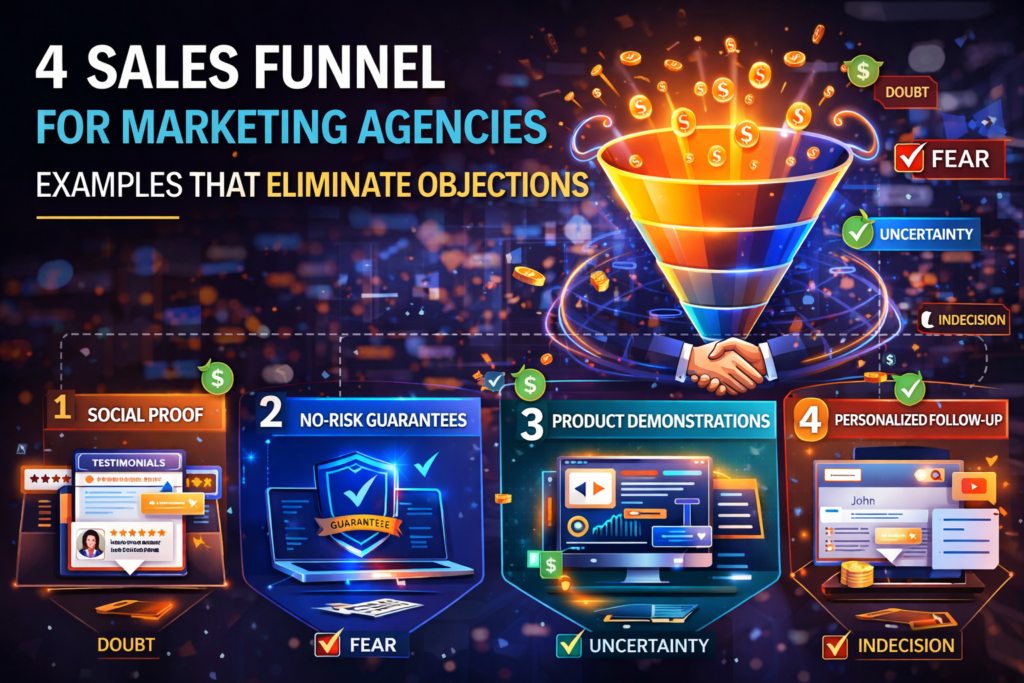
A sales funnel for marketing agencies needs to do more than generate leads. It needs to pre-qualify prospects, demonstrate expertise, and eliminate objections before the sales conversation even begins. Most agencies struggle because their funnels treat every visitor the same, failing to address the specific concerns that prevent business owners from committing to a retainer or project.
The best agency funnels are built around objection elimination. They anticipate hesitation around pricing, results, timelines, and trust, then systematically address each concern through strategic content, proof points, and positioning. Below are four proven funnel structures that marketing agencies use to convert cold traffic into qualified opportunities.
1. The Authority-First Funnel
This funnel leads with educational content that demonstrates deep expertise in a specific vertical or service area. Instead of pushing a consultation immediately, it builds trust through value delivery first.
The structure typically follows this sequence:
- Paid or organic traffic lands on a high-value resource (guide, audit tool, or diagnostic)
- Visitor exchanges email for the resource or tool access
- Automated email sequence delivers additional insights while addressing common objections
- Qualified prospects are invited to book a strategy session or apply to work together
This approach works particularly well for agencies targeting sophisticated buyers who need to see proof of thinking before they’ll take a meeting. The funnel eliminates the “are they actually good?” objection by demonstrating competence upfront.
The key is specificity. A generic “digital marketing guide” won’t cut through. A “Patient Acquisition System Audit for Multi-Location Dental Practices” immediately signals relevance and expertise to the right audience.
If you want to see the broader strategic version of this, review what funnel the top 1% of agencies use when they want better-fit leads instead of more noise, then use the funnel agency partner checklist to judge whether a build team can own CRM, tracking and follow-up as well as page structure.
2. The Case Study Showcase Funnel
For agencies with strong client results, this funnel puts proof front and center. It’s designed to overcome the most common objection: “Will this actually work for my business?”
The flow prioritizes evidence over promises:
- Landing page features specific, quantified results from similar businesses
- Visitor can filter or navigate to case studies matching their industry or challenge
- Each case study breaks down the strategy, timeline, and results
- Clear next step to book a consultation or request a custom plan
This sales funnel for marketing agencies works because it lets results do the selling. Instead of making claims about what you can do, you show what you’ve already done. The specificity of the case studies pre-qualifies leads, as only businesses with similar needs and budgets will move forward.
The mistake most agencies make here is being vague about results or timelines. “Increased revenue” means nothing. “Generated $847K in attributed revenue over 6 months from a $12K/month ad spend” tells a complete story.
3. The Diagnostic-to-Proposal Funnel
This funnel replaces the traditional “book a call” approach with an interactive diagnostic or assessment. It works by giving prospects immediate value while collecting qualification data.
The mechanism is straightforward but powerful. A prospect answers questions about their current marketing, goals, and challenges. Based on their responses, they receive a customized report or scorecard that identifies gaps and opportunities. The report naturally positions your agency’s services as the solution.
What makes this effective is the psychological shift it creates. Instead of asking for a meeting with nothing in return, you’re providing analysis and insights first. The prospect feels like they’re getting value regardless of whether they hire you, which reduces resistance.
The diagnostic also eliminates the “I’m not sure what I need” objection by clarifying the prospect’s situation for them. By the time they book a call, they already understand their gaps and are primed to discuss solutions.
Building an Effective Diagnostic
The questions should accomplish three things: qualify budget and fit, identify specific pain points, and collect information that makes your sales conversation more efficient. Avoid generic questions that don’t inform your recommendation or qualification process.
The output report needs to feel personalized, even if it’s automated. Use conditional logic to reference their specific answers and tailor recommendations to their situation. A generic report defeats the purpose.
4. The Productized Service Funnel
This funnel works for agencies offering clearly defined, fixed-scope services rather than custom retainers. It eliminates the “what will this cost?” and “what exactly am I getting?” objections by making everything transparent upfront.
The structure is deliberately simple:
- Landing page clearly defines the service, deliverables, timeline, and price
- Prospect can see exactly what’s included and what results to expect
- Checkout or application process is straightforward with minimal friction
- Onboarding begins immediately after purchase or approval
This approach works because it removes uncertainty. There’s no “let’s hop on a call to discuss your needs” ambiguity. The prospect knows what they’re buying and what it costs before any conversation happens.
The trade-off is that this funnel only works for services that can be standardized. A “SEO Foundation Package” or “GoHighLevel Setup and Integration” can be productized. Fully custom growth strategy work cannot.
Agencies using this model often combine it with a qualifier at the front end. Before someone can purchase, they complete a brief application to ensure fit. This maintains quality control while keeping the process efficient.
What Makes a Sales Funnel for Marketing Agencies Actually Convert
The common thread across these funnels is that they all address specific objections rather than making generic promises. They recognize that agency buyers are skeptical, often burned by previous experiences, and need concrete reasons to believe you’re different.
The technical execution matters too. These funnels require proper tracking, CRM integration, and follow-up automation. A brilliant funnel concept falls apart if leads aren’t nurtured properly or if sales conversations happen too late or too early in the buyer’s journey.
Most agencies also need different funnels for different service lines or buyer types. The funnel that works for local businesses seeking lead generation won’t work for enterprise clients evaluating a marketing partner. Segmentation isn’t optional at scale.
For the longer-term view, read whether sales funnels for marketing agencies will survive AI over the next five years. It sharpens the difference between short-term objection handling and durable funnel strategy.
HubSpot’s sales funnel guide is a useful benchmark when you want to compare these objection-handling examples against a more standard stage-based model.
Conclusion
An effective sales funnel for marketing agencies does the heavy lifting before the sales call. It qualifies prospects, demonstrates capability, and systematically eliminates the objections that typically derail agency sales processes. Whether you lead with authority content, case studies, diagnostics, or productized offerings, the goal is the same: create a system that turns cold traffic into qualified opportunities who already understand your value and are ready to move forward.
Want us to set this up for your business?
Book a FREE call with us to see how we can help by visiting: https://scale-agency.co/
Learn more below:
