Scroll breakdown
In this guide, we’ll cover:
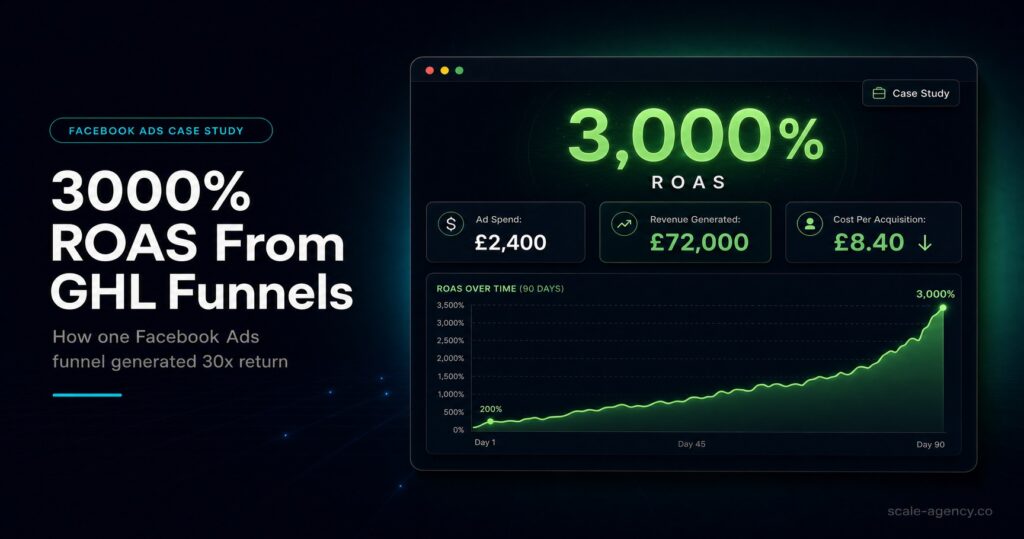
Ad Spend
Why the return is decided by what happens after the click, not just inside the ad account.
Funnel Conversion
Where attention becomes a measurable lead with intent, context and a clear next step.
GHL Follow-Up
How GoHighLevel protects ROAS with faster nurture, pipeline movement and booked-call logic.
ROAS Proof
What proves the system worked: spend, revenue, CPA and return tracked in one view.
“The 3000% ROAS came from the full system: ads, funnel, CRM follow-up and revenue tracking working together.”
A sales funnel for Facebook ads only becomes commercially interesting when it improves lead quality, follow-up speed and tracked revenue at the same time. The point of a GoHighLevel-built funnel is not just more clicks. It is giving paid traffic a cleaner path from cold attention to booked sales conversations.
SCALE builds GoHighLevel CRM, funnel, and automation systems for businesses that need better lead quality, faster follow-up, and clearer attribution.
If a Facebook Ads funnel depends on clean handoff, booked calls and revenue reporting, a SCALE GoHighLevel expert build gives the funnel, CRM and follow-up system stronger commercial control.
If you want SCALE to pressure-test that system for your business, book a free Growth Systems Audit and we will show you where ad spend, nurture and conversion flow are leaking profit.
Most businesses waste their Facebook ad budget because they treat the funnel as an afterthought. They send traffic to generic pages, fail to segment audiences based on behaviour, and lose prospects in the gaps between ad click and purchase. The difference between a 50% ROAS and a 3000% ROAS often comes down to funnel architecture, not ad creative.
Why Facebook Ads Need a Purpose-Built Sales Funnel
Facebook’s algorithm rewards engagement and conversions, but it can’t fix a broken funnel. When you send cold traffic directly to a product page or a contact form, you’re asking for a commitment before building any trust or demonstrating value. This approach burns budget and trains the algorithm on the wrong signals.
A properly structured sales funnel for Facebook ads works because it matches the temperature of your traffic to the appropriate offer. Cold audiences get educational content or low-commitment lead magnets. Warm audiences see case studies, testimonials, or product demos. Hot audiences receive direct offers with urgency and clear calls to action.
The funnel also gives you data. Every page view, form submission, and email open becomes a signal you can use to refine targeting, automate follow-up, and identify which prospects are ready to buy versus those who need more nurturing.
If you are building that system inside one stack, pair this with whether Facebook ads should be managed inside GoHighLevel and these GoHighLevel Facebook ads automations so the handoff between ads, CRM and follow-up stays clean.
Core Components of a High-Converting Facebook Ad Funnel
Building a sales funnel that actually converts paid traffic requires specific elements working together. Miss one, and you create friction that kills conversions. Include them all, and you create a system that compounds results over time.
Landing Pages Designed for Single Outcomes
Every landing page in your funnel should have one job. If you’re capturing leads, remove navigation, eliminate distractions, and focus entirely on the value exchange. If you’re selling, make the offer clear, address objections immediately, and make the path to purchase obvious.
GoHighLevel makes this straightforward with its drag-and-drop builder, but the real work is in the messaging. Your headline needs to match the ad that brought them there. The copy should speak directly to the pain point or desire that made them click. And the form or checkout process should ask for the minimum information required to move forward.
Segmentation Based on Behaviour
Not everyone who clicks your ad is at the same stage of awareness. Some are just discovering their problem. Others are comparing solutions. A few are ready to buy today.
Your funnel should tag and segment prospects based on what they do. Someone who watches 75% of your video ad is more engaged than someone who clicked and bounced. Someone who visits your pricing page twice is hotter than someone who only read a blog post. Use these signals to trigger different follow-up sequences and retargeting campaigns.
Automated Follow-Up Sequences
Most conversions don’t happen on the first visit. The average buyer needs multiple touchpoints before making a decision, especially for higher-ticket offers. This is where automation separates profitable funnels from expensive experiments.
When someone enters your funnel, they should immediately receive a confirmation email with the promised resource or next step. Over the following days, they should get a sequence of emails that build trust, provide value, and move them closer to a purchase decision. SMS can work even better for time-sensitive offers or appointment-based businesses.
Inside GoHighLevel, these sequences can be triggered by specific actions: form submissions, page visits, link clicks, or even inactivity. The system tracks everything and ensures no lead falls through the cracks.
How to Structure Your Sales Funnel for Facebook Ads
The exact structure depends on your offer, price point, and sales cycle, but most high-performing funnels follow a predictable pattern. Here’s the framework that consistently delivers results:
- Ad to landing page: Drive cold traffic to a high-value lead magnet or educational content that addresses a specific problem. The goal is to get permission to continue the conversation.
- Thank you page with immediate value: Deliver what you promised instantly, then introduce the next logical step. This could be booking a call, watching a demo, or accessing a limited-time offer.
- Email and SMS nurture sequence: Over the next 5-7 days, send a mix of educational content, social proof, and soft offers. Each message should provide value while moving prospects toward a decision.
- Retargeting campaigns: Use Facebook’s pixel data to show different ads to people based on how far they progressed in your funnel. Someone who visited your sales page but didn’t buy needs a different message than someone who only opted in.
- Conversion event: Whether it’s a purchase, a booked call, or a demo request, this is where the funnel pays off. Make this step as frictionless as possible.
Tracking and Optimising Your Facebook Ad Funnel
A sales funnel is never finished. The first version you launch will have leaks, friction points, and missed opportunities. The goal is to identify them quickly and fix them systematically.
Start by tracking conversion rates at every stage. What percentage of ad clicks become landing page views? How many landing page views become leads? How many leads become customers? These numbers tell you exactly where to focus your optimisation efforts.
If your ad click-through rate is strong but landing page conversions are weak, the problem is message match or page design. If you’re getting plenty of leads but few sales, your follow-up sequence or offer needs work. If people are dropping off at checkout, you have a friction or trust issue.
GoHighLevel’s built-in analytics make this process straightforward. You can see the entire customer journey from first click to final purchase, identify bottlenecks, and test improvements without needing multiple tools or complex integrations.
Common Mistakes That Kill Facebook Ad Funnel Performance
Even experienced marketers make predictable mistakes when building funnels for paid traffic. Avoid these and you’ll outperform most of your competitors by default:
- Sending all traffic to the same page: Cold, warm, and hot audiences need different messaging and offers. One-size-fits-all funnels waste budget and miss opportunities.
- Asking for too much too soon: If your first interaction asks for a phone number, credit card, or 30-minute call, you’re creating unnecessary friction. Start with a low-commitment offer and build from there.
- Ignoring mobile experience: Most Facebook traffic comes from mobile devices. If your pages load slowly, forms are difficult to fill out, or buttons are hard to tap, you’re losing conversions.
- Weak or missing follow-up: Getting someone into your funnel is the expensive part. Failing to follow up aggressively is leaving money on the table.
- Not testing: Your first version won’t be your best version. Test headlines, offers, form lengths, and email sequences. Small improvements compound into significant revenue increases.
Why GoHighLevel Works for Facebook Ad Funnels
Most businesses cobble together their funnels using multiple tools: a landing page builder, an email platform, a CRM, a calendar system, and analytics software. This creates integration headaches, data gaps, and unnecessary complexity.
GoHighLevel consolidates everything into one platform. You build your landing pages, set up your automation, manage your leads, track your conversions, and run your follow-up sequences all in the same place. This means fewer things to break, cleaner data, and faster optimisation cycles.
The platform also includes features specifically valuable for paid traffic campaigns: call tracking, SMS automation, appointment scheduling, and pipeline management. When someone clicks your Facebook ad, you can guide them through the entire journey without switching tools or losing visibility.
Scaling a Profitable Sales Funnel for Facebook Ads
Once you’ve built a funnel that converts profitably at a small scale, the next challenge is scaling without destroying your economics. This requires systematic testing and careful monitoring of key metrics.
Start by expanding your audience gradually. Test new interest groups, lookalike audiences, and geographic regions one at a time. Monitor your cost per lead and cost per acquisition closely. If they stay stable or improve, continue scaling. If they deteriorate, pause and diagnose the issue before spending more.
As you scale, your creative will fatigue. What worked at $100 per day might stop working at $1,000 per day. Plan to refresh your ad creative regularly and test new angles, hooks, and formats. The funnel itself can often stay the same while you rotate the ads feeding it.
Also watch for changes in lead quality. Sometimes scaling brings in more leads but lower-quality prospects. If your lead-to-customer conversion rate drops significantly, you may need to tighten your targeting or adjust your lead magnet to attract better-fit prospects.
If you want to see how this result fits into a bigger acquisition system, review the sales funnel for digital marketing agency growth and four sales funnel for marketing agencies examples that eliminate objections. Those pages make it easier to see how profitable ad funnels support broader agency growth.
Conclusion
A well-built sales funnel for Facebook ads transforms paid traffic from an expense into a predictable revenue channel. The key is treating the funnel as a complete system, not just a landing page. When you match your messaging to audience temperature, automate intelligent follow-up, and continuously optimise based on data, you create a compounding advantage that competitors can’t easily replicate. The businesses winning with Facebook ads aren’t necessarily spending more or running better creative. They’re building better funnels that convert more of the traffic they already have.
Want SCALE to build this for your business?
Book a free Growth Systems Audit and we will show you where your funnel, CRM and follow-up system are leaking revenue: https://scale-agency.co/
Learn more below:
