If you’re evaluating a sales funnel digital marketing agency, the question is not whether you need more marketing activity. Instead, you need to know whether you have a tighter system that connects traffic, qualification, follow-up and closing inside one revenue engine. That is usually where long-term revenue gets won or lost.
If the long-term revenue plan depends on GoHighLevel doing more than hosting pages, a GoHighLevel CRM and funnel expert should map the CRM, automation and attribution path before more campaigns are added.
SCALE builds GoHighLevel CRM, funnel, and automation systems for businesses that need better lead quality, faster follow-up, and clearer attribution.
When that system runs properly inside GoHighLevel, your agency gets cleaner lead flow, better sales visibility and less operational drag. If you want SCALE to diagnose where your current funnel is leaking revenue, book a free Growth Systems Audit and we will show you what needs tightening first.
What a Sales Funnel Digital Marketing Agency Actually Does
A sales funnel digital marketing agency doesn’t just run ads or build websites. It architects the entire customer journey from first touch to final sale, then optimises each stage based on data. This includes mapping out awareness, consideration, conversion, and retention phases—then building the assets, automation, and acquisition channels needed to move prospects through each one.
The core difference is systems thinking. Where a traditional agency might deliver a Facebook campaign or a landing page, a funnel-focused agency delivers an integrated system where every piece works together: ad creative that speaks to specific pain points, landing pages designed for one clear action, email sequences that nurture based on behaviour, and backend automation that qualifies leads before they ever reach your sales team.
This approach requires expertise across multiple disciplines: copywriting that converts, design that guides attention, technical implementation that tracks every interaction, and analytics that reveal where revenue is won or lost. It’s not about doing more marketing—it’s about engineering a repeatable process that generates predictable outcomes.
Why GoHighLevel Has Become the Backbone of Modern Funnel Agencies
GoHighLevel has emerged as the platform of choice for agencies building serious funnel infrastructure. Unlike duct-taped solutions involving five different tools, GoHighLevel consolidates CRM, email and SMS automation, landing page builders, appointment scheduling, pipeline management, and reporting into one unified system. If you want the platform-specific side of this broken down further, review these GoHighLevel sales funnel models built for long-term profit.
For business owners, this matters because it means faster implementation, cleaner data, and fewer integration headaches. For agencies like SCALE, it means we can build sophisticated automation without the technical debt that comes from connecting Zapier workflows between incompatible platforms.
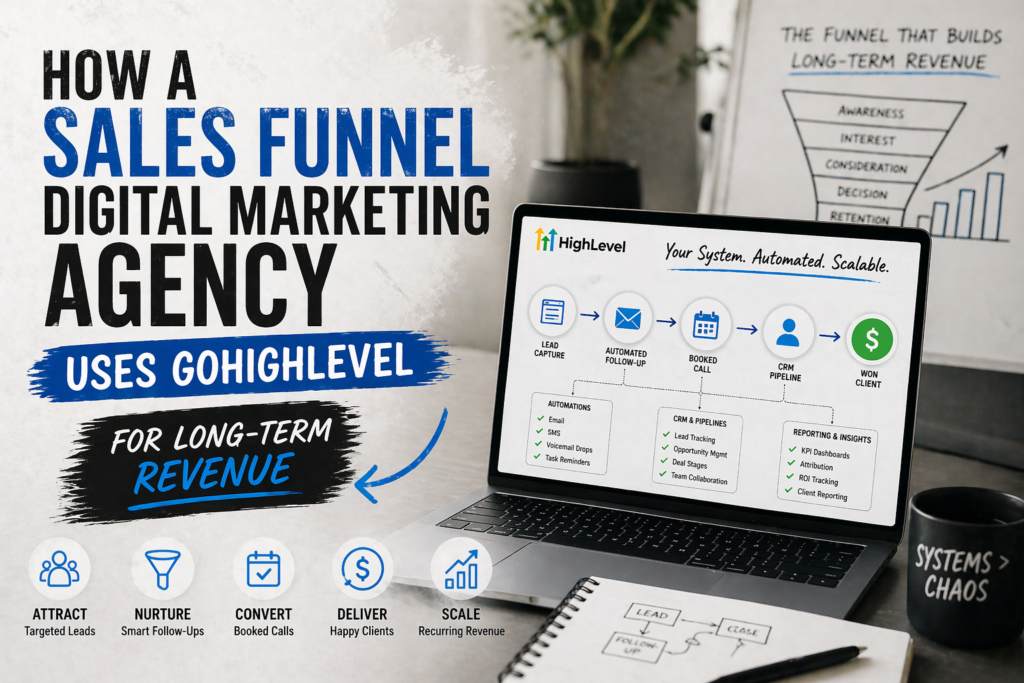
The platform enables behaviour-based automation that actually works. If a lead downloads a guide, they enter a nurture sequence. After a prospect books a call, the system notifies your team, updates the pipeline, and triggers pre-call reminders. If they do not show up, a re-engagement sequence starts automatically. This level of orchestration once required custom development. Now it is configurable within a single platform.
Key GoHighLevel Capabilities for Funnel Systems
- Unified contact database that tracks every interaction across channels
- Visual automation builder for complex, multi-step nurture sequences
- Two-way SMS and email communication from one inbox
- Pipeline management with customisable stages and triggers
- Built-in appointment scheduling with calendar sync and reminders
- Landing page and funnel builder with conversion-focused templates
- Reporting dashboards that connect marketing activity to revenue outcomes
The Five Stages a Proper Sales Funnel Agency Builds
A complete funnel system isn’t linear—it’s a series of interconnected stages, each with specific objectives and metrics. Here’s how a competent sales funnel digital marketing agency structures the customer journey:
- Awareness and Traffic Generation: Paid acquisition through Google Ads, Meta, YouTube, or LinkedIn; organic reach through SEO and content; and strategic partnerships or referral systems. The goal isn’t maximum traffic—it’s qualified traffic that matches your ideal customer profile.
- Lead Capture and Qualification: Landing pages, lead magnets, quizzes, or assessments designed to capture contact information while simultaneously qualifying interest level and fit. This stage separates browsers from genuine prospects.
- Nurture and Education: Automated email and SMS sequences that address objections, demonstrate expertise, and build trust over time. This is where most businesses lose opportunities—they capture leads but never systematically follow up.
- Conversion and Sales: Application funnels, sales calls, webinars, or direct purchase flows depending on your business model. The infrastructure here includes booking systems, sales scripts, proposal automation, and payment processing.
- Retention and Ascension: Onboarding sequences, customer communication systems, upsell triggers, and referral programs. Revenue doesn’t stop at the first sale—this stage often determines lifetime value.
What to Look for When Choosing a Sales Funnel Digital Marketing Agency
Not every agency that claims to build funnels actually understands revenue systems. Here’s what separates competent funnel agencies from those just adding “funnel” to their service list:
Platform expertise that goes beyond surface level. Ask if they’re GoHighLevel certified, how many funnel systems they’ve built on the platform, and whether they handle the technical implementation themselves or outsource it. You want an agency that knows the platform’s capabilities and limitations intimately.
A process for mapping your specific customer journey. Generic funnel templates rarely work. The agency should start by understanding your offer, customer psychology, sales cycle length, and current conversion barriers before proposing solutions.
Integration of paid and organic acquisition. Funnels need traffic. The agency should be able to drive qualified visitors through SEO, content strategy, and paid campaigns—not just build the funnel and hope people find it.
Clear reporting on funnel metrics, not vanity numbers. You need visibility into cost per lead, lead-to-customer conversion rate, customer acquisition cost, and lifetime value. Traffic and impressions don’t pay the bills.
Ongoing optimisation, not just setup and disappear. Funnels require continuous testing and refinement. Conversion rates improve through systematic experimentation with copy, offers, sequences, and timing—not one-time builds.
How Automation Multiplies Funnel Performance
The real leverage in modern funnel systems comes from intelligent automation. This isn’t about replacing human interaction—it’s about ensuring no lead falls through the cracks and that your team only engages with properly qualified, warmed-up prospects.
Behaviour-based triggers allow your funnel to respond differently based on what people actually do. Someone who opens every email but doesn’t book a call needs a different approach than someone who visited your pricing page three times. Automation makes this level of personalisation scalable.
Lead scoring systems can automatically prioritise your sales team’s attention. When a prospect hits certain engagement thresholds—downloaded two resources, visited high-intent pages, opened the last five emails—the system can notify your team to reach out personally or move them into a higher-touch sequence.
This is where GoHighLevel’s workflow builder becomes powerful. You can create decision trees that route leads based on their responses, engagement level, or profile data. A B2B service business might route enterprise leads to a direct sales process while sending smaller prospects through an automated webinar funnel.
The Difference Between Campaign Thinking and System Thinking
Most businesses approach marketing as a series of campaigns: run some ads this month, try a promotion next month, maybe do some SEO when there’s time. This creates revenue that spikes and crashes, with no compounding growth.
A sales funnel digital marketing agency builds systems that compound. New leads go into a database. Interactions get tracked. Conversion points get measured and optimised. Over time, you accumulate assets: an email list that has been segmented and nurtured, content that ranks and drives organic traffic, automation sequences refined through testing, and data that shows which channels and messages drive revenue.
This shift from campaign thinking to system thinking is what creates sustainable growth. You’re not starting from zero every month—you’re improving a machine that gets more efficient over time.
When to Bring in a Funnel Agency vs Building In-House
Building funnel systems in-house is possible, but it requires a specific skill stack that most businesses don’t have sitting around: conversion copywriting, funnel strategy, technical implementation, design, paid acquisition, and analytics. Hiring for all these roles is expensive and slow.
A funnel agency makes sense when you need expertise across all these areas without the overhead of full-time hires. It also makes sense when you want systems built quickly so you can generate ROI sooner, or when your internal team is already stretched and cannot take on a complex technical project.
The economics work when the agency can deliver a funnel system that generates more revenue than it costs within a reasonable timeframe—usually three to six months. If your average customer value is high enough and your market has sufficient demand, the math typically works strongly in favour of bringing in specialists.
For stronger context, compare this with the sales funnel for digital marketing agency growth and three agency funnels that remove the pressure from selling. Together they make it easier to see how better infrastructure protects margin and improves long-term pipeline quality.
Conclusion
A genuine sales funnel digital marketing agency doesn’t sell you marketing services—it builds revenue infrastructure. The deliverable isn’t a campaign or a website; it’s a complete system that captures attention, qualifies interest, nurtures relationships, converts sales, and maximises customer value over time.
This requires platform expertise, strategic thinking, technical execution, and ongoing optimisation. When done properly on a platform like GoHighLevel, you get a unified system that tracks every customer interaction, automates repetitive tasks, and gives you clear visibility into what’s actually driving revenue.
The difference between scattered marketing efforts and a proper funnel system is the difference between hoping for sales and engineering them predictably.
If you want to compare in-house execution against outside support, read five sales funnel agency examples that turn traffic into revenue and what drives profit in a sales funnel agency. That gives you a clearer benchmark for what good looks like.
Want SCALE to build this for your business?
Book a free Growth Systems Audit and we will show you where your funnel, CRM and follow-up system are leaking revenue: https://scale-agency.co/
Learn more below:
