
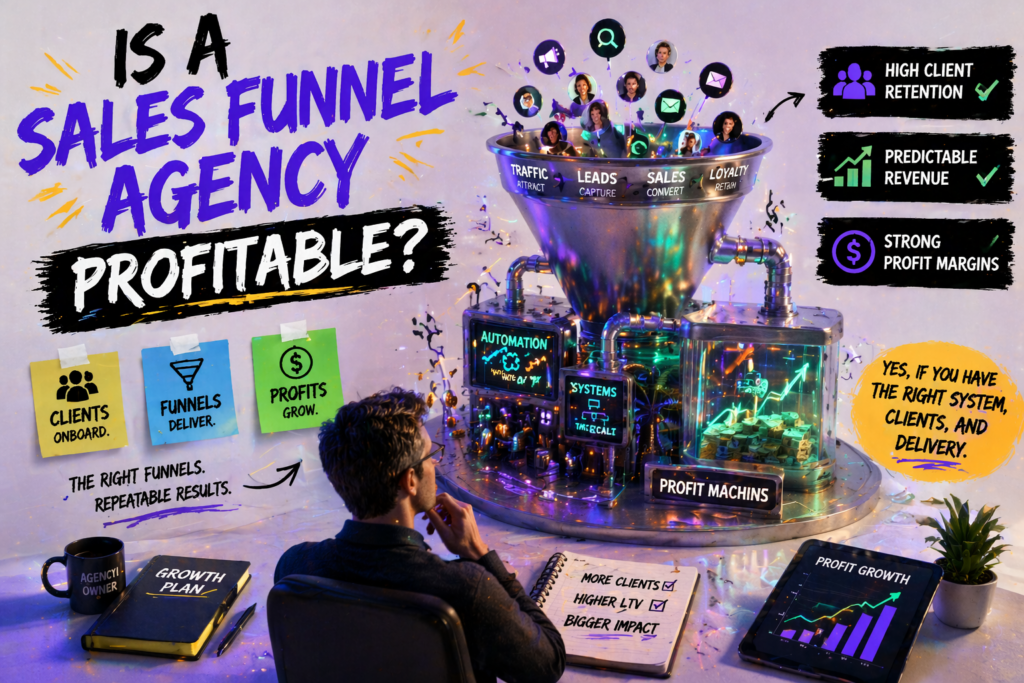
If you are asking whether a sales funnel agency is profitable, the better question is what kind of agency model creates margin without destroying delivery capacity. Funnel agencies get paid well when they solve an expensive problem: turning traffic into revenue with stronger conversion paths, automation and attribution. The ones that stay mediocre usually sell pages. The profitable ones sell systems.
When profit depends on CRM, follow-up and reporting rather than landing pages alone, a GoHighLevel CRM and funnel expert can protect the economics of the funnel. SCALE builds GoHighLevel CRM, funnel, and automation systems for businesses that need better lead quality, faster follow-up, and clearer attribution.
If you want SCALE to map the right funnel economics for your business, book a free Growth Systems Audit and we will show you where revenue, lead quality and follow-up are slipping.
Is a Sales Funnel Agency Profitable?
The profitability of a sales funnel agency depends on three core factors: the ability to deliver measurable revenue growth, the operational leverage built into service delivery, and the recurring value created for clients. Agencies that treat funnels as isolated projects struggle. Those that position funnels as growth systems with ongoing optimization, automation, and attribution tend to command higher fees and retain clients longer.
For the GoHighLevel version of that model, read how GoHighLevel agency models attract higher-value clients and why agencies are switching their CRM stack to GoHighLevel.
For stronger benchmarks, look at why top brands rely on funnel agencies for marketing and the funnel system top digital agencies use to stay ahead. Both show why profitable funnel work is tied to systems, not one-off assets.
From a client perspective, the question is whether the investment pays for itself. From an agency perspective, it’s whether the business model scales without linear increases in labor costs.
What Makes a Sales Funnel Agency Different from Traditional Marketing Agencies
Traditional marketing agencies often focus on brand awareness, creative campaigns, or channel-specific execution. A sales funnel agency is built around a single objective: moving prospects through a defined conversion path that generates revenue.
This means the work centers on:
- Mapping customer journeys from first touch to closed sale
- Building landing pages, email sequences, and offer structures that convert
- Integrating CRM systems, automation platforms, and attribution tools
- Testing and optimizing based on conversion data, not vanity metrics
- Aligning paid acquisition, organic traffic, and retention into a cohesive system
The deliverable is not a campaign or a website. It’s a repeatable system that turns traffic into customers at a predictable cost.
Why Businesses Hire a Sales Funnel Agency
Most businesses don’t lack traffic. They lack conversion infrastructure. A company might be spending thousands per month on ads or SEO, but if the landing experience is generic, the follow-up is manual, and there’s no clear path from interest to purchase, that traffic is wasted.
Hiring a sales funnel agency makes sense when:
- The business has product-market fit but struggles to scale acquisition profitably
- Internal teams lack the technical skills to build automation, integrate platforms, or structure offers
- There’s a disconnect between marketing activity and revenue attribution
- The sales process is inconsistent or relies too heavily on individual effort
- The business wants to move from project-based marketing to a growth system
The value proposition is simple: pay an agency to build the infrastructure that increases customer lifetime value and lowers cost per acquisition. If the funnel works, the ROI is measurable and the relationship continues.
Revenue Models That Make Sales Funnel Agencies Profitable
Profitability for a sales funnel agency comes from pricing models that align with the value delivered, not just hours worked. Agencies that bill hourly or charge flat fees for one-time builds often hit a ceiling. Those that structure pricing around outcomes, retainers, and performance tend to scale better.
Project-Based Funnel Builds
This is the entry point for most agencies. A client pays a fixed fee for a complete funnel build, including strategy, design, copywriting, technical setup, and initial testing. Pricing typically ranges from a few thousand dollars for simple funnels to mid-five figures for complex, multi-step systems with CRM integration and automation.
The challenge is that project work doesn’t recur. Once the funnel is live, the relationship often ends unless the agency positions ongoing optimization as essential.
Retainer-Based Optimization and Management
The more profitable model involves retaining clients after the initial build. This includes split testing, traffic analysis, email sequence refinement, conversion rate optimization, and funnel expansion. Monthly retainers create predictable revenue and allow the agency to capture the long-term value of improving a funnel over time.
Clients stay because the funnel is a living system, not a static asset. Conversion rates improve with testing. Offers evolve. New traffic sources require new landing experiences. The agency becomes a growth partner, not a vendor.
Performance-Based and Hybrid Models
Some agencies charge a base fee plus a percentage of revenue generated or cost savings achieved. This works when attribution is clean and the agency has control over enough variables to influence outcomes. It’s higher risk but can be significantly more profitable when the funnel performs.
Hybrid models combine a lower retainer with performance bonuses, balancing predictability with upside.
Operational Leverage: How Sales Funnel Agencies Scale Without Burning Out
The biggest threat to profitability in any service business is the inability to scale without adding headcount proportionally. Sales funnel agencies that rely entirely on custom work for every client hit a ceiling quickly.
Profitable agencies build leverage through:
- Templated frameworks that adapt to different industries without starting from scratch
- Platform specialization such as GoHighLevel, ClickFunnels, or HubSpot, reducing setup time and technical complexity
- Automation of internal processes including client onboarding, reporting, and project management
- Productized services with fixed scopes and pricing, making sales and delivery more efficient
- White-label partnerships or offshore teams for design and development, freeing senior strategists to focus on high-value work
The goal is to increase the value delivered per hour worked, not just to work more hours.
Common Pitfalls That Hurt Profitability
Not all sales funnel agencies succeed. The ones that struggle typically fall into a few predictable traps.
Underpricing based on hours instead of value. If a funnel generates an extra hundred thousand dollars in revenue, charging five thousand for the build leaves money on the table. Pricing should reflect the outcome, not the effort.
Failing to set clear expectations around performance. Funnels don’t work in isolation. If the client’s offer is weak, their traffic is cold, or their sales team doesn’t follow up, the funnel won’t convert. Agencies that don’t qualify clients or educate them on what’s required end up blamed for poor results.
Treating funnels as one-time projects. A funnel that isn’t tested and optimized will underperform. Agencies that don’t build ongoing relationships leave revenue on the table and lose clients to competitors who offer continuous improvement.
Lack of specialization. Generalist agencies that build funnels for any industry struggle to develop repeatable processes or demonstrate deep expertise. Focusing on a niche allows for better positioning, faster delivery, and higher fees.
What to Look for When Hiring a Sales Funnel Agency
If you’re a business owner evaluating agencies, the decision should be based on their ability to deliver measurable outcomes, not just attractive designs or impressive portfolios.
Ask about their process for understanding your customer journey. A good agency will want to know your offer, your average transaction value, your current conversion rates, and your traffic sources before proposing a solution.
Look for technical competence with the platforms you use or plan to use. If your business runs on GoHighLevel, hiring an agency that specializes in WordPress won’t deliver the integration and automation you need.
Evaluate their approach to testing and optimization. A funnel is a hypothesis until data proves it works. Agencies that don’t plan for iteration are building static assets, not growth systems.
Finally, assess whether they think in terms of systems or projects. The right agency will position the funnel as part of a broader revenue engine, not an isolated landing page.
Is Building a Sales Funnel Agency a Good Business Model?
For entrepreneurs considering starting a sales funnel agency, the model is viable if you can solve the core profitability challenges: pricing based on value, building operational leverage, and creating recurring client relationships.
The market is strong. Businesses need conversion infrastructure, and most don’t have the in-house expertise to build it. The barrier to entry is relatively low if you have technical skills and marketing knowledge, but the barrier to scaling profitably is higher.
Success requires specialization, systemization, and a clear positioning that differentiates you from the hundreds of agencies offering similar services. Agencies that focus on a specific platform, industry, or business model tend to outperform generalists.
Conclusion
A sales funnel agency can be highly profitable when it delivers measurable revenue growth, structures pricing around value rather than hours, and builds recurring client relationships through ongoing optimization. For businesses, hiring the right agency means finding a partner that understands your customer journey, integrates the right technology, and treats funnels as systems that improve over time. The profitability question, whether you’re hiring or building an agency, comes down to whether the work creates compounding value or just one-time deliverables.
Want SCALE to build this for your business?
Book a free Growth Systems Audit and we will show you where your funnel, CRM and follow-up system are leaking revenue: https://scale-agency.co/
Learn more below:
