
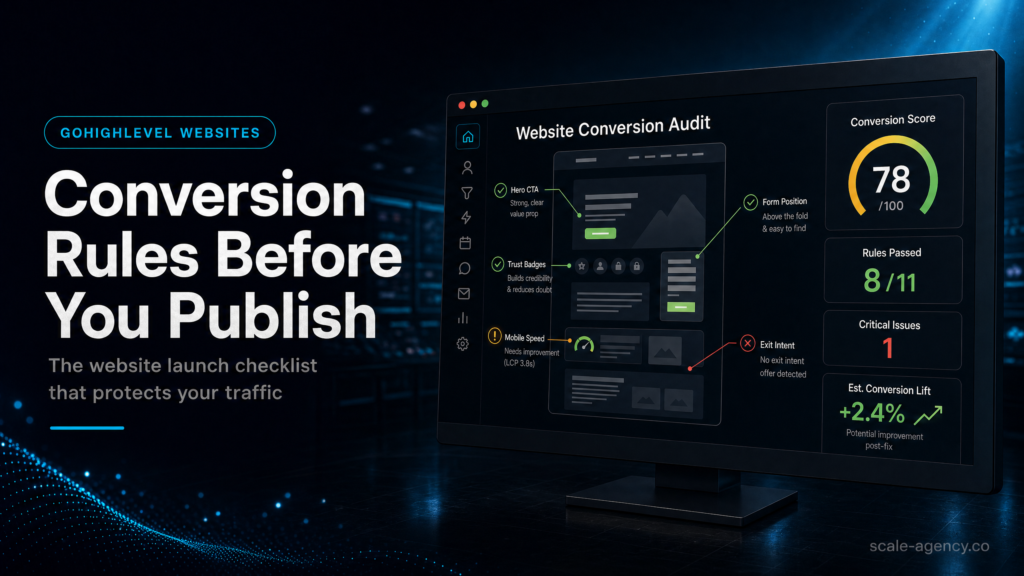
In this guide, we’ll cover:
A pre-publish view of the conversion rules that protect form fills, bookings, lead quality, routing, attribution and speed-to-lead before traffic starts. SCALE builds GoHighLevel CRM, funnel, and automation systems for businesses that need better lead quality, faster follow-up, and clearer attribution.
CTA
Will This Page Create One Clear Action?
A page with too many competing choices makes the visitor decide what matters. Conversion improves when the next step is obvious and commercially aligned.
Forms
Can The Form Route The Right Lead?
The form should collect enough signal to qualify and route the lead without making the visitor abandon the page before submitting.
Speed
Will Follow-Up Start Before Intent Cools?
The best page still loses money if nobody responds quickly. Follow-up needs to trigger immediately with owner assignment and reminders.
Tracking
Can You Prove Which Source Worked?
Every conversion should carry source and campaign data into the CRM so the business can see which pages and channels create pipeline.
GoHighLevel website builder conversion rules matter because a page is only useful if it creates a measurable next step. Before you publish, the page needs one job, one primary CTA, a clean form or calendar handoff, reliable source tracking and follow-up that starts before intent cools.
A page can follow every conversion rule and still lose revenue if broken integrations between the page and CRM delay routing, follow-up or attribution.
A GoHighLevel page is not ready to publish until the CTA, form, CRM, follow-up and tracking have been tested as one journey.
Quick Answer
The most important GoHighLevel website builder conversion rules are: one page, one primary action; a clear above-the-fold promise; forms that reduce friction but capture useful signal; every submit routed into a pipeline; fast follow-up; and source tracking at conversion. Test the full journey before traffic goes live.
TL;DR
- One page should have one primary job, even if secondary links exist lower down.
- The first screen should explain who the page is for, what happens next and why the visitor should care.
- Forms should capture enough qualification data to route the lead without creating unnecessary friction.
- Every form or calendar action should create/update a contact, opportunity, owner and follow-up path.
- UTMs, source fields and page context should be saved at the moment of conversion, not guessed later.
Conversion Rules Decision Table
| Rule | Weak Version | Stronger Version | Metric To Watch |
|---|---|---|---|
| One Primary CTA | Header, hero and body compete with different actions. | One main action above the fold, with secondary actions de-emphasised. | Click-through rate and form start rate. |
| Friction With Signal | Generic contact form or too many unnecessary fields. | Minimal contact fields plus qualification questions that affect routing. | Qualified lead rate and form completion rate. |
| CRM Handoff | Submission creates an email notification only. | Contact, opportunity, owner, stage and follow-up are created automatically. | Time to first response and opportunity creation rate. |
| Source Capture | Ad platform reports clicks, but CRM source is blank. | UTMs and original/latest source fields are written to the contact. | Percentage of leads with populated source fields. |
Rule 1: One Page, One Job
A GoHighLevel page should make one primary action feel obvious. Book a call, request a quote, claim a trial, download a guide or start a challenge. If the page gives equal weight to five different actions, the visitor has to do strategy work before they can act.
The clean rule is simple: primary CTA above the fold, repeated at natural decision points, with secondary actions kept lower or visually lighter. This protects both conversion rate and lead quality because the page is built around one measurable outcome.
Rule 2: The First Screen Must Qualify Fast
The first screen should answer four questions quickly: who is this for, what problem does it solve, what happens next, and why should the visitor trust it? If those answers are missing, traffic bounces or enters the wrong path.
This is especially important for paid traffic. Every vague headline, generic hero and unclear CTA increases the cost of learning. A strong first screen does not need to be clever. It needs to match intent, qualify the right person and make the next step feel safe.
Rule 3: Forms Should Reduce Friction And Increase Signal
Short forms convert more easily, but they can create low-quality conversations if they capture no useful context. Long forms qualify better, but they can suppress conversion if the visitor does not yet trust the offer.
The better approach is minimum viable qualification. Capture contact details, then ask two to four questions that directly affect routing, urgency or sales preparation. If a field does not change the follow-up path, remove it or move it later.
Rule 4: No Orphan Leads
A lead is orphaned when it submits a form but does not create the right contact, opportunity, owner task, pipeline stage and follow-up sequence. This is where attractive pages silently lose revenue.
SCALE builds GoHighLevel CRM, funnel and automation systems for businesses that need better lead quality, faster follow-up and clearer attribution. If your pages convert but sales still complains about missing context, use the GoHighLevel expert checklist before publishing the next page.
Rule 5: Tracking Must Be Captured At Conversion
Source data should not be reconstructed after the fact. UTMs, source, campaign, page, form and offer context should be written when the visitor converts. That gives reporting a stable record before workflows, sales activity or manual edits change the contact.
This is what lets the business decide which campaigns and pages deserve more budget. Without it, the page can generate leads while the team still guesses what worked.
Conclusion
The strongest GoHighLevel website builder conversion rules are not design tricks. They are operating rules that make the page measurable: clear action, useful qualification, clean routing, fast follow-up and source capture.
Before publishing, test the full journey like a customer. Submit the form, book the appointment, check the contact, inspect the opportunity, confirm the owner, trigger the follow-up and review the source fields. If any step fails, the page is not conversion-ready yet.
FAQs
What is the most important GoHighLevel website builder conversion rule?
One page should have one primary job. The headline, CTA, form, calendar and follow-up should all support the same measurable outcome.
Should I use a form or calendar as the main CTA?
Use a calendar when speed-to-conversation matters and the lead is likely ready to talk. Use a form when qualification is needed before a booking should happen.
How do I reduce form friction without lowering lead quality?
Ask only the questions that change routing, urgency or sales preparation. Remove fields that do not affect the follow-up path.
How should tracking work before publishing?
UTMs, source, campaign, page and offer context should write into GoHighLevel at conversion. Test this before sending traffic.
What should I check after a test submission?
Confirm contact creation, opportunity creation, owner assignment, pipeline stage, workflow trigger, notification, source fields and next-step messaging.
