Scroll breakdown
In this guide, we’ll cover:
Ad Reality
Why Facebook ads need more than clicks before they can become reliable growth.
Funnel Fit
Where the landing page turns attention into a qualified lead with one clear next step.
Follow-Up System
How CRM, email, SMS and sales tasks turn interest into booked calls instead of lost leads.
Growth Decision
What to measure before increasing spend: lead quality, speed to lead and booked-call movement.
“Marketing funnel Facebook ads work best when the ad, funnel and follow-up system are built as one revenue journey.”
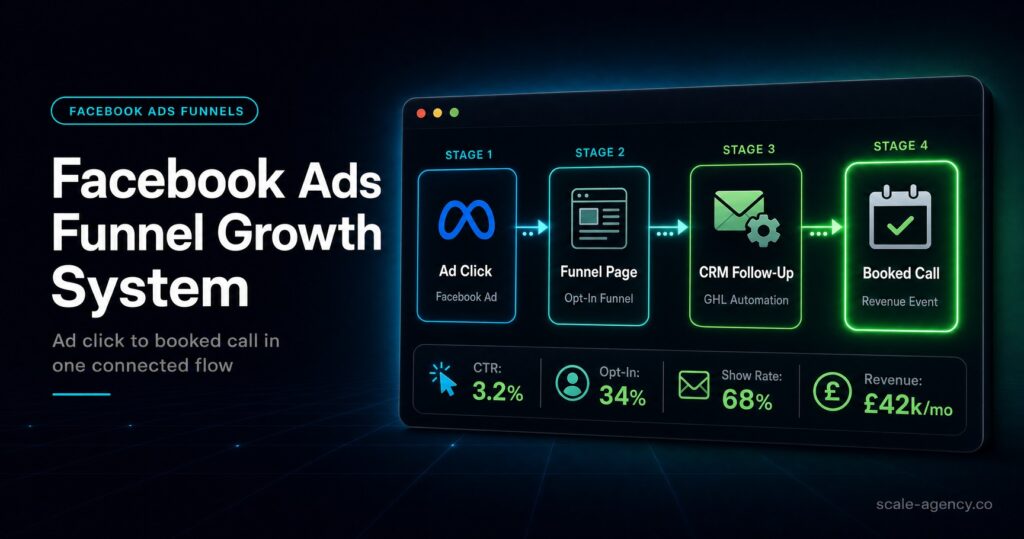
If you are asking whether marketing funnel Facebook ads will help grow your business, the real question is whether your ads have a system behind them. Facebook ads can create attention quickly, but growth usually comes from what happens after the click: the landing page, follow-up, CRM visibility and booked-call process.
SCALE builds GoHighLevel CRM, funnel, and automation systems for businesses that need better lead quality, faster follow-up, and clearer attribution.
If the funnel is already producing leads but follow-up, pipeline ownership or attribution is unclear, use the hire a GoHighLevel expert guide before pushing more budget through the same system.
Used properly, this combination can turn cold traffic into qualified pipeline. Used badly, it can burn budget while making the ads look like the problem.
If you want SCALE to show you where your current ads, funnel and follow-up process are leaking revenue, book a free Growth Systems Audit and we will map the fixes that improve lead quality, speed to lead and booked calls.
For the GoHighLevel side of this, see our guides on Facebook Ads inside GoHighLevel and GoHighLevel Facebook Ads automations.
Why Facebook Ads Need a Funnel to Actually Work
Most businesses make the mistake of treating Facebook ads as a standalone tactic. They run ads directly to a product page or a generic contact form, then wonder why their cost per acquisition is through the roof. The reality is that cold traffic needs nurturing, and that’s exactly what a funnel provides.
Facebook’s audience targeting allows you to reach people who’ve never heard of you. But those people aren’t ready to buy immediately. A proper marketing funnel acknowledges this and builds a journey:
- Top of funnel: Awareness content that educates and attracts
- Middle of funnel: Lead magnets, webinars, or case studies that build trust
- Bottom of funnel: Sales pages, calls, or demos that convert
When you map Facebook ads to each stage, you’re not just hoping for conversions—you’re engineering them.
The Core Components of a Marketing Funnel Facebook Ads Strategy
Building a funnel that works with Facebook ads requires more than just setting up a few campaigns. You need to think about the entire system and how each piece connects.
Audience Segmentation and Targeting
Facebook’s targeting capabilities are powerful, but they’re wasted if you’re showing the same ad to everyone. Your funnel should segment audiences based on awareness level. Cold audiences see educational content. Warm audiences who’ve engaged with your content see lead magnets. Hot audiences who’ve visited your sales page see retargeting ads with urgency or social proof.
Ad Creative Matched to Funnel Stage
Your ad creative must match where someone is in the funnel. Top-of-funnel ads should focus on problems and insights, not your product. Middle-of-funnel ads can introduce your solution and offer something valuable in exchange for contact information. Bottom-of-funnel ads should be direct, benefit-focused, and designed to close.
Landing Pages That Continue the Conversation
The landing page is where most funnels break. If your ad promises one thing and your landing page delivers something else, you’ve lost the prospect. Every landing page in your funnel should have a single, clear objective and match the message and tone of the ad that sent traffic there.
Follow-Up Sequences and Retargeting
Most conversions don’t happen on the first visit. Email sequences, SMS follow-ups, and retargeting ads keep your offer in front of prospects who aren’t ready to buy immediately. This is where automation tools become essential—manually following up with every lead doesn’t scale.
How to Structure Your Marketing Funnel for Facebook Ads
There’s no one-size-fits-all funnel, but there are proven frameworks that work across most industries. Here’s a straightforward structure that balances simplicity with effectiveness:
- Awareness campaign: Run traffic or engagement campaigns to cold audiences with educational content, blog posts, or videos that address a core problem your audience faces.
- Lead generation campaign: Retarget engaged users with a lead magnet—something valuable enough that they’ll exchange their email for it. This could be a guide, checklist, webinar, or free consultation.
- Nurture sequence: Use email and retargeting ads to build trust, share case studies, and demonstrate your expertise over several days or weeks.
- Conversion campaign: Present your core offer to warm leads through a sales page, application funnel, or booking page. Use retargeting ads to bring back visitors who didn’t convert.
- Ascension: Once someone becomes a customer, use email and ads to introduce higher-ticket offers or complementary products.
This structure ensures you’re not asking for the sale too early, and you’re maximizing the value of every person who enters your funnel.
Common Mistakes That Kill Marketing Funnel Facebook Ads Performance
Even with the right structure, execution matters. Here are the mistakes that consistently undermine funnel performance:
Skipping the warm-up stage. Sending cold traffic directly to a sales page rarely works unless you’re selling something extremely low-ticket or impulse-driven. Most businesses need to warm up their audience first.
Not tracking the full funnel. If you’re only looking at cost per click or even cost per lead, you’re missing the bigger picture. What matters is cost per customer and lifetime value. You need tracking set up across the entire funnel to know what’s actually profitable.
Ignoring creative fatigue. Facebook ads lose effectiveness over time as audiences see them repeatedly. You need to refresh creative regularly and test new angles to maintain performance.
Weak offers at each stage. If your lead magnet isn’t compelling, people won’t opt in. If your core offer doesn’t clearly solve a painful problem, they won’t buy. Every stage of your funnel needs a strong, clear offer.
When Marketing Funnel Facebook Ads Make Sense for Your Business
This approach isn’t right for every business at every stage. If you’re still figuring out product-market fit or you don’t have a clear understanding of your customer’s journey, you’re better off starting with organic channels and direct outreach to learn what resonates.
But if you have a proven offer, you understand your customer’s pain points, and you’re ready to scale acquisition, a marketing funnel powered by Facebook ads is one of the most effective growth systems available. It gives you control over your lead flow, predictability in your revenue, and the ability to scale profitably.
Integrating Automation and CRM Systems
A funnel is only as good as the systems behind it. Once leads start flowing in, you need automation to handle follow-up, segmentation, and nurturing without manual work. Platforms like GoHighLevel allow you to build complete funnel systems with landing pages, email sequences, SMS campaigns, and pipeline management all in one place.
This integration is critical because it ensures no leads fall through the cracks and every prospect receives timely, relevant communication based on their behavior. When your Facebook ads feed directly into an automated funnel with proper CRM tracking, you’ve built a true revenue engine.
Measuring What Matters in Your Funnel
Vanity metrics like impressions and clicks don’t pay the bills. To know whether your marketing funnel Facebook ads strategy is working, focus on these metrics:
- Cost per lead: What you’re paying to get someone into your funnel
- Lead-to-customer conversion rate: What percentage of leads actually buy
- Cost per acquisition: Total ad spend divided by customers acquired
- Customer lifetime value: How much revenue each customer generates over time
- Return on ad spend: Revenue generated divided by ad spend
When you track these numbers consistently, you can identify exactly where your funnel is strong and where it’s leaking. That clarity allows you to optimize systematically rather than guessing.
Conclusion
A well-built marketing funnel paired with strategic Facebook ads isn’t just a nice-to-have—it’s a competitive advantage. It transforms unpredictable lead generation into a scalable, measurable system that drives consistent revenue growth. The key is understanding that Facebook ads and funnels aren’t separate tactics—they’re two halves of the same growth engine. When you align your ad strategy with a properly structured funnel, track the right metrics, and continuously optimize based on data, you create a system that can profitably scale your business.
Want to learn more about this?
Watch the video below:
