If you’re running Facebook ads without a structured sales funnel, you’re essentially paying for traffic that leaks out before it converts. A sales funnel for Facebook ads is the system that captures attention, nurtures interest, and converts cold audiences into paying customers—predictably and at scale. When combined with automation platforms like GoHighLevel, this approach transforms sporadic campaigns into a revenue engine that runs on autopilot.
SCALE builds GoHighLevel CRM, funnel, and automation systems for businesses that need better lead quality, faster follow-up, and clearer attribution.
If the automation is meant to run beyond a simple campaign, use the expert GoHighLevel setup guide to check whether capture, routing, follow-up and reporting are ready before scaling ad spend.
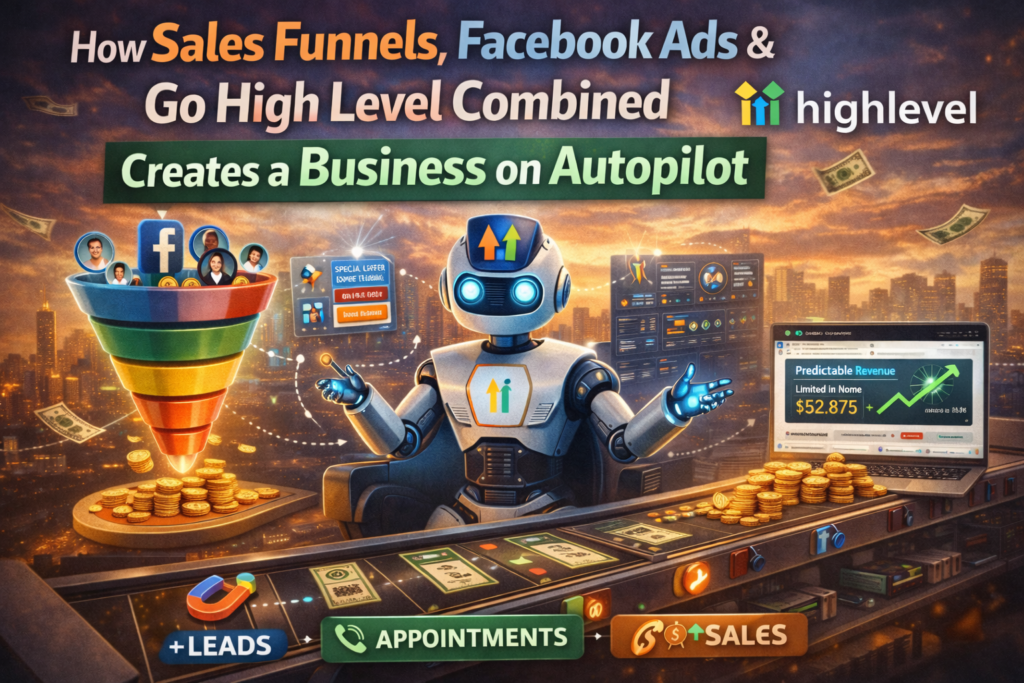
How Sales Funnels, Facebook Ads & Go High Level Combined Creates a Business on Autopilot…
The core challenge most businesses face with Facebook advertising isn’t traffic volume—it’s conversion efficiency. You can drive thousands of clicks, but without a funnel designed to guide prospects through awareness, consideration, and decision stages, most of that spend evaporates. A sales funnel built specifically for Facebook ads addresses this by creating a structured pathway that matches user intent at each stage of the customer journey.
Why Facebook Ads Need a Dedicated Sales Funnel
Facebook traffic is fundamentally different from search traffic. People on Facebook aren’t actively looking for your solution—they’re scrolling, engaging with content, and discovering new things. This means your funnel must do more heavy lifting to warm up cold audiences and build trust before asking for a purchase.
A properly structured sales funnel for Facebook ads typically includes:
- A lead magnet or value-first offer that interrupts the scroll
- A landing page optimized for a single conversion action
- An email or SMS nurture sequence that builds relationship and authority
- A conversion mechanism—whether that’s a sales call, checkout page, or application
- Retargeting campaigns that re-engage users who didn’t convert initially
Without these components working together, you’re relying on immediate conversions from cold traffic, which is both expensive and inefficient.
The Three-Stage Facebook Ad Funnel Framework
The most effective sales funnel Facebook ads strategy mirrors the customer awareness journey: top of funnel (TOFU), middle of funnel (MOFU), and bottom of funnel (BOFU). Each stage requires different creative, messaging, and conversion goals.
Top of Funnel: Awareness and Lead Capture
At this stage, your objective is to introduce your brand and capture contact information. Facebook’s targeting capabilities allow you to reach cold audiences based on interests, behaviors, and demographics. The offer here should be low-friction—a free guide, quiz, webinar registration, or discount code.
Your landing page must be singular in focus. Remove navigation, minimize distractions, and make the value proposition immediately clear. The goal is to exchange something valuable for an email address or phone number, which gives you permission to continue the conversation outside of Facebook’s platform.
Middle of Funnel: Nurture and Education
Once someone enters your funnel, the nurture sequence begins. This is where automation platforms like GoHighLevel become essential. You can trigger email sequences, SMS follow-ups, and even voicemail drops based on user behavior.
The content at this stage should educate, build authority, and address objections. Case studies, testimonials, educational videos, and comparison content work well here. You’re moving prospects from “I’m interested” to “I’m seriously considering this.”
Simultaneously, you should be running retargeting ads on Facebook to people who visited your landing page but didn’t convert, or who engaged with your content but haven’t taken the next step. These ads should reference their previous interaction and present the next logical offer.
Bottom of Funnel: Conversion and Ascension
This is where the sale happens. Your BOFU ads and messaging should be direct and conversion-focused. You’re speaking to warm audiences who understand your offer and are evaluating whether to buy.
Depending on your business model, this could be:
- A direct purchase page for e-commerce or low-ticket offers
- A sales call booking page for high-ticket services
- An application funnel for selective programs or partnerships
- A demo request for software or complex solutions
The key is removing friction. If someone has engaged with your content multiple times and consumed your nurture sequence, the final conversion step should be as simple as possible.
Building Your Sales Funnel Facebook Ads System in GoHighLevel
GoHighLevel consolidates the tools you’d typically need from multiple platforms—landing pages, email automation, SMS, CRM, and pipeline management—into one system. This is particularly valuable for Facebook ad funnels because it allows you to track the entire customer journey from ad click to closed sale without data fragmentation.
When you run Facebook ads into a GoHighLevel funnel, you can:
- Build mobile-responsive landing pages without a developer
- Automatically tag and segment leads based on their source, behavior, and engagement
- Trigger multi-channel follow-up sequences that combine email, SMS, and even ringless voicemail
- Track pipeline stages and conversion rates at each funnel step
- Set up appointment booking that syncs with your calendar and sends automatic reminders
- Create workflows that notify your team when high-intent actions occur
This level of automation means your sales funnel continues working even when you’re not actively managing it. Leads are captured, nurtured, and moved toward conversion without manual intervention.
Optimizing Your Facebook Ad Funnel for Revenue, Not Just Leads
The mistake many businesses make is optimizing for cost per lead rather than cost per acquisition or return on ad spend. A cheaper lead that never converts is worthless. Your funnel optimization should focus on revenue metrics.
Start by tracking conversion rates at each stage. If your landing page converts at 30% but only 2% of leads book a call, the problem isn’t your ad—it’s your nurture sequence or your offer positioning. If 50% of booked calls show up but only 10% close, you need to improve qualification or sales process.
Facebook’s Conversions API, when integrated properly with your funnel platform, allows you to send conversion data back to Facebook. This trains the algorithm to find more people likely to complete your desired action, not just click your ad. Over time, this improves both lead quality and cost efficiency.
Common Sales Funnel Facebook Ads Mistakes to Avoid
Even well-intentioned funnel strategies fail when certain fundamentals are overlooked. Sending traffic to your homepage instead of a dedicated landing page dilutes conversion rates. Asking for too much information upfront creates friction. Failing to retarget engaged users wastes warm traffic.
Another critical mistake is not having a clear monetization path. Your funnel should have an obvious route to revenue, whether that’s immediate purchase, booked consultation, or qualified application. If you’re collecting leads without a systematic way to convert them, you’re building a list, not a business.
Finally, neglecting the speed of follow-up kills conversions. Research consistently shows that response time dramatically impacts conversion rates. Automation solves this—when a lead comes in from your Facebook ad, they should receive immediate confirmation and value, followed by systematic touchpoints that keep your business top of mind.
Scaling Your Funnel Profitably
Once your sales funnel Facebook ads system is converting profitably at a small scale, scaling becomes a matter of increasing budget while maintaining unit economics. This requires monitoring your key metrics: cost per lead, lead-to-customer conversion rate, average customer value, and overall return on ad spend.
As you scale, you’ll need to expand your creative testing, audience segmentation, and offer variations. What works for your first thousand leads may not work for your next ten thousand. Successful scaling means continuously testing new angles while doubling down on what’s proven to work.
The advantage of having your funnel infrastructure in a platform like GoHighLevel is that your automation scales without additional overhead. Whether you’re processing 10 leads per day or 1,000, the nurture sequences, follow-ups, and pipeline management continue functioning without requiring more team members.
GoHighLevel’s Facebook lead ad integration guide is a useful technical reference when you want the automation stack behind this model to run cleanly.
Conclusion
A sales funnel built specifically for Facebook ads is the difference between spending money on traffic and building a predictable revenue system. When you combine strategic funnel design with Facebook’s targeting capabilities and GoHighLevel’s automation infrastructure, you create a business development engine that works continuously—capturing leads, nurturing relationships, and converting customers without constant manual intervention. The businesses that win with paid acquisition aren’t necessarily spending more; they’re converting better through systematic funnel optimisation and intelligent automation.
Want us to set this up for your business?
Book a FREE call with us to see how we can help by visiting: https://scale-agency.co/
Learn more below:
