A strong sales funnel marketing agency creates predictable revenue when the funnel, CRM and follow-up logic all sit inside one operating system. The real edge is not just better pages. It is cleaner attribution, faster automation and fewer gaps between lead capture and close.
SCALE builds GoHighLevel CRM, funnel, and automation systems for businesses that need better lead quality, faster follow-up, and clearer attribution.
When predictable revenue depends on GoHighLevel doing more than hosting pages, a GoHighLevel CRM and funnel expert should map the source, pipeline, automation and attribution path before more campaigns are added.
If you want SCALE to show you where that revenue path is breaking in your business, book a free Growth Systems Audit and we will map the conversion gaps between traffic, nurture and booked calls.
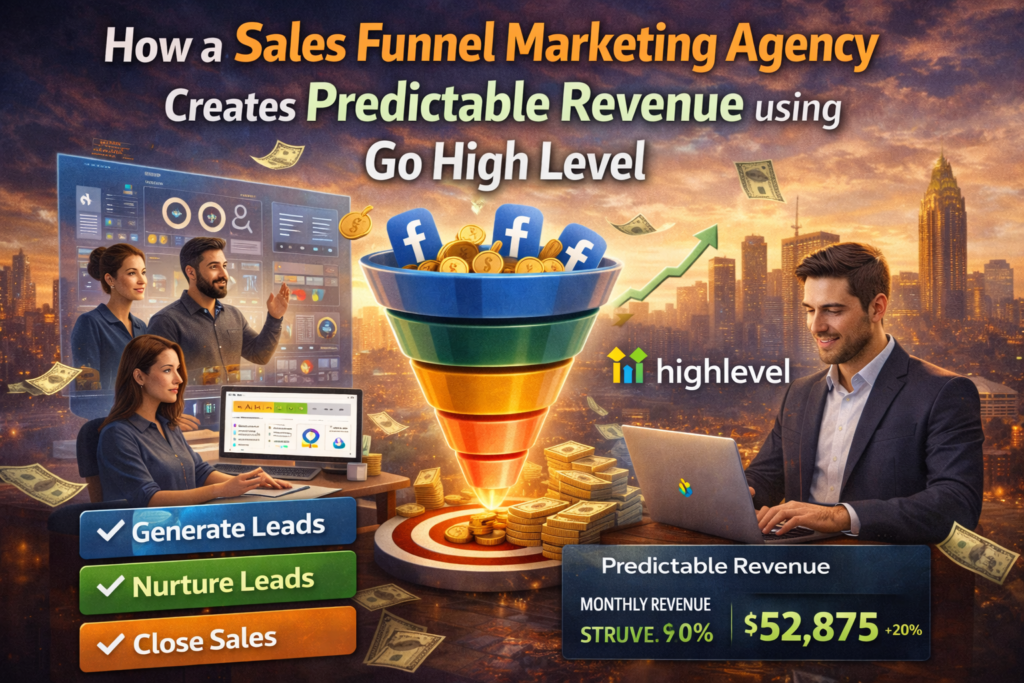
How a Sales Funnel Marketing Agency Creates Predictable Revenue Using GoHighLevel
A sales funnel marketing agency specializes in building end-to-end customer acquisition systems. Unlike generalist marketing firms that spread efforts across brand awareness and content calendars, funnel-focused agencies zero in on one objective: moving prospects through defined stages from awareness to purchase, with every step tracked, tested, and optimized.
The best agencies in this space use platforms like GoHighLevel to centralize the entire funnel operation—landing pages, email sequences, SMS follow-up, pipeline management, and appointment booking—all within one ecosystem. This eliminates the fragmentation that kills conversion rates and makes attribution nearly impossible.
What Separates a Sales Funnel Marketing Agency from Traditional Agencies
Traditional marketing agencies often operate in silos. The SEO team works separately from the paid ads team. The content team doesn’t talk to the CRM specialist. The result is a disjointed customer journey where leads fall through the cracks.
A dedicated sales funnel agency approaches growth differently. Every element of the funnel is designed with the next step in mind. Traffic sources are selected based on conversion potential, not vanity metrics. Landing pages are built to qualify leads, not just collect emails. Follow-up sequences are timed and segmented based on behavior, not arbitrary schedules.
This systems-thinking approach means the agency is accountable to revenue outcomes, not activity metrics. You’re not paying for impressions or clicks in isolation—you’re investing in a machine that produces customers.
Core Components of a High-Performing Sales Funnel
When a sales funnel marketing agency builds a system for you, they’re typically engineering several interconnected layers:
- Traffic acquisition: Paid ads, SEO, partnerships, or outbound—whatever channel delivers qualified prospects at an acceptable cost per acquisition
- Lead capture: Landing pages, lead magnets, and opt-in mechanisms designed to convert cold traffic into identifiable contacts
- Qualification and segmentation: Automated questions, behavior tracking, and tagging systems that route leads based on fit and intent
- Nurture sequences: Email, SMS, and retargeting campaigns that educate, build trust, and move prospects toward a buying decision
- Conversion mechanisms: Sales calls, application funnels, order forms, or trial sign-ups depending on your business model
- Pipeline management: CRM workflows that ensure no lead is ignored and every opportunity is followed up systematically
- Analytics and optimization: Conversion tracking, A/B testing, and regular reporting that identifies bottlenecks and growth levers
Each of these components must work together. A high-converting landing page means nothing if your follow-up sequence is generic. Strong ad creative won’t save a funnel with a broken checkout process. The agency’s job is to ensure every piece is optimized and aligned.
Why GoHighLevel Has Become the Platform of Choice
GoHighLevel has emerged as the preferred infrastructure for sales funnel agencies because it consolidates what used to require five or six separate tools. Instead of stitching together ClickFunnels, Mailchimp, Calendly, Zapier, and a CRM, everything lives in one platform.
This matters for several reasons. First, it reduces technical debt and integration failures. When your landing page, email platform, and CRM are natively connected, data flows seamlessly. Tags applied based on form submissions trigger the right follow-up sequence without manual intervention or API glitches.
Second, it gives the agency complete control over the customer experience. They can build multi-step funnels, set up complex automation rules, manage your sales pipeline, and even handle reputation management—all from a single dashboard. This speed and flexibility means faster iteration and better results.
Third, GoHighLevel is built for agencies managing multiple clients. White-labeling, sub-accounts, and templated funnels allow experienced agencies to deploy proven systems quickly, then customize based on your specific offer and market.
How a Sales Funnel Marketing Agency Approaches a New Engagement
The process typically begins with a deep dive into your current customer acquisition process. A competent agency will ask questions like:
- What does your ideal customer look like, and where do they spend time online?
- What’s your current cost per lead and cost per acquisition across all channels?
- How long is your sales cycle, and what are the common objections or drop-off points?
- What does your existing tech stack look like, and what data do you currently track?
- What’s your capacity to handle new leads, and do you have a sales team or rely on automated conversions?
From there, the agency will map out a funnel strategy tailored to your business model:
- For a high-ticket service business, this might mean a lead magnet funnel that feeds into a qualification call.
- For an e-commerce brand, it could be a product launch sequence with cart abandonment recovery.
- For a SaaS company, a free trial funnel with behavior-triggered onboarding.
Once the strategy is defined, the agency builds the assets, sets up automations and tracking, and launches the first traffic campaigns.
In the first 30 to 60 days, the team gathers data, measures baseline performance, tests headlines, adjusts targeting, refines follow-up sequences, and scales the campaigns that perform best.
What to Look for When Evaluating Agencies
Not all agencies claiming to specialize in funnels actually understand the mechanics of conversion optimization and systems thinking. Here’s what separates the competent from the mediocre:
Technical Fluency with Automation Platforms
Ask whether they build in GoHighLevel, and if so, request examples of workflows they’ve created. A strong agency should be able to walk you through complex automation logic—conditional splits, tagging strategies, multi-channel sequences—without hesitation.
Focus on Metrics That Matter
If an agency leads with traffic numbers or social media followers, that’s a red flag. The conversation should center on conversion rates, cost per acquisition, customer lifetime value, and return on ad spend. They should be able to explain how they’ll track these metrics and what benchmarks to expect.
Experience in Your Market or Business Model
Funnel mechanics vary significantly between industries and sales models. An agency experienced in e-commerce may struggle with lead generation for professional services. Ask for examples of work with similar businesses, and probe how they adapted their approach to different contexts.
Transparent Process and Reporting
You should understand exactly what the agency will build, how long it will take, and what success looks like at each stage. Avoid agencies that promise overnight results or refuse to share detailed reporting. The best partnerships are built on clear expectations and regular communication.
Common Pitfalls and How Agencies Solve Them
Even well-designed funnels can underperform if certain fundamentals are overlooked. Experienced agencies know where things typically break down:
Traffic-offer mismatch: Sending cold traffic directly to a sales page rarely works. The agency should match the level of awareness in your traffic source to the appropriate funnel entry point—educational content for cold audiences, direct offers for warm traffic.
Weak follow-up: Most leads don’t convert immediately. If your funnel lacks a robust nurture sequence, you’re leaving money on the table. Agencies build multi-touch campaigns that stay relevant without being pushy, using a mix of value-driven content and strategic offers.
Leaky handoffs: The transition from marketing to sales is where many funnels fail. Agencies implement lead scoring, automated notifications, and CRM workflows that ensure sales teams engage with hot leads immediately, not three days later.
Ignoring existing customers: The most profitable part of your funnel is often post-purchase. Agencies extend funnel thinking into retention, upsells, and referrals—maximizing lifetime value rather than just focusing on acquisition.
When It Makes Sense to Hire a Sales Funnel Marketing Agency
Not every business needs a full-service funnel agency. If you’re still validating product-market fit or operating on a shoestring budget, a DIY approach or fractional consultant might be more appropriate.
But if you’re generating leads inconsistently, struggling to scale paid acquisition profitably, or losing track of prospects in a tangled mess of spreadsheets and tools, an agency can deliver immediate value. The same applies if you’ve tried building funnels yourself but lack the technical expertise or time to optimize them properly.
The ROI calculation is straightforward: if the agency can improve your conversion rate by even a few percentage points, or reduce your cost per acquisition by 20%, the engagement pays for itself quickly. The real value comes from the compounding effect of a system that continues to perform month after month.
For stronger system context, compare this with sales funnels in digital marketing that stay profitable and what keeps a Facebook sales funnel working long term. Both make it easier to see why predictable revenue comes from the full funnel, not a single tactic.
Conclusion
A sales funnel marketing agency does more than run campaigns—it builds revenue infrastructure. By combining strategic funnel design, automation expertise, and platforms like GoHighLevel, the right agency transforms inconsistent lead flow into a predictable growth system. For businesses ready to move beyond ad-hoc marketing tactics and invest in scalable acquisition, partnering with a specialized agency is one of the highest-leverage decisions you can make.
Want SCALE to build this for your business?
Book a free Growth Systems Audit and we will show you where your funnel, CRM and follow-up system are leaking revenue: https://scale-agency.co/
Learn more below:
