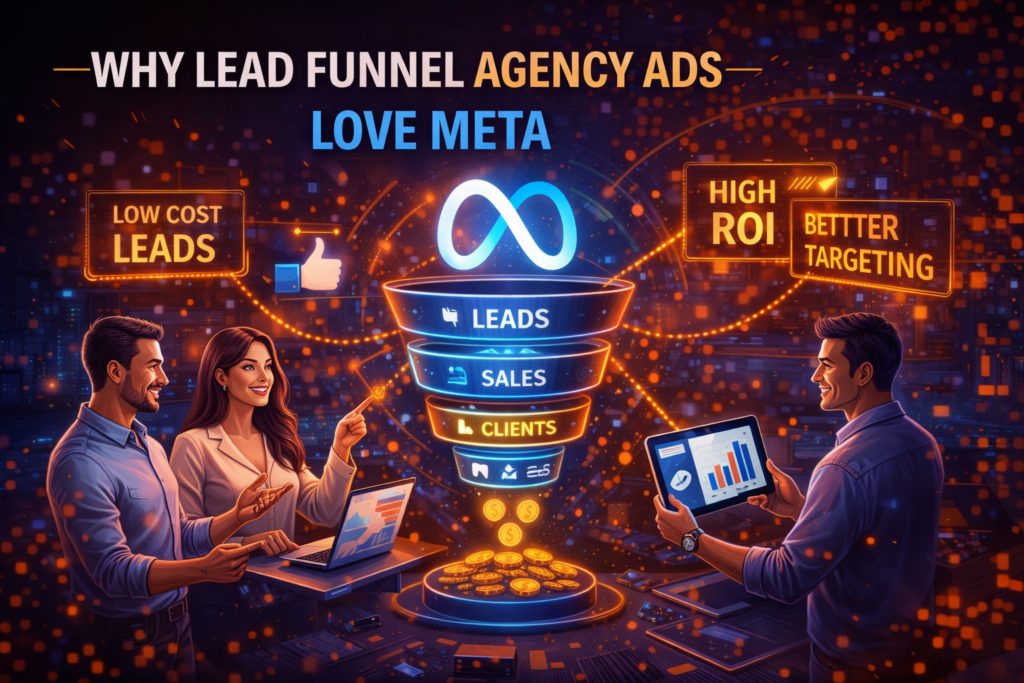
A strong lead funnel agency leans into Meta because the platform creates intent before prospects are actively searching. When the funnel is structured properly, Meta gives you cheap attention at the top, qualified action in the middle and enough signal to keep reducing wasted spend over time.
If you want SCALE to map that acquisition path for your business, book a free Growth Systems Audit and we will show you where your ads, funnel stages and follow-up system are suppressing lead quality.
That is also where the decision to hire a GoHighLevel expert becomes commercial, not technical: Meta can create demand, but the CRM has to capture source, owner, follow-up and revenue outcomes. SCALE builds GoHighLevel CRM, funnel and automation systems for businesses that need better lead quality, faster follow-up and clearer attribution.
What a Lead Funnel Agency Actually Does
A lead funnel agency specializes in building multi-stage conversion systems that guide prospects through awareness, consideration, and decision phases. Unlike traditional marketing agencies that focus on brand awareness or creative campaigns, a lead funnel agency is accountable for measurable outcomes: lead volume, cost per acquisition, and ultimately revenue contribution.
The core deliverables typically include:
- Funnel strategy and mapping based on customer journey analysis
- Landing page design and conversion rate optimization
- Lead magnet creation and offer positioning
- Email and SMS automation sequences
- CRM integration and lead scoring systems
- Paid traffic management across multiple channels
- Analytics setup and performance reporting
The best agencies treat funnels as living systems that require continuous testing, refinement, and scaling rather than one-time projects.
Why Lead Funnel Agencies Favor Meta Platforms
Meta’s advertising ecosystem—Facebook and Instagram—remains the dominant channel for most lead funnel agencies, and for good reason. The platform offers unmatched targeting granularity, native lead form functionality, and cost efficiency at scale.
Meta’s Lead Ads format eliminates friction by allowing users to submit information without leaving the platform. This dramatically improves conversion rates compared to driving cold traffic to external landing pages. For service businesses, B2B companies, and local businesses, this format consistently delivers lower cost per lead while maintaining quality.
The platform’s Advantage+ audience features and machine learning capabilities have also matured significantly. Agencies can now leverage automated targeting that identifies high-intent prospects based on behavioral signals rather than relying solely on demographic targeting. This shift has made Meta particularly effective for businesses with clear offer-market fit but limited audience data.
How to Evaluate a Lead Funnel Agency
Not all agencies claiming funnel expertise actually deliver results. Here’s what to assess during your evaluation process:
- Technical infrastructure: Ask what CRM and automation platforms they use. Agencies working with GoHighLevel, HubSpot, or ActiveCampaign typically have more sophisticated automation capabilities than those relying on basic email tools.
- Attribution and tracking: Confirm they implement proper conversion tracking, UTM parameters, and can demonstrate clear attribution from ad spend to revenue. Agencies that can’t show you their tracking setup will struggle to optimize performance.
- Offer development experience: The best funnel agencies help refine your lead magnet and offer positioning, not just execute what you hand them. Ask for examples of how they’ve improved conversion rates through offer iteration.
- Retention and follow-up systems: Generating leads is only valuable if they’re properly nurtured. Evaluate their approach to email sequences, retargeting, and lead reactivation campaigns.
- Reporting transparency: Request sample dashboards or reports. You should see metrics beyond vanity numbers—cost per qualified lead, lead-to-customer conversion rate, and customer acquisition cost matter more than impressions or clicks.
The Role of Automation in Modern Lead Funnels
Automation separates agencies that deliver scalable systems from those that create manual, high-maintenance processes. Effective lead funnel agencies build automation that handles lead qualification, follow-up sequencing, appointment booking, and sales handoff without requiring constant human intervention.
This includes:
Automated lead scoring that prioritizes prospects based on engagement and fit. When someone downloads a lead magnet, visits your pricing page, and opens three follow-up emails, your system should flag them as high-intent and route them accordingly.
Conditional email and SMS sequences that adapt based on behavior. If a lead clicks on a specific service in your email, subsequent messages should reference that interest rather than sending generic content.
Calendar integration and reminder systems that reduce no-show rates for sales calls. Automated confirmation emails, SMS reminders, and pre-call questionnaires improve show rates and call quality.
The technical execution of these systems requires both marketing automation expertise and strategic thinking about customer psychology and sales process design.
When to Hire a Lead Funnel Agency vs. Building In-House
Building funnel capabilities in-house makes sense when you have consistent volume, clear processes, and can justify full-time specialists in paid media, conversion optimization, and marketing automation. For most businesses under $5M in revenue, this threshold hasn’t been reached.
A lead funnel agency provides immediate access to specialists across multiple disciplines without the overhead of full-time hires. You gain expertise in copywriting, design, paid media buying, analytics, and automation without managing five separate employees.
The financial break-even typically occurs when your monthly ad spend exceeds $20,000-30,000. Below that threshold, agency partnerships usually deliver better ROI than hiring internally. Above it, you may benefit from hybrid models where an agency handles strategy and specialized execution while an internal coordinator manages day-to-day operations.
Common Lead Funnel Agency Mistakes to Avoid
Many businesses hire agencies with impressive portfolios but misaligned expectations. The most common failure points include:
Focusing exclusively on top-of-funnel metrics without addressing conversion bottlenecks further down. An agency might generate 500 leads per month, but if only 2% convert to customers due to poor sales follow-up or weak offer positioning, the funnel isn’t actually working.
Neglecting existing traffic and audience assets. Before scaling paid acquisition, effective agencies audit your organic traffic, email list, and past customers to maximize conversion from warmer audiences first.
Over-complicating funnel architecture. The best funnels are often surprisingly simple—one strong offer, clear messaging, and consistent follow-up outperform elaborate multi-step sequences with weak offers.
Ignoring mobile experience. With 70-80% of Meta traffic coming from mobile devices, agencies that don’t prioritize mobile-first design and fast load times will consistently underperform.
What Working with a Lead Funnel Agency Looks Like
The engagement typically begins with discovery and funnel mapping. The agency should audit your current customer acquisition process, identify conversion gaps, and propose a phased implementation plan.
Initial setup usually takes 3-4 weeks and includes landing page development, automation configuration, tracking implementation, and initial campaign launch. Expect to provide input on messaging, offer details, and sales process requirements during this phase.
Once live, the optimization phase begins. Competent agencies run structured A/B tests on ad creative, landing page elements, and email sequences. They should present performance data weekly or biweekly with clear recommendations for scaling or pivoting based on results.
The relationship works best when you maintain clear communication about sales outcomes. If leads aren’t converting to customers, the agency needs that feedback to adjust targeting, qualification criteria, or messaging upstream in the funnel.
For stronger commercial context, compare this with lead funnel agency secrets that reduce cost per lead and marketing agency sales funnel examples built for booked appointments. That combination makes it easier to see why Meta performs best when the downstream funnel is disciplined.
Conclusion
Choosing a lead funnel agency means selecting a partner who understands that leads only matter when they convert to revenue. The best agencies combine technical execution across paid media, automation, and conversion optimization with strategic thinking about offer positioning and customer journey design. They favor platforms like Meta for their targeting capabilities and lead generation efficiency, but they’re platform-agnostic in service of results. Evaluate potential partners based on their technical infrastructure, attribution capabilities, and ability to build automated systems that scale without proportional increases in manual effort. The right agency doesn’t just generate leads—they build revenue systems that compound over time.
Want SCALE to build this for your business?
Book a free Growth Systems Audit and we will show you where your funnel, CRM and follow-up system are leaking revenue: https://scale-agency.co/
Learn more below:
