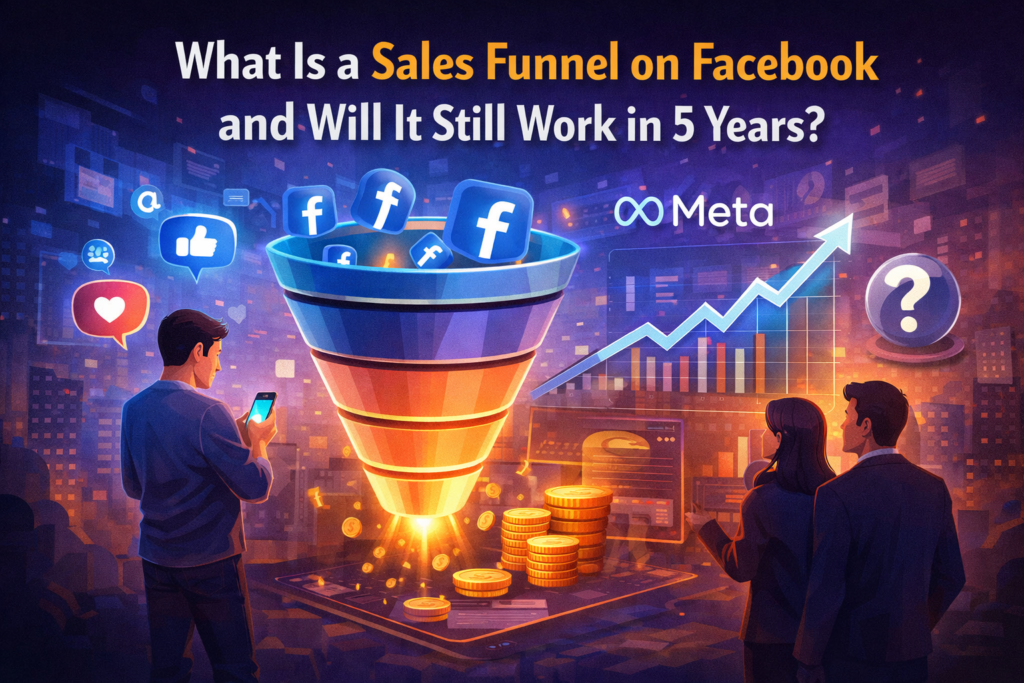
A sales funnel on Facebook still works when it is treated like a full system rather than a single ad play. The real question is whether your Meta traffic is being routed into stronger nurture, better retargeting and clearer conversion logic than the average account.
If you want SCALE to stress-test that funnel for your business, book a free Growth Systems Audit and we will show you where Facebook traffic is leaking before it turns into revenue.
What Is a Sales Funnel on Facebook and Will It Still Work in 5 Years?
A sales funnel on Facebook is a structured sequence of touchpoints designed to move cold audiences from initial awareness through to a purchase decision, all within or originating from the Facebook ecosystem. Unlike a single ad or post, a funnel uses multiple stages—awareness, consideration, conversion—to guide prospects through a journey that matches their readiness to buy.
The funnel typically starts with content designed to capture attention: a video, lead magnet, or educational post. From there, retargeting ads, Messenger sequences, email follow-ups, and landing pages work together to nurture interest and drive conversions. The goal is to create a predictable system that turns ad spend into revenue, not just clicks.
How a Sales Funnel on Facebook Actually Works
Facebook funnels rely on the platform’s targeting and retargeting capabilities. At the top of the funnel, you’re reaching cold traffic—people who don’t know your brand yet. These users might engage with a piece of content, watch a video, or click through to a landing page. Facebook’s pixel and Conversions API track these actions, allowing you to build custom audiences based on behavior.
Once someone enters your funnel, the middle stage focuses on nurturing. This might include retargeting ads that address objections, offer social proof, or provide more detailed information. You can also use Facebook Lead Ads to capture contact information without sending users off-platform, then follow up via email or SMS automation.
The bottom of the funnel is where conversion happens. This could be a direct sale, a booked call, or a demo request. The key is that each stage is intentional, and the messaging evolves based on where the prospect is in their decision-making process.
Key Components of a High-Performing Facebook Sales Funnel
Not all funnels are created equal. The ones that consistently deliver results share a few common elements:
- Clear offer and audience alignment: Your funnel should speak directly to a specific pain point or desire, not try to be everything to everyone.
- Retargeting strategy: Most conversions don’t happen on the first touch. Retargeting ads keep your offer in front of warm audiences who’ve already shown interest.
- Landing pages optimized for conversion: Sending traffic to your homepage or a generic page kills momentum. Every funnel stage should have a dedicated landing page with one clear goal.
- Automation and follow-up: Whether it’s email sequences, Messenger bots, or SMS, automation ensures no lead falls through the cracks.
- Tracking and attribution: Without proper tracking via the Facebook pixel, Conversions API, and a CRM, you’re flying blind. You need to know what’s working and what’s not.
Building a Sales Funnel on Facebook: Step-by-Step
Here’s a practical framework for building a funnel that actually converts:
- Define your offer and target audience. Start with the end in mind. What are you selling, and who is it for? Be specific.
- Create top-of-funnel content. This could be a lead magnet, a short educational video, or a quiz. The goal is to provide value and capture attention.
- Set up your Facebook pixel and Conversions API. This is non-negotiable. Without tracking, you can’t retarget or optimize effectively.
- Build a landing page for each funnel stage. Top-of-funnel pages should focus on capturing leads. Middle and bottom-of-funnel pages should address objections and drive conversions.
- Launch your awareness campaign. Use interest-based targeting or lookalike audiences to reach cold traffic. Test multiple ad creatives and angles.
- Set up retargeting campaigns. Create custom audiences based on engagement, page visits, and lead magnet downloads. Serve ads that move people to the next stage.
- Automate follow-up. Use email sequences, Messenger automation, or SMS to nurture leads who don’t convert immediately.
- Optimize based on data. Review your funnel metrics weekly. Identify drop-off points and test improvements.
Will Facebook Sales Funnels Still Work in 5 Years?
The short answer: yes, but they’ll look different. Facebook—now Meta—has faced significant challenges in recent years. iOS privacy changes, rising ad costs, and increased competition have all made it harder to run profitable campaigns. But the fundamentals of funnel marketing aren’t going anywhere.
What will change is how funnels are built and tracked. First-party data will become even more critical. Businesses that rely solely on Facebook’s tracking will struggle, while those that integrate their CRM, use server-side tracking, and build owned audiences (email, SMS, customer lists) will thrive.
The platform itself will continue to evolve. AI-driven ad targeting is already reducing the need for granular audience segmentation. Advantage+ campaigns and automated placements are shifting control away from advertisers and toward Meta’s algorithms. This means funnels will need to be simpler, with clearer conversion signals and better creative.
Another factor is diversification. Relying solely on Facebook for acquisition is risky. The most resilient funnels integrate multiple channels—Google, YouTube, organic content, referrals—while still using Facebook as a core driver. The funnel concept remains sound; the execution just needs to adapt.
Common Mistakes That Kill Facebook Funnels
Even well-intentioned funnels fail when these mistakes creep in:
- Skipping the nurture stage: Trying to sell immediately to cold traffic rarely works. People need time and trust.
- Weak creative: Your ad is competing with friends, family, and entertainment. If it doesn’t stop the scroll, the funnel never starts.
- Poor tracking setup: If your pixel isn’t firing correctly or your Conversions API isn’t configured, your data is incomplete and your optimization suffers.
- Ignoring mobile experience: Most Facebook users are on mobile. If your landing pages aren’t mobile-optimized, you’re losing conversions.
- No follow-up system: Leads go cold fast. If you’re not following up within minutes to hours, your cost per acquisition will skyrocket.
Integrating Facebook Funnels with Broader Growth Systems
A sales funnel on Facebook shouldn’t exist in isolation. The most effective setups integrate Facebook traffic into a larger growth system that includes CRM automation, email marketing, and multi-channel retargeting.
For example, a lead captured via Facebook Lead Ads can be automatically added to a GoHighLevel CRM, tagged based on their interests, and entered into a nurture sequence that includes email, SMS, and even direct mail. Meanwhile, that same lead is retargeted on Facebook, Instagram, and the broader web via Google Display.
This level of integration ensures that no lead is wasted and that your funnel is resilient to changes on any single platform. It also improves attribution, since you’re tracking the customer journey across multiple touchpoints, not just within Facebook’s walled garden.
Measuring What Matters in Your Facebook Funnel
Vanity metrics like reach and impressions don’t pay the bills. Focus on metrics that tie directly to revenue:
- Cost per lead (CPL): What does it cost to get someone into your funnel?
- Lead-to-customer conversion rate: What percentage of leads actually buy?
- Customer acquisition cost (CAC): Total ad spend divided by number of customers acquired.
- Return on ad spend (ROAS): Revenue generated divided by ad spend. Aim for at least 3:1 to be sustainable.
- Funnel drop-off rates: Where are people leaving? Fixing leaks often has more impact than increasing traffic.
Track these metrics at each stage of the funnel, not just at the end. If your CPL is low but your lead-to-customer rate is terrible, the problem isn’t your ads—it’s your offer, follow-up, or landing page.
For a stronger reference point, compare this with top-of-funnel Facebook ads that convert cold traffic and what a serious sales funnel marketing agency actually optimises. Both show why Facebook still works when the system behind it is sound.
Conclusion
A sales funnel on Facebook remains one of the most effective ways to turn cold audiences into paying customers, but it’s not a set-it-and-forget-it strategy. The platform is evolving, privacy regulations are tightening, and competition is increasing. The funnels that will still work in five years are the ones built on strong fundamentals: clear offers, proper tracking, multi-stage nurture, and integration with broader growth systems. If you’re willing to adapt and treat your funnel as a living system rather than a static campaign, Facebook will continue to be a viable acquisition channel for the foreseeable future.
Want SCALE to build this for your business?
Book a free Growth Systems Audit and we will show you where your funnel, CRM and follow-up system are leaking revenue: https://scale-agency.co/
Learn more below:
