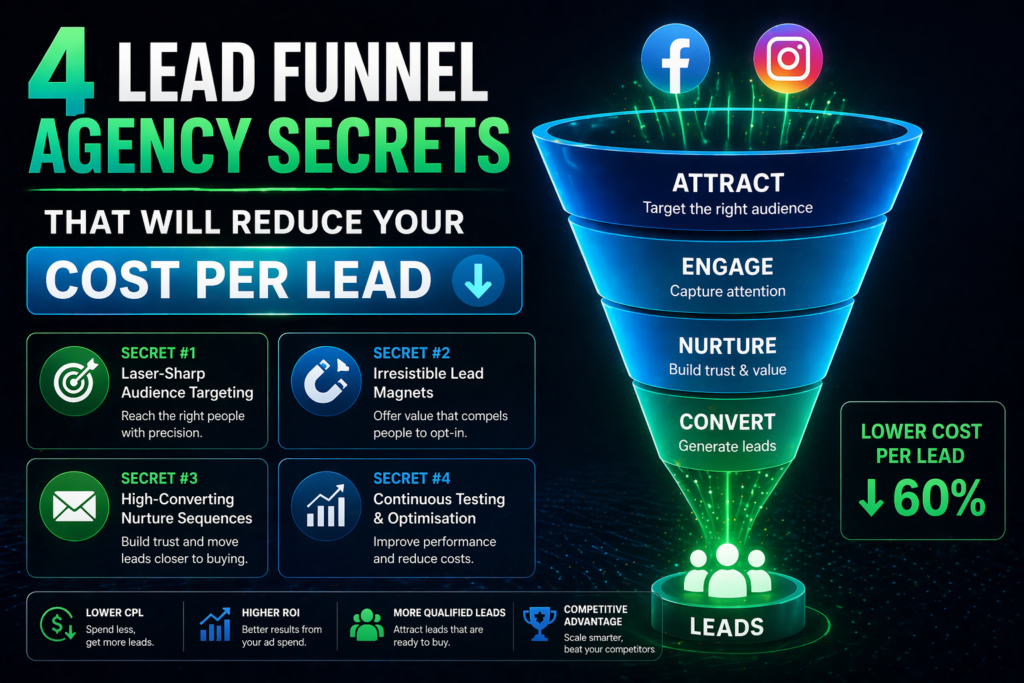
In this guide, we’ll cover:
The practical pieces that decide whether this funnel becomes a useful revenue system or another disconnected marketing asset.
CAPTURE
The Opt-In Is Not The Finish Line
Lead quality is proven after capture, not at the form submit.
AUTOMATION
Unified Systems Stop Leakage
CRM, calendars, nurture and alerts need to trigger in one flow.
QUALITY
Cheap Leads Can Cost More
A higher CPL can win when sales readiness and show rate improve.
ATTRIBUTION
Revenue Decides The Winner
Source data should reveal which leads become pipeline and revenue.
A lower cost per lead only matters when the lead still has enough intent, context and follow-up to become revenue.
Quick Answer
A lead funnel agency reduces cost per lead by improving what happens before and after capture. Better targeting helps, but the larger gains usually come from stronger qualification, faster follow-up, behaviour-based nurture and attribution that shows which leads become revenue.
TL;DR
- Cost per lead is useful only when lead quality is protected.
- Micro-conversions show whether prospects are moving toward sales readiness.
- Unified CRM and automation reduce leakage after opt-in.
- Follow-up speed can change the real cost per qualified lead.
- Attribution should show revenue, not just form fills.
Cost Per Lead Quality Table
| Metric | What weak teams optimise | What strong teams optimise | Why it matters |
|---|---|---|---|
| Cost per lead | Lowest possible form-fill cost | Lowest cost per qualified opportunity | Cheap leads can still be expensive |
| Follow-up | One email after opt-in | Segmented workflow plus sales alert | Speed and relevance improve conversion |
| Attribution | Ad platform lead count | CRM source to revenue | Budget decisions need outcome data |
The best lead funnel agency operators do not just chase cheaper clicks. They reduce cost per lead by improving the full path from attention to qualification, so the account gets more efficient without flooding the pipeline with weak enquiries.
If you want SCALE to pressure-test that path in your business, book a free Growth Systems Audit and we will show you where funnel sequencing, follow-up and offer positioning are inflating acquisition costs.
1. They Architect Funnels Around Micro-Conversions, Not Just Lead Capture
The most common mistake in lead funnel design is treating the opt-in as the finish line. A competent lead funnel agency knows that the quality of a lead is determined by what happens immediately after capture, not before it.
This means building post-opt-in sequences that segment leads based on behaviour, not just demographics. When someone downloads your lead magnet, the next three touchpoints should accomplish specific goals:
- Confirm their specific problem or goal through engagement tracking
- Deliver quick wins that build trust and demonstrate expertise
- Identify buying intent through strategic content consumption patterns
- Route high-intent leads to sales while nurturing others automatically
Agencies that understand this don’t just hand you more leads. They hand you leads that are pre-qualified, pre-educated, and significantly more likely to convert into revenue. This is where cost per lead becomes misleading as a metric. A $50 lead that converts at 20% is vastly more valuable than a $10 lead that converts at 2%.
2. They Build Funnels Inside Platforms That Enable Real Automation
Most businesses are running their funnels across a fragmented stack: landing pages on one platform, email on another, CRM somewhere else, and appointment booking bolted on as an afterthought. Every integration point is a place where leads leak, data gets lost, and attribution becomes impossible.
Agencies that consistently reduce cost per lead build funnels inside unified platforms like GoHighLevel, where the entire customer journey lives in one system. This isn’t about technology for its own sake. It’s about creating closed-loop systems where every action triggers the right next step automatically.
When a lead books a call, the system should automatically tag them, stop irrelevant email sequences, start appointment-specific nurture, send SMS reminders, and notify your sales team with full context. When they don’t show up, re-engagement should be automatic and behaviour-based. This level of orchestration is what turns a 30% show rate into a 70% show rate, which directly impacts your effective cost per qualified lead.
What a Lead Funnel Agency Should Deliver in the First 90 Days
If you’re hiring an agency to build or optimise your lead funnel, you should have clear expectations about deliverables and timeline. Here’s what a competent engagement looks like:
- Funnel audit and conversion analysis – identifying exactly where leads are dropping off and why, with specific recommendations prioritised by potential impact
- Offer and messaging refinement – testing lead magnets, headlines, and value propositions against your actual audience, not generic best practices
- Technical implementation – building the funnel infrastructure with proper tracking, automation, and integration between all systems
- Traffic calibration – running controlled tests to determine which traffic sources deliver the lowest cost per qualified lead, not just the lowest cost per click
- Conversion optimisation – systematic testing of funnel elements based on data, with clear documentation of what works and what doesn’t
Agencies that can’t articulate a clear 90-day plan with measurable milestones are typically operating without a proven methodology. You’re paying them to figure it out on your dime.
3. They Obsess Over Lead Quality Metrics, Not Vanity Metrics
The fastest way to identify an inexperienced lead funnel agency is to ask them what metrics they track. If the conversation stays focused on impressions, clicks, and raw lead volume, you’re talking to someone who doesn’t understand funnel economics.
Agencies that reduce cost per lead track metrics that actually correlate with revenue:
- Cost per qualified lead, not just cost per lead
- Lead-to-opportunity conversion rate by traffic source
- Time to conversion from first touch to closed deal
- Customer acquisition cost relative to lifetime value
- Show rates for booked appointments and next-step actions
This requires proper attribution and CRM integration from day one. If an agency isn’t asking for access to your sales data and closed-loop reporting, they’re optimising in the dark. They might reduce your cost per lead while simultaneously tanking your lead quality, leaving you with a full pipeline of unqualified prospects who will never buy.
4. They Use Paid Traffic to Validate, Then Build Organic Assets
Here’s the secret that most agencies won’t tell you: paid traffic is the fastest way to validate a funnel, but organic traffic is what makes it profitable long-term. The best approach combines both strategically.
A sophisticated agency will use paid acquisition to quickly test offers, messaging, and funnel mechanics. Once they’ve identified what converts, they build organic assets around those proven concepts. This means creating SEO-optimised content that targets the same audience with the same offers that already converted via paid channels.
This approach reduces risk and accelerates results. You’re not waiting six months to see if your SEO strategy works. You’re using paid traffic to prove the concept in weeks, then scaling it through organic channels that reduce your cost per lead over time as traffic compounds.
The agencies that do this well also understand how to use retargeting and nurture sequences to extract maximum value from organic traffic, which typically converts at lower rates on first touch but costs significantly less to acquire.
How to Evaluate a Lead Funnel Agency Before You Hire
When you’re vetting agencies, ask these specific questions:
What’s your process for determining offer-market fit?
If they start talking about their creative process or their experience in your industry, that’s a red flag. The right answer involves testing, data collection, and iteration based on actual audience response.
How do you handle leads that don’t convert immediately?
This reveals whether they understand nurture sequences and long-term funnel economics. Most leads aren’t ready to buy on first contact. Agencies that only focus on immediate conversion are leaving money on the table.
What platforms and tools do you build funnels in?
The answer should reflect an understanding of your business model and scale. There’s no one-size-fits-all solution, but they should be able to articulate why they recommend specific tools based on your needs, not just what they’re comfortable with.
How do you attribute revenue to specific funnel elements?
If they can’t explain their attribution model clearly, they can’t optimise effectively. You need to know which traffic sources, offers, and funnel steps are actually generating revenue, not just activity.
To connect the theory to execution, review why lead funnel agency ads love Meta and marketing agency sales funnel examples built around booked appointments. Both show how lower CPL only matters when the funnel produces sales-ready conversations.
Conclusion
Choosing the right lead funnel agency comes down to finding a partner who understands that reducing cost per lead is not about generating cheaper leads. It is about building systems that attract better-qualified prospects, convert them more efficiently and attribute results accurately.
SCALE’s perspective is that CPL has to be tied to CRM quality. If the business cannot see source, follow-up, appointment status and revenue outcome, the funnel is optimising the wrong number.
FAQs
What does a lead funnel agency do?
A lead funnel agency builds the path from traffic to lead capture, nurture, qualification and booked sales opportunity.
How can a funnel reduce cost per lead?
It can reduce waste by improving targeting, offer clarity, landing-page focus, follow-up speed and lead qualification.
Why is cheap CPL sometimes bad?
Cheap leads often have low intent or poor fit. The better metric is cost per qualified opportunity or cost per closed customer.
Where does GoHighLevel help?
GoHighLevel can connect forms, CRM, automations, reminders and attribution so the funnel can act on leads quickly.
What should SCALE inspect first?
SCALE should inspect source tracking, lead capture, workflow timing, appointment handoff and reporting before changing campaign budgets.
