In this guide, we’ll cover:
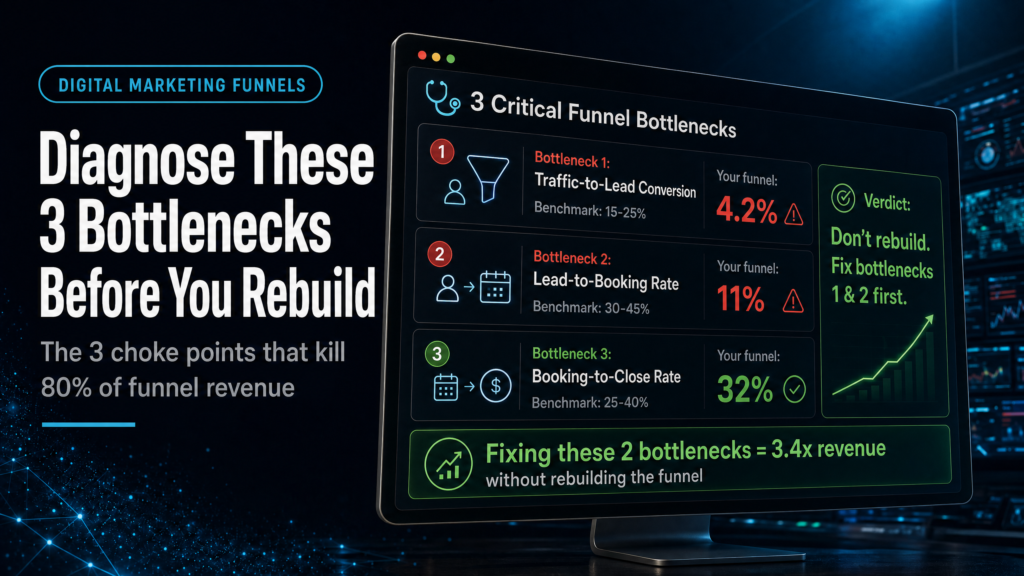
The three bottlenecks to diagnose before rebuilding a funnel: attribution, CRM routing and follow-up speed.
SCALE builds CRM, funnel, automation and reporting systems for businesses that need better lead quality, faster follow-up and clearer revenue visibility.
Find Where Demand Actually Comes From
Why source data and conversion-path tracking should be checked before another page rebuild.
Stop Leads Going To The Wrong Place
How owner assignment, pipeline stages and qualification fields stop good enquiries getting buried.
Reduce The Gap Between Enquiry And Reply
Why response speed, reminders and stop conditions often recover more revenue than new traffic.
Rebuild Only After The Leak Is Proven
How to decide whether the visible page, backend system or sales handoff deserves the next fix.
“Rebuilding the page is expensive when the leak is actually in the handoff after the form.”
If the leak starts before the CRM handoff, use the agency funnels that remove sales pressure breakdown to check whether the page should qualify, educate or route leads differently before you rebuild it.
Quick Answer
The three funnel optimization agency bottlenecks to diagnose before a rebuild are attribution gaps, CRM routing gaps and slow follow-up. If those are weak, a new page can still send good leads into a broken revenue path.
Start by checking whether every lead keeps its source, reaches the right CRM stage, triggers the right owner and receives a fast next step. Rebuild the page only when the evidence shows the visible funnel is the real constraint.
TL;DR
- Do not rebuild the funnel until you know whether the leak is attribution, CRM routing or follow-up.
- Missing source data makes it impossible to see which traffic creates pipeline.
- Poor CRM routing loses revenue after the form, even when the page converts.
- Slow follow-up reduces booked calls and makes paid demand less profitable.
- SCALE fixes the full revenue path: funnel, CRM, automations, calendar handoff and reporting.
Bottleneck Diagnosis Table
| Bottleneck | What It Looks Like | Fix Before Rebuild | Metric To Watch |
|---|---|---|---|
| Attribution gap | The team cannot connect source, page, lead, booked call and revenue. | Preserve source data through forms, CRM stages, calendar bookings and opportunity records. | Source completeness, revenue by source. |
| CRM routing gap | Leads arrive but lack owner, status, qualification or next action. | Assign owner, stage, source, qualification and task rules as soon as the lead enters. | Qualified lead rate, stage movement. |
| Follow-up gap | High-intent enquiries wait too long or receive generic messages. | Use speed-to-lead alerts, SMS/email follow-up, booking prompts and stop conditions. | First response time, booked-call rate. |
| Booking gap | Leads show intent but do not book or do not attend. | Tighten confirmation pages, reminders, calendar routing and no-show recovery. | Booking rate, show rate. |
| Page gap | Traffic is qualified but the offer, proof or next step is unclear. | Improve first-screen promise, proof, qualification and call-to-action clarity. | Conversion rate, qualified booked calls. |
Bottleneck 1: You Cannot See Where Leads Came From
The first bottleneck is usually attribution. If source, campaign, page and CRM outcome do not stay connected, you cannot tell whether the funnel needs more traffic, a better offer, a cleaner booking path or stronger follow-up.
A funnel optimization agency should check whether every lead carries useful source data through the form, CRM, calendar, opportunity stage and revenue report. Without that path, the next rebuild will be based on opinion.
Bottleneck 2: CRM Routing Breaks After The Form
The second bottleneck appears after lead capture. A visitor fills in the form, but the CRM record lacks the right owner, stage, qualification or next action. The page technically converted, but the revenue path immediately weakened.
For GoHighLevel builds, routing should assign the lead, preserve source data, place the opportunity in the correct pipeline, trigger the right task and start the correct follow-up. If that does not happen, rebuilding the page will not fix the leak.
Bottleneck 3: Follow-Up Is Too Slow Or Too Generic
The third bottleneck is speed-to-lead. High-intent enquiries decay quickly when nobody responds, when the next action is unclear or when the follow-up is generic. The fastest win is often reducing the time between enquiry and meaningful reply.
Strong follow-up uses alerts, tasks, SMS/email, reminders, stop conditions and booking prompts. It should make the next action obvious for the prospect and visible for the team.
When To Rebuild The Page Instead
A rebuild makes sense when the traffic is qualified, CRM routing is clean, follow-up is fast and attribution proves the visible page is the constraint. That may show up as weak form completion, unclear offer-message match or poor first-screen proof.
Until then, the safer move is diagnosis. Fix the bottleneck closest to revenue before paying for a bigger design or copy rebuild.
Use A Diagnosis Sprint Before A Rebuild
A practical diagnosis sprint checks source tracking, form fields, CRM stage, owner assignment, workflow triggers, calendar handoff, reminder logic and revenue reporting. That creates a short evidence list of what should be repaired first.
SCALE uses this approach because the fastest recovery is often inside the system the buyer enters after the form. When those handoffs work, page-level improvements become easier to measure and more likely to create revenue.
Conclusion
A funnel optimization agency should diagnose bottlenecks before recommending a rebuild. The most common leaks are not always visible on the page. They often sit in attribution, CRM routing, follow-up, booking flow and revenue reporting.
Start with the full path from source to booked call. If that path is broken, fix the handoff. If it is clean and the page is still underperforming, then rebuild with evidence.
FAQs
What are the main funnel optimization agency bottlenecks?
The main bottlenecks are attribution gaps, CRM routing gaps, slow follow-up, weak booking flow and unclear page-level offer messaging. The right order depends on where the revenue path breaks.
Should I rebuild my funnel first?
Not until the full path is diagnosed. If leads lose source data, reach the wrong CRM stage or wait too long for follow-up, a page rebuild may not solve the revenue problem.
How do CRM bottlenecks hurt funnel performance?
CRM bottlenecks hurt performance when leads lack owner, stage, qualification, next action or source data. That creates slow follow-up and weak reporting even if the page converts.
What should a funnel optimization agency measure?
Measure source completeness, qualified lead rate, first response time, booked-call rate, show rate, pipeline value and revenue by source. Page conversion rate should be tied to those outcomes.
How does SCALE diagnose funnel bottlenecks?
SCALE maps the funnel, GoHighLevel CRM structure, automations, lead follow-up, calendar flow and attribution. The goal is to find the handoff closest to revenue before rebuilding the visible page.
