If you run a digital marketing agency, you already know that selling your services is fundamentally different from selling products. A well-designed sales funnel for digital marketing agency operations isn’t just about lead capture—it’s about demonstrating expertise, building trust over multiple touchpoints, and converting high-value clients who need proof before they commit. The agencies that consistently win aren’t just good at marketing for clients; they’ve built systematic funnels that position them as the obvious choice.
If the funnel system needs to connect landing pages, forms, calendars, CRM stages and nurture, use this sales funnel agency support checklist first, then use the SCALE GoHighLevel expert checklist before rebuilding the stack.
Why Most Agency Funnels Fail Before They Start
Most digital marketing agencies approach their own sales process the same way they approach client work: tactically. They run ads, collect leads, and hope someone books a call. But agency sales cycles are longer, involve multiple stakeholders, and require significant trust. A single landing page and a calendar link won’t cut it.
The agencies that scale predictably treat their funnel as a qualification and education system, not just a lead generation machine. They understand that the goal isn’t to get every visitor on a call—it’s to get the right visitors educated, pre-sold, and ready to buy before the first conversation happens.
The Core Structure of a High-Converting Sales Funnel for Digital Marketing Agency Growth
A revenue-focused agency funnel has three distinct stages, each with a specific job to do:
Stage 1: Awareness and Authority
This is where most prospects first encounter your agency. They’re not ready to buy, but they’re researching solutions, comparing approaches, or trying to understand what’s possible. Your funnel needs to capture attention and establish credibility fast.
Top-performing agencies use a combination of organic content, paid traffic, and strategic lead magnets. The key is specificity. Instead of offering a generic “marketing audit,” offer something that speaks directly to a known pain point: a funnel teardown for SaaS companies, a paid acquisition blueprint for e-commerce brands, or a revenue diagnostic for service businesses.
Stage 2: Consideration and Qualification
Once someone enters your ecosystem, the funnel’s job shifts to education and filtering. You want to answer objections, showcase your methodology, and make it clear who you work with and who you don’t.
This stage typically includes:
- Email sequences that explain your process and philosophy
- Case breakdowns or strategy walkthroughs that demonstrate how you think
- Qualification mechanisms like application forms or self-assessment tools
- Retargeting that reinforces your positioning across multiple channels
The best agency funnels don’t try to convince everyone. They use this stage to repel bad-fit prospects and attract ideal clients who already align with your approach.
Stage 3: Conversion and Commitment
By the time someone reaches this stage, they should already understand what you do, how you do it, and whether they’re a fit. The final conversion point—whether it’s a strategy call, proposal review, or direct booking—should feel like a natural next step, not a hard sell.
High-ticket agency offers benefit from adding friction here. Application forms, minimum budget requirements, and pre-call questionnaires all serve to increase perceived value and ensure sales conversations are productive.
Building Your Agency Funnel: The Step-by-Step Sequence
Here’s how to structure a practical, scalable funnel that works for agencies selling services in the $3k–$50k+ range:
- Traffic source: Paid ads, SEO content, partnerships, or outbound—choose based on where your ideal clients actually spend time and what your agency can execute consistently.
- Lead magnet or entry offer: A high-value resource that requires an email but delivers immediate insight. This should showcase your methodology, not just collect contacts.
- Indoctrination sequence: A series of 5–7 emails that explain your philosophy, introduce your process, share relevant examples, and set expectations for how you work.
- Qualification step: An application, survey, or self-assessment that segments leads by fit and readiness. This is where you separate tire-kickers from serious buyers.
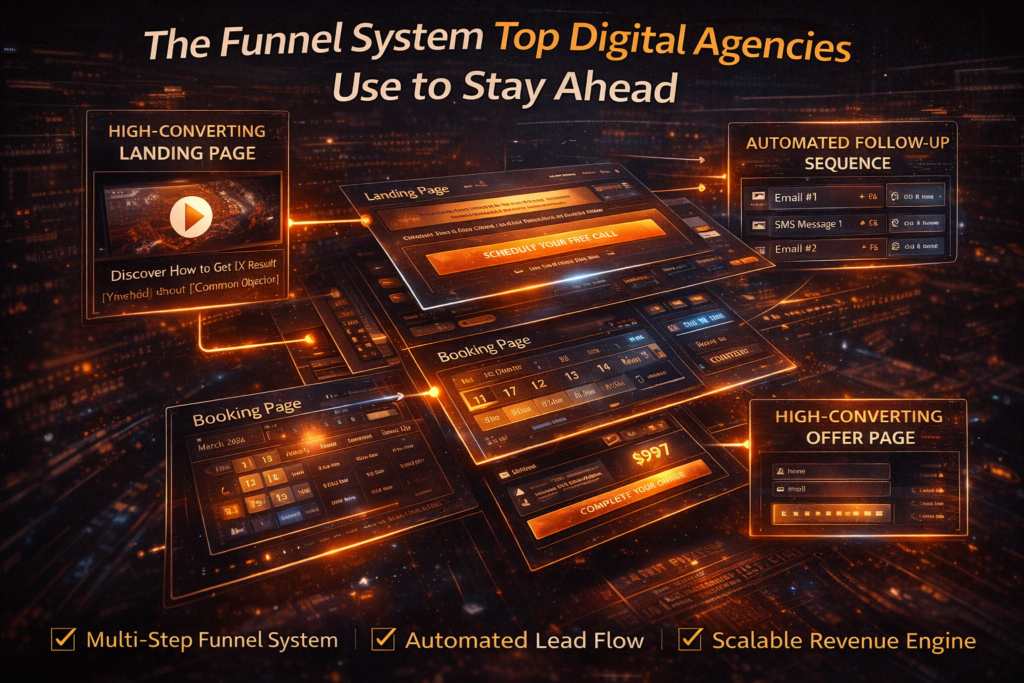
- Conversion mechanism: A strategy call, workshop, or audit that positions your agency as the solution and transitions naturally into a proposal or agreement.
- Onboarding and delivery: The funnel doesn’t end at the sale. A smooth onboarding process reduces buyer’s remorse and sets up long-term retention.
Automation and Tools That Make Agency Funnels Scalable
Manual follow-up doesn’t scale, and neither does a funnel held together with five different platforms. The agencies that grow without adding headcount use integrated systems that handle lead capture, nurture, qualification, and booking automatically.
Platforms like GoHighLevel are purpose-built for this. You can run the entire funnel—landing pages, email sequences, SMS follow-up, booking calendars, CRM, and pipeline management—inside one system. This eliminates integration headaches and gives you full visibility into where leads drop off and which sources convert best.
Automation should handle repetitive tasks: sending nurture emails, tagging leads based on behavior, triggering follow-ups when someone doesn’t book, and moving prospects through your pipeline. But it shouldn’t replace strategy. The content, positioning, and offer still need to be sharp.
What Separates a Good Funnel from a Revenue Engine
A good funnel generates leads. A great funnel generates qualified opportunities. But a true revenue engine does something more: it creates leverage.
The difference comes down to a few key elements:
- Clear positioning: Your funnel should make it obvious who you serve and what transformation you deliver. Generalist messaging attracts generalist inquiries.
- Value before the sale: Prospects should leave your funnel better informed even if they don’t buy. This builds trust and referrals.
- Data-driven iteration: Track conversion rates at every stage. Know your cost per lead, lead-to-call rate, call-to-close rate, and customer lifetime value. Optimize the biggest leaks first.
- Scalable acquisition: Your funnel should work with paid traffic, not just organic. If you can’t profitably buy attention, growth will always be slow.
Common Mistakes That Kill Agency Funnel Performance
Even well-designed funnels fail when execution is off. Here are the most common issues:
Trying to sell too early. If your funnel pushes for a call before establishing any credibility, expect low show rates and unqualified leads. Build trust first.
Ignoring follow-up. Most agency leads don’t convert on the first touch. If you’re not running retargeting, email sequences, and multi-channel follow-up, you’re leaving money on the table.
Weak offers. A “free consultation” isn’t compelling. Frame your conversion step as valuable in itself—a strategy session, a funnel audit, a revenue diagnostic. Make people want to qualify.
No qualification. If you’re taking calls with anyone who books, you’re wasting time. Use forms, minimum budget questions, or intake surveys to filter before the calendar.
How to Measure Whether Your Sales Funnel for Digital Marketing Agency Is Actually Working
Metrics matter, but only if you’re tracking the right ones. Vanity metrics like traffic and email list size don’t pay the bills. Focus on these:
- Cost per qualified lead: What does it cost to get someone into your funnel who actually fits your ideal client profile?
- Lead-to-call conversion rate: What percentage of leads book a sales conversation?
- Call-to-close rate: How many calls turn into signed clients?
- Customer acquisition cost (CAC): Total marketing and sales cost divided by new clients.
- Lifetime value (LTV): Average revenue per client over the entire relationship.
If your LTV is at least 3x your CAC, your funnel is healthy. If it’s lower, you either need to increase pricing, improve retention, or reduce acquisition costs.
HubSpot’s conversion funnel breakdown is a useful external reference if you want to compare this agency model against a more conventional funnel framework.
Conclusion
A sales funnel for digital marketing agency growth isn’t a one-time build—it’s a system that evolves as you learn what resonates with your market. The agencies that win long-term don’t just have a funnel; they have a repeatable process for attracting the right leads, educating them efficiently, and converting them predictably. Focus on clarity, qualification, and value at every stage, and your funnel becomes the most valuable asset your agency owns.
Want us to set this up for your business?
Book a FREE call with us to see how we can help by visiting: https://scale-agency.co/
Learn more below:
