
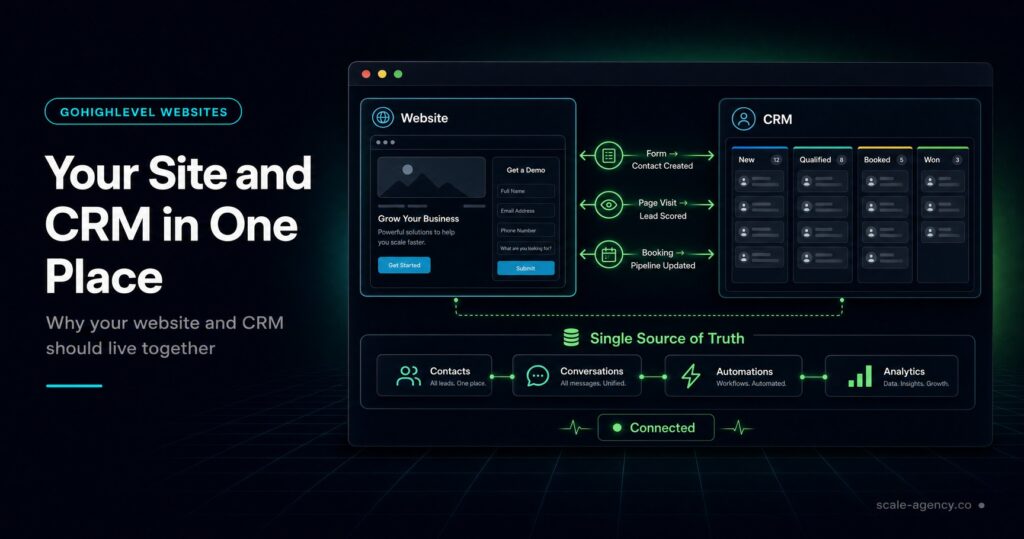
In this guide, we’ll cover:
A system-of-record view of how GoHighLevel and WordPress should divide the work when websites, funnels, CRM, forms, automation and reporting all affect revenue. SCALE builds GoHighLevel CRM, funnel, and automation systems for businesses that need better lead quality, faster follow-up, and clearer attribution.
Cost
What Is The Real Cost Of Staying Split?
The page builder is rarely the expensive part. The leak usually appears when forms, calendars, CRM stages and source fields do not agree on what happened to the lead.
Ownership
Which System Should Own The Lead?
One platform needs to own contact creation, pipeline stage, source fields and follow-up. Without that owner, every report becomes a negotiation.
SEO
Where Does WordPress Still Win?
WordPress can still be the stronger content engine when editorial scale, index control and plugin flexibility matter more than page-to-pipeline speed.
Conversion
When Should GoHighLevel Take Over?
GoHighLevel should control capture, qualification, booking, reminders and reporting when speed-to-lead and revenue visibility decide the outcome.
Most GoHighLevel website vs WordPress comparisons stop at design freedom, plugins and SEO settings. That misses the commercial issue. The real cost of staying split is what happens after someone becomes a lead: whether source data is captured, whether the right owner follows up, whether the pipeline shows reality, and whether revenue can be attributed.
Before moving a live lead path into GHL, use the GoHighLevel website builder conversion rules checklist to verify the CTA, form, routing and tracking logic that decides whether the page can convert.
The GoHighLevel website vs WordPress decision is not about which builder looks better. It is about which system protects the lead after the click.
Quick Answer
In the GoHighLevel website vs WordPress decision, use WordPress when SEO publishing and content flexibility are the main growth engine. Use GoHighLevel when the page must connect directly to CRM, forms, calendars, automation, follow-up and revenue reporting. The safest setup is one clear system of record for leads.
TL;DR
- WordPress can remain valuable for SEO-led content, editorial workflows and large information architectures.
- GoHighLevel is usually stronger for landing pages, forms, calendars, pipeline ownership, automation and speed-to-lead.
- The expensive mistake is splitting lead capture across plugins, inboxes, calendars and CRM records without one source of truth.
- If you keep WordPress, route forms and conversion actions into GoHighLevel with strict UTM and source capture.
- SCALE treats websites, funnels, CRM and automation as one revenue system, not separate build decisions.
Website Platform Decision Table
| Build Path | Best Fit | Main Risk | When To Choose It |
|---|---|---|---|
| WordPress-led site | SEO-heavy businesses with frequent publishing, flexible content types and strong editorial needs. | Lead capture can drift into plugins, inboxes and disconnected forms if CRM ownership is weak. | Choose it when organic content is the growth engine and every conversion still routes into GoHighLevel. |
| GoHighLevel-led website | Businesses where paid traffic, booked calls, speed-to-lead and follow-up matter more than complex content publishing. | SEO flexibility and advanced editorial control can be thinner than a mature WordPress setup. | Choose it when the page is a conversion asset that must create pipeline immediately. |
| Hybrid WordPress + GoHighLevel | Teams that need WordPress for content and GoHighLevel for CRM, funnels, calendars and automation. | Split ownership creates attribution gaps unless the integration is designed properly. | Choose it when WordPress owns content and GoHighLevel owns leads, stages, follow-up and reporting. |
The Real Cost Of Staying Split
The visible cost of a split setup is usually small: a WordPress host, a page plugin, a form plugin, a calendar tool and a GoHighLevel account. The hidden cost appears when those tools disagree. A form submission might create an email notification but no opportunity. A booking might bypass the original UTM. A sales rep might follow up without knowing which campaign, page or offer created the enquiry.
That is why the decision should start with lead ownership. If a visitor converts on WordPress, GoHighLevel still needs to receive the source, contact record, pipeline stage, owner assignment and follow-up trigger. Otherwise, the business is paying for a website and a CRM without getting a dependable revenue system.
Use System Of Record As The Decision Rule
A system of record is the place the business trusts when it wants to answer a revenue question. For leads, that usually means GoHighLevel. It should know who converted, where they came from, which offer they requested, who owns the follow-up, what stage they are in and what happened next.
WordPress can still own long-form content and organic discovery. But it should not quietly own the lead record if the sales process runs in GoHighLevel. The clean model is simple: WordPress attracts and educates; GoHighLevel captures, follows up, attributes and reports.
Where WordPress Still Deserves A Place
WordPress still makes sense when a business publishes frequently, needs advanced content structures, depends on SEO plugins, or has a large existing library that already ranks. Rebuilding that whole content surface inside GoHighLevel without a migration plan can create unnecessary SEO risk.
The stronger hybrid approach is to preserve the content engine while cleaning the conversion handoff. High-intent pages can push into GoHighLevel forms, surveys, calendars or landing pages. Source fields should persist from the first click to the pipeline, so organic and paid leads can be compared properly.
Where GoHighLevel Should Take Control
GoHighLevel should take control when the page is built to produce booked calls, quote requests, consultations, trials or follow-up sequences. That is where forms, calendars, SMS, email, call tasks, pipeline stages and attribution need to work together.
SCALE builds GoHighLevel CRM, funnel and automation systems for businesses that need better lead quality, faster follow-up and clearer attribution. If the website is generating leads but the team cannot see source, owner, stage and outcome, the platform decision is already affecting revenue.
Conclusion
GoHighLevel website vs WordPress is the wrong question if it only compares builders. The better question is which system should own content, which system should own conversion, and how lead data moves between them without breaking.
For many businesses, the best answer is not a full rebuild. It is a clean operating rule: WordPress can keep doing SEO and content work while GoHighLevel owns forms, calendars, pipeline, automation, source data and reporting. That gives the business the benefit of both platforms without letting leads disappear between them.
FAQs
Is GoHighLevel or WordPress better for SEO?
WordPress is usually stronger for large-scale SEO publishing, plugin flexibility and editorial control. GoHighLevel can still rank pages, but it is usually chosen for connected funnels, CRM and automation rather than pure content operations.
Can I keep WordPress and use GoHighLevel for CRM?
Yes. Keep WordPress for content if it already supports SEO, then route forms, calendars and conversion events into GoHighLevel with proper source capture and pipeline creation.
What is the biggest risk of a split WordPress and GoHighLevel setup?
The biggest risk is lead leakage. Forms, calendars and CRM records can drift apart, which creates slow follow-up, missing source data and unreliable reporting.
When should I rebuild pages inside GoHighLevel?
Rebuild high-intent landing pages inside GoHighLevel when the goal is booked calls, quote requests, trials or fast follow-up. Keep content-heavy SEO pages on WordPress when they already perform.
How should I compare the real cost?
Compare missed leads, response speed, manual admin, attribution gaps, duplicate contacts and sales visibility. Those costs usually matter more than the monthly platform bill.
