In this guide, we’ll cover:
Is The Website Designed To Make A Buyer Move?
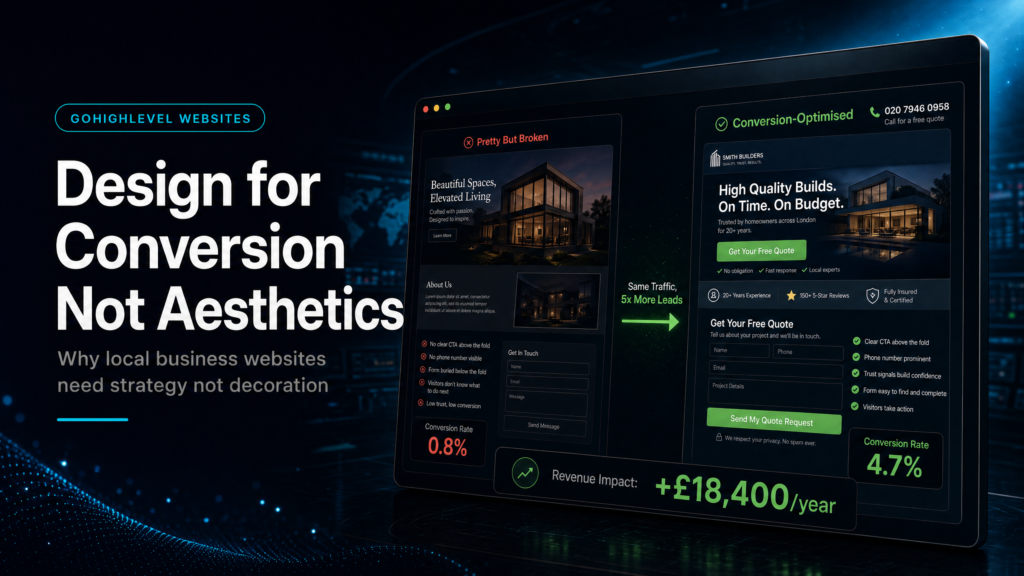
A local business website should do more than look clean. It should make the next step obvious, measurable and easy to complete.
For a cost angle, compare this with GoHighLevel website examples that cut software spend so the design decision also protects the software stack, CRM handoff and attribution path.
When a local-business page is close to launch, check the conversion rules before you publish so the design, form, CRM stage and follow-up path all support the same revenue action.
What Happens When A Visitor Raises Their Hand?
Forms, calls and bookings need to push into the CRM with source data intact, otherwise the page cannot prove which channel created demand.
Can The Business Respond Before The Lead Cools?
Conversion design includes the moments after submission: notifications, owner assignment, reminders and recovery when prospects do not book.
When Is GoHighLevel Better Than A Pretty Site?
GoHighLevel becomes the better local-business website choice when revenue depends on routing, follow-up and CRM visibility as much as design.
A better GoHighLevel build is not just cleaner software. It is a cleaner path from click to conversation to revenue.
Quick Answer
A GoHighLevel website for local business should be designed around conversion, not only aesthetics. The strongest setup connects pages, forms, calls, bookings, CRM stages, follow-up and attribution so the business can see which visits become conversations, opportunities and revenue.
TL;DR
- A local business website should make the next action clear: call, book, request pricing or submit a form.
- GoHighLevel is useful when the website needs CRM, booking, follow-up and reporting in the same operating system.
- Design still matters, but conversion design means page structure plus lead handling.
- The biggest leaks are usually slow response, unclear ownership and missing source data.
- Use GoHighLevel when the site has to support sales activity, not just online presence.
Local Business Website Decision Table
| Website Route | Best Fit | Conversion Risk | When To Choose It |
|---|---|---|---|
| Design-Only Website | Brand presence with low inbound lead volume | Looks good but does not manage follow-up | Choose it only when the website does not need CRM or booking workflows. |
| GoHighLevel Website | Service businesses that need calls, forms, booking and follow-up | Weak if pages are copied without conversion planning | Choose it when every enquiry needs routing, reminders and source tracking. |
| SCALE Conversion Build | Local businesses using paid traffic or high-value leads | Underbuilding attribution and pipeline ownership | Choose it when missed leads, no-shows or unclear reporting are already costing revenue. |

Related Read
For the wider platform decision, compare this with the GoHighLevel website builder vs ClickFunnels guide.
Why Local Business Website Design Has To Start With Conversion
Most local business websites are judged too heavily on appearance. A clean page matters, but it does not guarantee a booked call, qualified form submission or followed-up lead.
Conversion design starts with the action the visitor should take. Then it works backward into page layout, proof, offer framing, CRM fields, notifications, owner assignment and follow-up rules.
What GoHighLevel Changes For Local Businesses
A GoHighLevel website can sit closer to the revenue process than a standard website. The same platform can host pages, capture forms, trigger workflows, update opportunities and show which source created the lead.
That matters for clinics, trades, legal services, med spas, home services and other local businesses where every enquiry needs a fast, organised response.
Where Aesthetic Websites Lose Revenue
A site can look professional and still leak leads if the phone number is hard to find, the form is too long, the booking path is buried, or the CRM does not tell the team who owns the next step.
- Mobile visitors need clear tap targets and short decision paths.
- Paid traffic needs message match from ad to page to follow-up.
- Sales teams need source, stage and owner data inside the CRM.
- Managers need reporting that separates activity from revenue.
When Implementation Becomes The Bottleneck
The website is only one layer. If routing, automation, pipeline stages or attribution are weak, the business may need a GoHighLevel expert build rather than another visual refresh.
Book a free Growth Systems Audit and SCALE will show you where your funnel, CRM or follow-up system is still leaking leads, visibility or revenue.
Conclusion
A GoHighLevel website for local business is strongest when it turns the website into part of the sales system.
SCALE’s view is that design should make conversion easier, but the real value appears when the form, call, booking, CRM, follow-up and reporting all support the same buyer journey.
- Use design to reduce friction, not decorate around a weak process.
- Connect every lead path to CRM ownership and follow-up.
- Measure success through booked conversations and revenue visibility.
FAQs
Is GoHighLevel good for a local business website?
Yes, especially when the business needs forms, booking, CRM, follow-up and reporting connected to the website. It is less about design alone and more about managing the lead after the visit.
Can a GoHighLevel website rank in Google?
A GoHighLevel website can support SEO basics, but ranking depends on content quality, technical setup, local relevance, page experience and backlinks. The platform does not replace SEO strategy.
What should a local business put on a GoHighLevel website?
Include the core offer, service areas, proof, clear calls to action, short forms, phone visibility, booking options and a CRM follow-up process behind every enquiry.
Should I use GoHighLevel or keep my current website?
Keep the current website if it already converts and reports clearly. Consider GoHighLevel when your site, CRM, booking and follow-up are split across tools and leads are being missed.
