Sales funnel Facebook ads still work after Andromeda, but only when the funnel has adapted to weaker attribution and noisier signal. The winning accounts are tighter on tracking, faster with follow-up and clearer about what happens after the click.
Once attribution gets noisier, expert ownership matters more; the GoHighLevel expert checklist helps you confirm the CRM, follow-up and reporting layer is built for revenue decisions, not just campaign setup.
If you want SCALE to diagnose where your Meta funnel is leaking performance, book a free Growth Systems Audit and we will map the handoff between traffic, nurture and conversion.
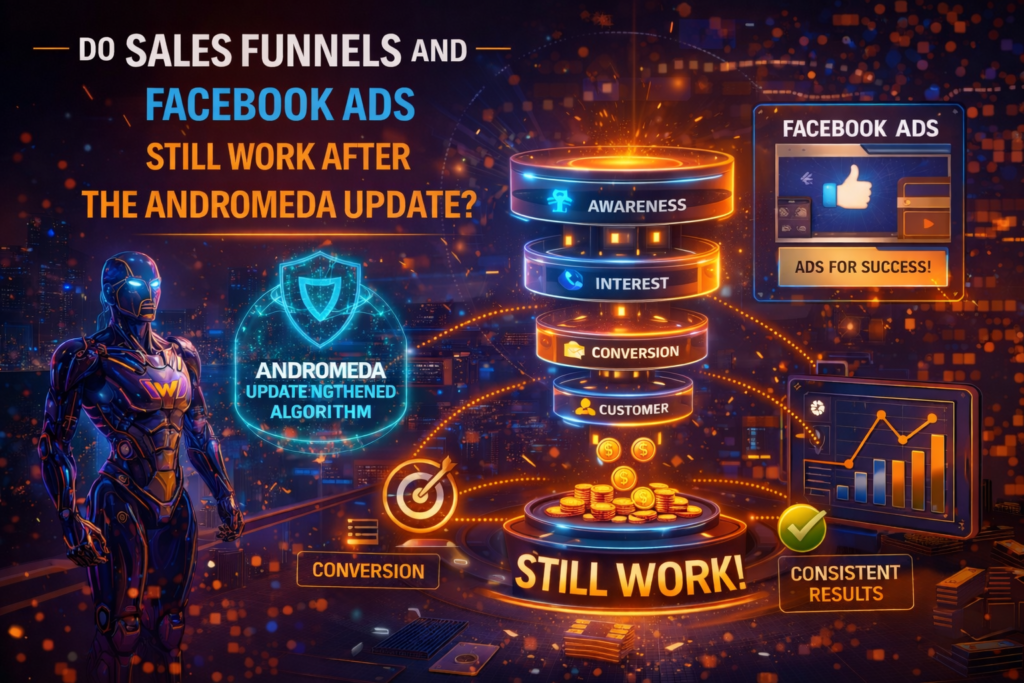
Do Sales Funnels and Facebook Ads Still Work After the Andromeda Update?
The short answer: yes, but not in the way most marketers remember. Facebook’s Andromeda update—part of a broader shift toward privacy-first advertising—fundamentally changed how the platform tracks conversions, optimizes campaigns, and attributes results. If your sales funnel strategy hasn’t adapted, you’re likely burning budget without understanding why performance dropped.
This article breaks down what’s actually changed, how to structure sales funnels for Facebook ads in the current environment, and what separates campaigns that scale from those that stall.
What the Andromeda Update Actually Changed
Andromeda isn’t a single event—it’s Meta’s ongoing response to iOS 14.5, GDPR, and the death of third-party cookies. The update introduced Aggregated Event Measurement, which limits the number of conversion events you can track per domain and delays reporting by up to 72 hours.
For sales funnels, this means:
- You can only optimize for eight conversion events per domain, forcing prioritization
- Attribution windows shortened from 28 days to 7 days click and 1 day view
- Pixel data is less granular, making retargeting audiences smaller and less precise
- Campaign learning phases take longer and require more conversion volume to stabilize
The marketers who adapted quickly realized that Facebook’s algorithm still works—but it needs cleaner data, higher conversion volumes, and funnel structures that account for attribution gaps.
If you are rebuilding that workflow inside one platform, review GoHighLevel Facebook ads automations and what to check before managing Facebook ads inside GoHighLevel.
How to Structure Sales Funnels for Facebook Ads in 2024
The multi-step funnel model hasn’t died, but it requires tighter integration and smarter event prioritization. Here’s what effective sales funnel Facebook ads campaigns look like now:
Prioritize Conversion Events That Matter
With only eight events available, you need to choose what Facebook optimizes toward. For most funnels, this hierarchy works:
- Purchase or lead submission (your primary conversion)
- Initiate checkout or form start
- Add to cart or landing page view (if relevant to your model)
- Page view (only if you’re running top-of-funnel awareness)
Avoid tracking vanity metrics like video views or scroll depth as conversion events. Facebook’s algorithm needs clear signals tied to revenue outcomes.
Shorten Your Funnel Where Possible
Long, complex funnels with multiple steps between ad click and conversion create more opportunities for attribution loss. If your funnel has five pages before someone can buy or book a call, you’re leaking data at every transition.
Consider consolidating steps: a single high-converting landing page with embedded calendar booking often outperforms a multi-page sequence, especially when tracking is imperfect. The goal is to get users to a trackable conversion event as quickly as possible while still qualifying intent.
Use Conversions API Alongside the Pixel
The Facebook Pixel alone isn’t enough anymore. Conversions API (CAPI) sends conversion data directly from your server to Meta, bypassing browser-based tracking limitations. This improves attribution accuracy and helps campaigns optimize faster.
Most funnel builders and CRMs—including GoHighLevel, ClickFunnels, and Shopify—now support CAPI integration. If your stack doesn’t, that’s a technical gap worth addressing before scaling ad spend.
Campaign Structure That Works with Modern Facebook Ads
The days of hyper-segmented campaigns with dozens of ad sets are mostly over. Facebook’s algorithm performs best with consolidated campaign structures that give it room to optimize.
Here’s a practical framework for sales funnel Facebook ads campaigns:
- Prospecting campaign: Broad targeting with minimal audience restrictions, optimizing for your primary conversion event. Let the algorithm find buyers rather than over-defining demographics.
- Retargeting campaign: Focused on users who engaged but didn’t convert. Keep audiences combined rather than splitting into micro-segments.
- Retention or upsell campaign: If applicable, target existing customers with offers that move them up your value ladder.
Within each campaign, limit ad sets to 3-5 maximum. More ad sets dilute spend and slow the learning phase. Facebook needs at least 50 conversions per ad set per week to optimize effectively—spreading budget too thin prevents this.
Creative and Messaging Adjustments
Attribution issues mean you can’t rely solely on last-click data to understand what’s working. Your creative needs to do more heavy lifting upfront, building intent and trust before the click.
Effective ad creative for sales funnels now includes:
- Clear value propositions in the first three seconds of video or the headline of static ads
- Social proof and specificity—vague claims don’t cut through
- Direct response hooks that pre-qualify intent before the click
- Multiple formats tested simultaneously (video, carousel, static) to capture different user behaviors
Because retargeting audiences are smaller, your prospecting ads need to convert cold traffic more effectively than before. This often means longer-form creative that educates and persuades within the ad itself, not just after the click.
Measuring Success When Attribution Is Imperfect
Facebook’s dashboard will underreport conversions. That’s not a bug—it’s the reality of privacy-first tracking. Smart marketers now use blended attribution models that combine:
- Facebook’s reported conversions (directional, not absolute)
- CRM or funnel analytics showing actual lead or sale volume by source
- Incrementality testing—turning campaigns on and off to measure true lift
- Customer surveys asking “how did you hear about us?”
If Facebook reports 20 conversions but your CRM shows 35 from the same period with UTM parameters matching your ads, the real number is closer to 35. Optimize based on business outcomes, not just what the ads manager displays.
When Sales Funnels and Facebook Ads Don’t Work
Not every business model thrives on Facebook, and forcing it rarely ends well. Sales funnel Facebook ads campaigns struggle when:
- Your average order value is too low to support acquisition costs (typically under $30 for cold traffic)
- Your conversion cycle is extremely long with no intermediate conversion event to optimize toward
- Your offer requires extensive education that can’t happen in an ad or landing page
- You’re in a highly restricted vertical (financial services, healthcare, etc.) where ad approval is inconsistent
In these cases, organic channels, email nurture sequences, or platforms like Google Ads may deliver better returns. Facebook works best for offers with clear value propositions, reasonable price points, and conversion paths that close within days or weeks.
Building Funnels That Scale Beyond Facebook
The smartest approach treats Facebook as one channel within a broader acquisition system. Your sales funnel should be platform-agnostic, with tracking and optimization infrastructure that works whether traffic comes from Facebook, Google, YouTube, or organic search.
This means:
- Hosting landing pages on your own domain with proper CAPI integration
- Using a CRM that centralizes lead data and attribution across channels
- Building email and SMS follow-up sequences that don’t rely on platform retargeting
- Testing offers and creative across multiple paid channels to reduce platform dependency
Facebook’s algorithm changes will continue. The businesses that survive these shifts are those with diversified traffic sources and conversion systems that don’t break when a platform updates its rules.
For a stronger view of what still works, compare this with how Facebook funnel ads become a competitive advantage and what the current top-of-funnel data actually shows. Together they make the post-Andromeda playbook much more practical.
Conclusion
Sales funnel Facebook ads absolutely still work, but the playbook has changed. Success now requires tighter funnel structures, server-side tracking, consolidated campaign architecture, and a realistic view of attribution limitations. The marketers winning on Facebook in 2024 aren’t using the same tactics from 2019—they’ve adapted their approach to match how the platform actually functions today.
If your campaigns haven’t evolved past pixel-only tracking and complex funnel sequences, that’s likely where performance is breaking down. The opportunity hasn’t disappeared—it’s just shifted to those willing to build systems that work with Facebook’s current reality rather than against it.
Want SCALE to build this for your business?
Book a free Growth Systems Audit and we will show you where your funnel, CRM and follow-up system are leaking revenue: https://scale-agency.co/
Learn more below:
