In this guide, we’ll cover:
The practical pieces that decide whether this funnel becomes a useful revenue system or another disconnected marketing asset.
ATTENTION
The Click Is Only The Start
Facebook ads interrupt attention, so the next step has to build intent.
CAPTURE
A Funnel Turns Interest Into Context
Lead capture should make the sales conversation easier, not just collect names.
FOLLOW-UP
Speed Protects Paid Traffic
CRM ownership and reminders stop paid leads going cold.
MEASURE
Revenue Beats Platform Optimisation
The business needs to know which ads created booked and closed opportunities.
Paid traffic becomes an advantage when every click has a clear handoff into funnel, CRM and follow-up.
Quick Answer
Sales funnel Facebook ads become a competitive advantage when paid traffic feeds a real conversion system. The ad creates attention, but the funnel, CRM, automation and sales follow-up decide whether that attention becomes qualified pipeline and measurable revenue.
TL;DR
- Facebook ads need a funnel because the audience is not actively searching.
- The landing page should capture intent without adding friction.
- CRM and automation protect the handoff after the click.
- Follow-up speed often matters as much as creative testing.
- Attribution should show which ads create booked and closed opportunities.
Ad Spend Handoff Decision Table
| System state | What happens | Risk | Best fix |
|---|---|---|---|
| Ads to generic page | Traffic lands without enough context | Low conversion and unclear intent | Use a focused funnel step |
| Ads to funnel without CRM | Leads submit but sales lacks context | Slow response and missed follow-up | Connect form, CRM stage and owner |
| Ads to full growth system | Source, offer, follow-up and sales action align | Needs stronger setup discipline | Build around pipeline and attribution |
Sales funnel Facebook ads only become a competitive advantage when the ad account feeds a real conversion system. Businesses that win on Meta are not simply buying cheaper traffic. They are building stronger handoffs between creative, landing pages, nurture and close.
If you want SCALE to diagnose that handoff in your business, book a free Growth Systems Audit and we will show you where ad spend is stalling before it becomes pipeline.
Why Facebook Ads Need a Funnel, Not Just a Landing Page
Facebook users aren’t searching with intent like they do on Google. They’re scrolling, distracted, and not necessarily ready to buy. That’s why sending them directly to a product page or generic contact form rarely works. A sales funnel accounts for this reality by meeting prospects where they are and warming them up progressively.
A proper funnel does three things:
- It qualifies traffic early, so you’re not wasting ad spend on people who will never convert
- It nurtures interest through multiple touchpoints, building trust and clarity
- It creates segmentation opportunities, allowing you to retarget and personalise messaging based on behaviour
Without this structure, you’re relying on a single impression to do all the heavy lifting. That’s expensive and inefficient.
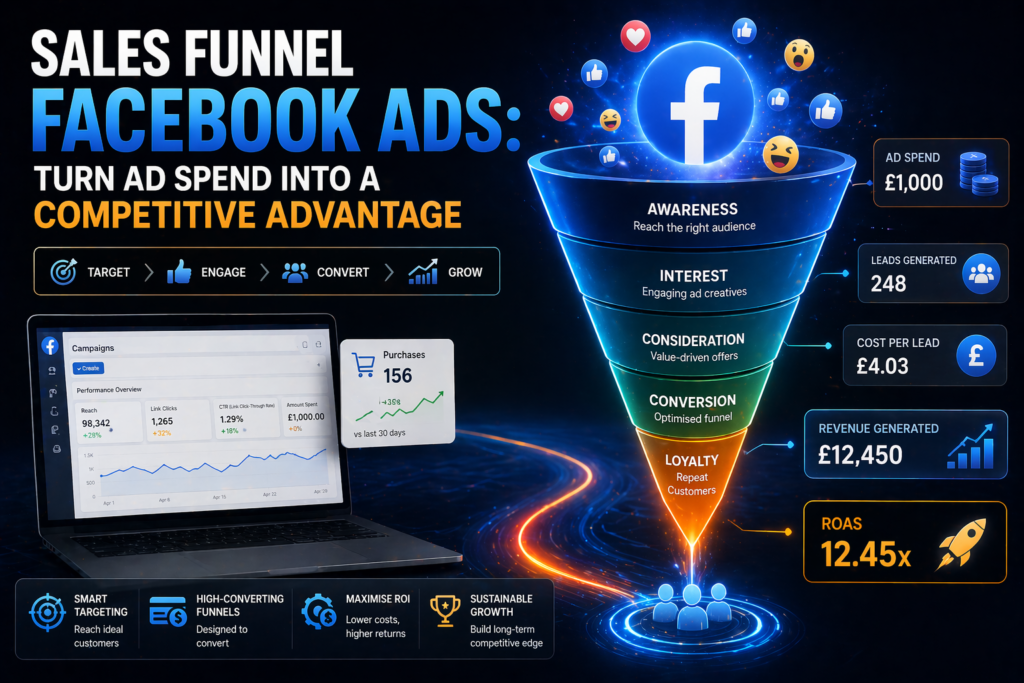
The Core Stages of a Sales Funnel for Facebook Ads
Every effective sales funnel built around Facebook ads follows a similar architecture, though the specifics vary by business model and offer complexity. Here’s the framework that consistently drives results:
Top of Funnel: Awareness and Lead Capture
This is where your Facebook ad does its job—stopping the scroll and creating enough curiosity or urgency to get a click. The ad should speak to a specific pain point, desire, or outcome your audience cares about. Avoid generic messaging. The more targeted your creative and copy, the better your cost per click and the higher the quality of traffic entering your funnel.
The landing page or lead magnet at this stage should have one goal: capture contact information in exchange for something valuable. This could be a guide, a calculator, a free audit, a webinar, or a discount. The key is that it’s relevant to the ad and requires minimal friction to access.
Middle of Funnel: Nurture and Qualification
Once someone enters your funnel, the real work begins. This is where email sequences, retargeting ads, and follow-up content come into play. The goal here is to build trust, educate the prospect, and move them from “interested” to “ready to buy.”
Retargeting ads on Facebook are especially powerful at this stage. You can show different messaging to people who visited your landing page but didn’t convert, or to those who engaged with your lead magnet but haven’t taken the next step. This keeps your brand top of mind and allows you to address objections or highlight social proof.
Bottom of Funnel: Conversion and Ascension
This is where the sale happens. Whether it’s a booking call, a product purchase, or a demo request, the bottom of the funnel is optimised for decision-making. Your messaging should be clear, your offer should be compelling, and any friction in the process should be eliminated.
For higher-ticket offers, this often involves a sales call or consultation. For e-commerce or lower-ticket services, it might be a direct checkout with urgency elements like limited-time offers or stock scarcity.
But the funnel doesn’t end at the first sale. Post-purchase sequences, upsells, and retention campaigns are what turn a one-time buyer into a long-term customer. Facebook ads can support this through lookalike audiences and customer reactivation campaigns.
How to Structure Your Sales Funnel Facebook Ads Strategy
Building a funnel is one thing. Running Facebook ads that actually fill it with qualified traffic is another. Here’s how to structure your campaigns to align with each funnel stage:
- Cold traffic campaigns: Target broad or interest-based audiences with ads designed to capture attention and generate leads. Use lead forms, landing pages, or content offers. Track cost per lead and lead quality, not just impressions.
- Retargeting campaigns: Build custom audiences based on website visitors, video viewers, or engagement. Show different ads to people at different stages—those who visited but didn’t opt in get one message, those who opted in but didn’t book get another.
- Conversion campaigns: Target warm audiences who have engaged multiple times or are further down the funnel. These ads should focus on the offer, the outcome, and removing objections. Use testimonials, guarantees, and clear calls to action.
- Lookalike and retention campaigns: Once you have conversion data, build lookalike audiences from your best customers. Run campaigns to existing customers for upsells, cross-sells, or reactivation offers.
Each campaign should have a specific objective and a corresponding funnel stage. Mixing these up or trying to do everything with one ad set is a common mistake that dilutes performance.
Common Mistakes That Kill Sales Funnel Performance
Even with a funnel in place, most businesses make predictable errors that cap their results. Here are the ones that matter most:
Sending all traffic to the same page. If your ad speaks to a specific pain point or audience segment, the landing page needs to match. A mismatch between ad message and landing page kills conversion rates and wastes spend.
Not tracking beyond the lead. Cost per lead is a vanity metric if those leads don’t convert to customers. You need to track lead-to-customer conversion rates and cost per acquisition to know if your funnel is actually profitable.
Ignoring the nurture stage. Most people won’t buy on the first touch. If you’re not retargeting and following up via email or other channels, you’re leaving money on the table.
Overcomplicating the funnel. More steps don’t always mean better results. Every additional page or form field is a chance for someone to drop off. Keep it as simple as possible while still qualifying and converting effectively.
Integrating Automation and CRM Into Your Funnel
A sales funnel isn’t just a series of pages—it’s a system. That means integrating your Facebook ads with a CRM, email platform, and ideally an automation tool that can handle lead scoring, segmentation, and follow-up without manual intervention.
Platforms like GoHighLevel are built for this. They allow you to capture leads from Facebook, automatically tag and segment them based on behaviour, trigger email or SMS sequences, and route high-intent leads to your sales team in real time. This level of automation is what separates a basic funnel from a revenue-generating system.
When your funnel is connected to a CRM, you can also feed conversion data back into Facebook’s algorithm, improving targeting over time and lowering your cost per acquisition. This closed-loop system is what makes paid acquisition scalable.
Measuring What Matters in Your Sales Funnel Facebook Ads
You can’t optimise what you don’t measure. Here are the metrics that actually indicate funnel health:
- Cost per lead (CPL): What you’re paying to get someone into your funnel
- Lead-to-customer conversion rate: The percentage of leads that become paying customers
- Cost per acquisition (CPA): What you’re paying to acquire a customer, not just a lead
- Return on ad spend (ROAS): Revenue generated divided by ad spend
- Customer lifetime value (LTV): Total revenue a customer generates over their relationship with your business
If your CPA is higher than your LTV, your funnel isn’t profitable. If your lead-to-customer rate is low, the problem is likely in your nurture or offer, not your ads. These metrics tell you where to focus your optimisation efforts.
For deeper context, compare this with the Facebook funnel system brands use to turn likes into customers and whether funnels are still the easiest way for digital agencies to scale. That pairing shows why the ad strategy only works when the sales path is already engineered.
If you want to see how that advantage compounds when the stack is unified, review how sales funnels, Facebook Ads and Go High Level combine into an automated business. That is where media buying and follow-up start working as one system.
If you want more concrete structures to compare, review five Facebook ad sales funnel examples that make scaling easier. It breaks down the actual funnel types behind more stable ad performance.
Conclusion
A sales funnel for Facebook ads is what turns paid traffic from an expense into an investment. The ad account creates demand, but the funnel and follow-up system decide whether that demand becomes pipeline.
SCALE’s perspective is that the strongest Facebook ads systems are not just media buying systems. They connect creative, landing pages, CRM, automation, sales follow-up and attribution before spend is scaled.
FAQs
Why do Facebook ads need a funnel?
Facebook users are often interrupted rather than actively searching. A funnel helps educate, qualify and move them toward a clear next step.
What should happen after someone clicks?
The landing page should match the ad promise, capture useful context and trigger fast CRM follow-up.
How does CRM improve Facebook ad performance?
CRM stages show which leads booked, showed, closed or stalled. That makes optimisation more commercial than platform lead counts alone.
Should I keep testing creative if leads do not convert?
Creative testing helps, but it will not fix a broken handoff. Check the funnel, CRM, reminders and sales follow-up before scaling spend.
When should SCALE inspect the system?
SCALE should inspect it when ad spend is producing leads but not enough qualified calls, revenue or attribution clarity.
