If you’re searching for a sales funnel digital marketing agency, you’re likely evaluating whether funnel-focused strategies still deliver the kind of predictable, scalable growth your business needs—or if they’ve been replaced by newer approaches. The short answer: sales funnels remain one of the most reliable frameworks for turning traffic into revenue, but only when built with precision, integrated automation, and ongoing optimisation. This article breaks down what makes a funnel-first agency effective, how to evaluate one, and whether this approach still makes sense in 2025.
If the funnel depends on GoHighLevel, CRM ownership and follow-up logic, use the checklist before you hire a GoHighLevel expert. SCALE builds GoHighLevel CRM, funnel, and automation systems for businesses that need better lead quality, faster follow-up, and clearer attribution.
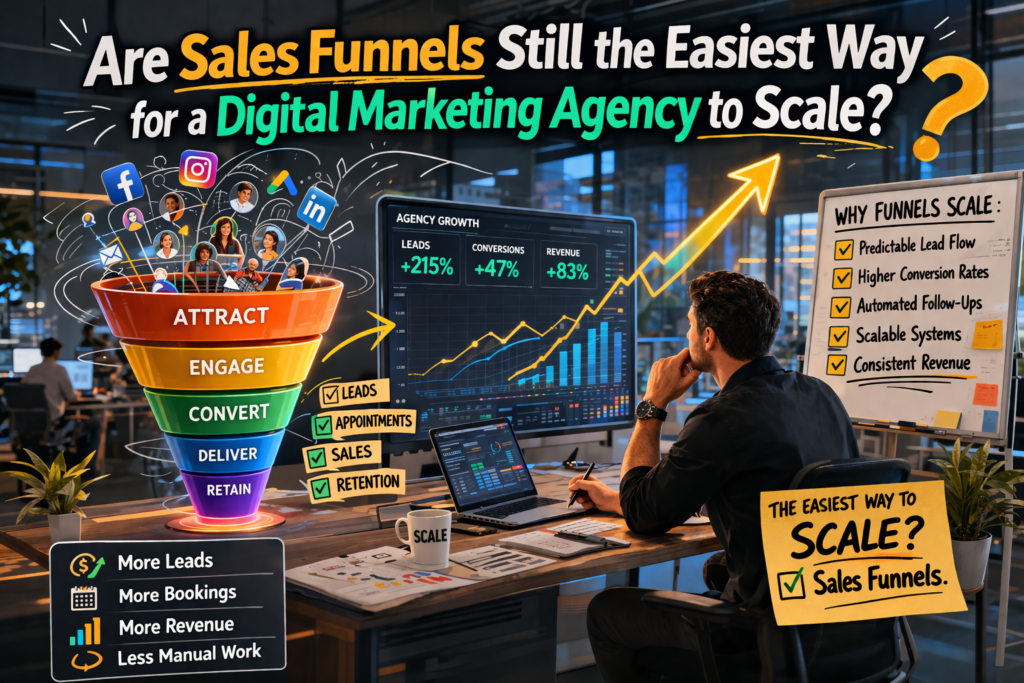
Are Sales Funnels Still the Easiest Way for a Digital Marketing Agency to Scale?
Sales funnels have been a cornerstone of digital marketing for over a decade. They map the customer journey from awareness to conversion, creating a structured path that turns cold traffic into paying customers. But with the rise of omnichannel marketing, AI-driven personalisation, and platform algorithm changes, some question whether funnels are still the most effective growth lever.
The reality is that funnels haven’t lost relevance—they’ve evolved. Modern sales funnels integrate CRM automation, multi-touch attribution, retargeting sequences, and real-time data tracking. A competent sales funnel digital marketing agency doesn’t just build landing pages and email sequences. They architect systems that connect paid acquisition, organic traffic, lead nurturing, and backend sales processes into a cohesive revenue engine.
If you want the broader non-agency angle, see whether a sales funnel in digital marketing is still the easiest way to scale without adding more manual work.
What Defines a Sales Funnel Digital Marketing Agency
Not every agency that mentions funnels actually specialises in them. A true funnel-focused agency operates differently from generalist marketing firms. Here’s what sets them apart:
- Revenue-first thinking: Every funnel decision is tied to conversion rates, customer acquisition cost, and lifetime value—not vanity metrics like impressions or engagement.
- Technical integration: They connect tools like GoHighLevel, HubSpot, or ActiveCampaign with ad platforms, analytics, and payment processors to create seamless automation.
- Conversion rate optimisation: They continuously test landing pages, ad copy, email sequences, and checkout flows to improve performance over time.
- Paid acquisition expertise: Funnels require traffic, and the best agencies know how to profitably scale paid campaigns on Google, Facebook, YouTube, and emerging platforms.
- Full-funnel visibility: They track users across every touchpoint, attributing revenue accurately and identifying where prospects drop off.
Agencies that only build landing pages or run ads without connecting the dots across the entire customer journey aren’t true funnel specialists. The value lies in the system, not individual tactics.
Why Businesses Hire a Sales Funnel Digital Marketing Agency
Most businesses don’t lack traffic—they lack conversion infrastructure. They drive visitors to their site, generate leads sporadically, and lose prospects in the gaps between awareness and purchase. A sales funnel agency solves this by creating a repeatable, measurable process that turns interest into revenue.
Here are the most common reasons businesses seek out funnel-focused agencies:
- Inconsistent lead flow: Marketing efforts generate sporadic interest but no predictable pipeline.
- Low conversion rates: Traffic arrives, but visitors don’t take action—whether that’s booking a call, signing up, or making a purchase.
- Disconnected tools: CRM, email platform, ad accounts, and analytics exist in silos, making it impossible to see what’s working.
- Scaling challenges: The business can acquire customers manually, but can’t scale without a system that automates nurture and qualification.
- Wasted ad spend: Paid campaigns drive clicks but don’t generate positive ROI because the post-click experience is weak.
A well-built funnel addresses all of these issues by creating a structured path from first touch to closed deal, with automation handling repetitive tasks and data guiding optimisation.
Core Components of a High-Performing Sales Funnel
Understanding what goes into a modern sales funnel helps you evaluate whether an agency knows what they’re doing. Here are the essential elements:
Traffic Generation
Funnels need volume. This comes from paid ads, SEO, content marketing, partnerships, or a combination. The key is matching traffic source to funnel stage—cold traffic from Facebook needs different messaging than warm traffic from a retargeting campaign or organic search.
Landing Pages and Opt-In Mechanisms
Every funnel needs a conversion point where visitors become leads. This could be a lead magnet download, a webinar registration, a quiz, or a direct booking form. The page must be focused, fast-loading, and aligned with the traffic source’s intent.
Automated Nurture Sequences
Most prospects aren’t ready to buy immediately. Email and SMS sequences keep leads engaged, educate them on the solution, and move them closer to a purchase decision. Effective sequences are segmented based on behaviour, not just time delays.
Sales Conversion Mechanism
Whether it’s an ecommerce checkout, a sales call booking system, or a demo request form, the funnel must have a clear path to revenue. This is where CRM integration, calendar automation, and payment processing become critical.
Retargeting and Follow-Up
Not everyone converts on the first visit. Retargeting ads and follow-up sequences re-engage prospects who dropped off, bringing them back into the funnel with tailored messaging.
Analytics and Optimisation
A funnel without tracking is just guesswork. Agencies should implement conversion tracking, attribution models, and A/B testing frameworks to continuously improve performance.
How to Evaluate a Sales Funnel Digital Marketing Agency
Choosing the right agency requires looking beyond portfolio pages and testimonials. Here’s what to assess:
Do they ask about your numbers? A serious agency will want to know your current conversion rates, customer acquisition cost, average order value, and lifetime value before proposing anything. If they pitch a solution without understanding your economics, they’re guessing.
Can they explain their tech stack? Funnel execution depends on tools. Ask which platforms they use for CRM, automation, landing pages, and analytics. If they’re platform-agnostic or recommend tools based on your needs rather than their convenience, that’s a good sign.
Do they focus on testing and iteration? No funnel works perfectly out of the gate. Agencies that promise instant results without mentioning testing, data analysis, or optimisation cycles are overselling.
What does their onboarding process look like? Building a funnel requires understanding your offer, audience, and sales process. Agencies that rush to execution without discovery are likely to build something generic.
How do they handle attribution? Multi-touch customer journeys are the norm. Ask how they track conversions across channels and whether they use first-click, last-click, or more sophisticated attribution models.
When a Sales Funnel Agency Makes Sense
Funnels aren’t the right solution for every business. They work best when:
- You have a defined offer with proven demand
- Your customer journey involves multiple touchpoints before purchase
- You’re willing to invest in paid traffic or have existing organic volume
- You need a scalable, repeatable system rather than one-off campaigns
- You have the budget to support both agency fees and ad spend
If you’re still validating product-market fit or your offer changes frequently, a full funnel build might be premature. In those cases, simpler lead generation or conversion optimisation work may be more appropriate.
The Role of Automation in Modern Funnels
Automation is what separates a manual sales process from a scalable funnel. Platforms like GoHighLevel, HubSpot, and ActiveCampaign allow agencies to build workflows that:
- Segment leads based on behaviour and engagement
- Trigger email and SMS sequences automatically
- Score leads to prioritise sales follow-up
- Sync data between ad platforms, CRM, and analytics tools
- Send reminders, confirmations, and post-purchase sequences without manual input
A sales funnel digital marketing agency that doesn’t leverage automation is leaving money on the table. The goal is to handle repetitive tasks programmatically so your team can focus on high-value activities like closing deals and refining strategy.
Common Funnel Mistakes Agencies Make
Even experienced agencies can fall into traps that undermine funnel performance. Watch for these red flags:
Overcomplicating the funnel: More steps don’t always mean better results. Unnecessary complexity increases drop-off and makes optimisation harder.
Ignoring mobile experience: Most traffic is mobile. If landing pages, forms, and checkout flows aren’t mobile-optimised, conversions will suffer.
Weak offer positioning: A funnel can’t fix a weak offer. If the value proposition isn’t clear or compelling, no amount of optimisation will drive conversions.
Neglecting speed and load times: Slow pages kill conversions. Agencies should prioritise fast hosting, optimised images, and minimal scripts.
Failing to align sales and marketing: If the sales team isn’t looped into the funnel strategy, leads will be mishandled and revenue will be lost.
If you want a more traditional benchmark for this debate, HubSpot’s sales funnel guide gives a useful baseline for comparing funnel-stage logic against agency growth realities.
Conclusion
A sales funnel digital marketing agency remains one of the most effective partners for businesses that need predictable, scalable growth. Funnels haven’t become obsolete—they’ve become more sophisticated, integrating automation, data, and multi-channel strategies to drive revenue efficiently. The key is choosing an agency that understands the full system, not just isolated tactics, and that approaches funnel building as an ongoing optimisation process rather than a one-time project. When executed well, a sales funnel transforms marketing from a cost centre into a measurable growth engine.
Want us to set this up for your business?
Book a FREE call with us to see how we can help by visiting: https://scale-agency.co/
Learn more below:
