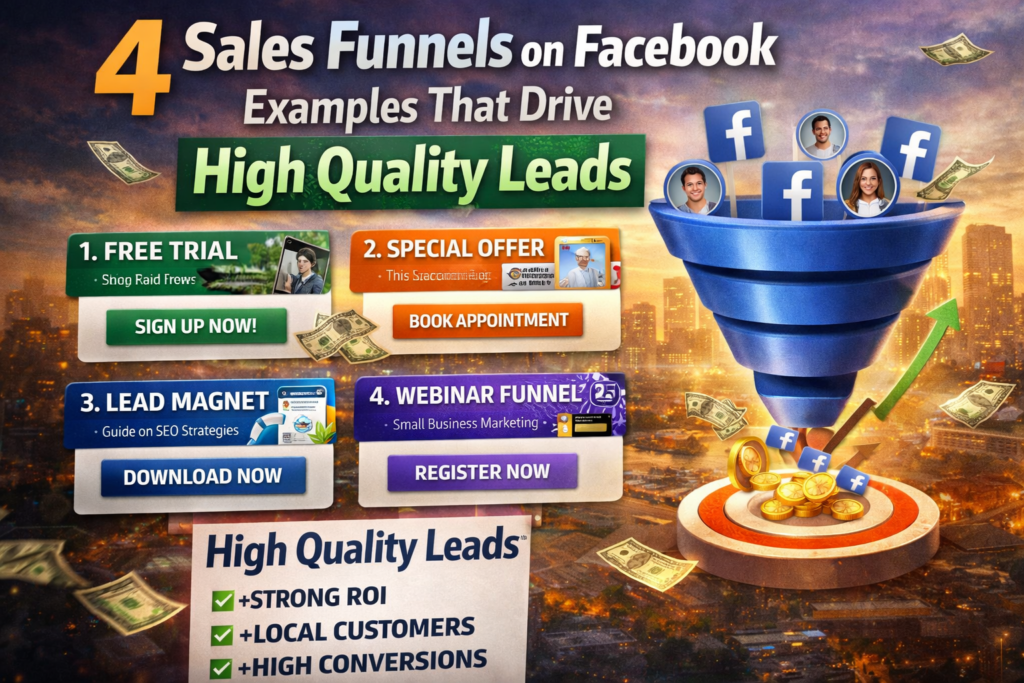
A strong sales funnel on Facebook is not just a collection of examples. It is a sequence designed to qualify attention and move people toward a sales conversation. The businesses that get high-quality leads are the ones that pair the right funnel type with the right buyer temperature.
If you want SCALE to map which Facebook funnel structure fits your offer, book a free Growth Systems Audit and we will show you where your current journey is losing qualified leads.
1. Lead Magnet to Email Nurture Funnel
This is the most common and versatile sales funnel on Facebook, especially for service businesses, coaches, consultants, and agencies. The structure is straightforward: offer a high-value lead magnet in exchange for contact information, then nurture leads via email until they’re ready to book a call or purchase.
How It Works
- Run a Facebook ad promoting a free resource—guide, checklist, template, or video training
- Send traffic to a landing page or use Facebook’s native lead form
- Deliver the lead magnet via email and trigger an automated nurture sequence
- Include a clear call-to-action in the email series—typically a discovery call, demo, or low-ticket offer
- Retarget engaged leads who don’t convert immediately
This funnel works because it respects the cold traffic reality on Facebook. You’re not asking for a sale upfront. You’re offering value first, building trust through email, and creating multiple conversion opportunities over time.
The key is ensuring your lead magnet is directly relevant to your core offer. If you sell SEO services, don’t offer a generic “social media checklist.” Offer an “SEO audit template” or “keyword research guide.” The tighter the alignment, the higher your lead quality and conversion rate.
2. Webinar Registration Funnel
Webinars remain one of the highest-converting formats for mid-to-high ticket offers. A webinar funnel on Facebook compresses education, authority-building, and sales into a single event, making it ideal for complex services, software, or coaching programs.
The funnel typically looks like this: Facebook ad drives registrations to a live or automated webinar. The webinar delivers genuine value for 45-60 minutes, then transitions into a pitch with a time-sensitive offer. Registrants who don’t attend get reminder sequences and replay access. Attendees who don’t buy enter a follow-up sequence with additional urgency or objection-handling content.
What makes this funnel effective is the time investment. Someone who registers and shows up for an hour-long webinar is far more qualified than someone who downloaded a PDF. They’ve demonstrated intent, attention, and interest. Your close rate on webinar attendees should be significantly higher than cold leads.
The challenge is driving enough registrations to make the economics work. Webinar funnels often require higher ad spend and more aggressive retargeting. You’ll also need strong email deliverability and reminder sequences to maximize show-up rates.
3. Tripwire to Core Offer Funnel
A tripwire funnel introduces a low-cost, high-value offer immediately after someone opts in or engages with your ad. The goal isn’t to make a profit on the front end—it’s to convert cold traffic into buyers as quickly as possible. Once someone purchases, even at a low price point, their likelihood of buying again increases dramatically.
Here’s the structure: run a Facebook ad offering a low-ticket product—typically between $7 and $47. This could be a mini-course, template pack, audit, or tool. After purchase, the buyer enters an upsell sequence or email funnel promoting your core offer at a higher price point.
This funnel works particularly well for e-commerce, digital products, and businesses with clear product ladders. It also improves your Facebook ad account performance. Conversion events happen faster, giving the algorithm more data to optimize toward buyers rather than just leads.
The tripwire must deliver immediate, tangible value. If it feels like a bait-and-switch or low-quality teaser, you’ll damage trust and hurt your core offer conversions. Think of it as a paid sample, not a cheap upsell trap.
4. Application Funnel for High-Ticket Services
If you’re selling services above $3,000 or working with a limited client capacity, an application funnel filters out unqualified leads before they ever reach your calendar. This sales funnel on Facebook prioritizes lead quality over volume, which is critical when your sales process involves human time and custom proposals.
The flow is simple but deliberate: Facebook ad drives traffic to a landing page explaining your service and the type of client you work with. Interested prospects click through to an application form with qualifying questions—budget, timeline, current situation, goals. Only applicants who meet your criteria receive a booking link or get contacted by your team.
This funnel protects your time and improves close rates. You’re not taking calls with tire-kickers or people who can’t afford your service. You’re speaking only with pre-qualified prospects who’ve already demonstrated serious intent by completing a detailed application.
The trade-off is volume. You’ll generate fewer leads than a simple lead magnet funnel, but the leads you do generate will be significantly more valuable. Your ad creative and landing page copy need to do heavy lifting here—clearly communicating who you serve, what results you deliver, and what the investment looks like.
Building Your Sales Funnel on Facebook: Key Considerations
Regardless of which funnel structure you choose, several principles apply across the board. These aren’t optional—they’re the difference between a funnel that converts and one that burns budget.
- Match message to temperature: Cold traffic needs education and value. Warm traffic can handle more direct offers. Retargeting audiences respond to urgency and social proof.
- Optimize for mobile: The majority of Facebook users are on mobile devices. Your landing pages, forms, and checkout processes must load fast and function flawlessly on small screens.
- Use Facebook’s native tools strategically: Lead forms reduce friction but often generate lower-quality leads. Sending traffic off-platform gives you more control but increases drop-off. Test both approaches.
- Build retargeting into your strategy from day one: Most conversions don’t happen on the first touch. Set up pixel tracking, create custom audiences, and plan your retargeting sequences before you launch.
- Integrate with automation: Your funnel doesn’t end when someone opts in. Use email automation, CRM workflows, and follow-up sequences to nurture leads and move them toward a sale.
- Track beyond Facebook metrics: Facebook will tell you cost per lead and click-through rate. You need to track lead-to-customer conversion rate, customer acquisition cost, and lifetime value to know if your funnel actually works.
The technical setup matters, but so does the offer itself. A perfectly optimized funnel with a weak offer will still fail. A strong offer in a mediocre funnel will often outperform a weak offer in a sophisticated funnel. Start with clarity on what you’re selling, who it’s for, and why they should care.
Choosing the Right Funnel for Your Business
There’s no universal best sales funnel on Facebook. The right choice depends on your offer complexity, price point, sales cycle, and internal capacity.
If you’re selling a service that requires custom proposals and discovery calls, the application funnel or webinar funnel will serve you better than a tripwire. If you’re launching a digital product or course, the lead magnet or tripwire funnel will generate volume and build your list.
Consider your sales process. Can you close deals via email and automated sequences, or do you need live conversations? How much time can you dedicate to sales calls? What’s your current lead volume, and what’s your close rate? These operational realities should guide your funnel design as much as the marketing theory.
Also consider your audience’s awareness level. If you’re in a crowded market where prospects already understand the problem and solution, you can move faster toward an offer. If you’re introducing a new concept or serving a skeptical audience, you’ll need more education and trust-building before asking for a purchase.
For deeper context, compare these examples with what a sales funnel on Facebook still looks like in the next five years and what the current top-of-funnel data says. That gives you the strategy behind the examples, not just the list.
Conclusion
A sales funnel on Facebook isn’t just a series of ads and landing pages—it’s a system for turning attention into revenue. The four funnel types covered here represent different approaches to the same core challenge: moving people from awareness to action in an environment where they’re not actively looking to buy.
The lead magnet funnel builds your list and nurtures over time. The webinar funnel compresses education and sales into a single event. The tripwire funnel converts cold traffic into buyers quickly. The application funnel filters for quality and protects your time. Each has its place, and the best choice depends on your business model, offer, and operational capacity.
What matters most isn’t which funnel you choose—it’s that you build one deliberately, test it consistently, and optimise based on real conversion data rather than vanity metrics. Facebook gives you the traffic. Your funnel determines whether that traffic becomes revenue.
Want SCALE to build this for your business?
Book a free Growth Systems Audit and we will show you where your funnel, CRM and follow-up system are leaking revenue: https://scale-agency.co/
Learn more below:
