
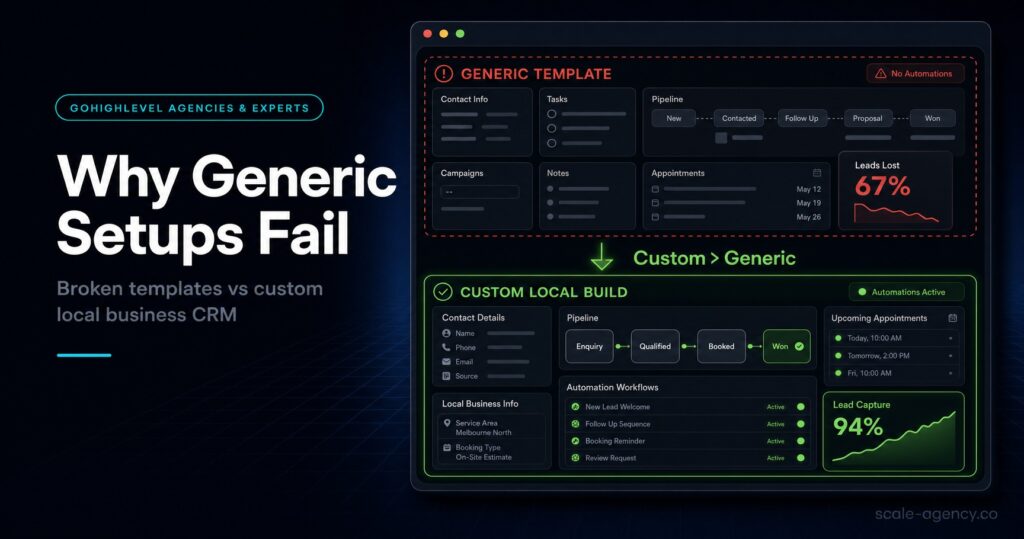
In this guide, we’ll cover:
A practical way to judge whether your local business needs a custom GoHighLevel build instead of another generic template.
Generic Setups Break At The Local Business Edge Cases
Why simple snapshots fail: calls, forms, missed calls, multiple services, locations and sales reps create routing decisions a template cannot guess.
Speed-To-Lead Needs More Than One Workflow
Where local businesses lose revenue: enquiries arrive with different urgency levels, sources and booking paths, but weak setups treat every lead the same.
Your Stages Have To Match The Real Sales Process
How reporting improves: pipeline stages should show contact, booking, show-up, quote, won and lost outcomes instead of vague activity labels.
Source Data Has To Survive From Click To Revenue
What owners need to see: which channel created the lead, which lead booked, which appointment showed, and which source produced revenue.
The Right Expert Designs The Operating System
How to choose the partner: ask how they map lead sources, route ownership, stop automations, QA test leads and report revenue by channel.
“A local business GoHighLevel build only works when CRM structure, follow-up, calendars, attribution and team ownership reflect how the business actually sells.”
Quick Answer
A GoHighLevel expert for local business is worth hiring when your CRM needs to handle paid leads, missed calls, multiple services, calendars, sales reps and source attribution. Generic setups fail because they install software without mapping the real sales process, so leads get misrouted, follow-up becomes generic and reporting cannot explain revenue.
For the service model behind that build, compare generic setup against the GoHighLevel agency model guide before choosing who should own the system.
TL;DR
- Generic GoHighLevel templates are usually too shallow for local businesses with real lead-routing, calendar and follow-up complexity.
- In practice, the first thing to inspect is not the dashboard; it is whether every lead is captured, assigned, contacted and reported correctly.
- Local businesses need pipeline stages that match sales milestones: attempted contact, booked, showed, quoted, won, lost and reason why.
- Attribution has to be designed before ads scale. Otherwise “source” data becomes inconsistent and budget decisions become guesswork.
- DIY can work for simple businesses, but only if someone owns QA, reporting and ongoing CRM hygiene.
- A specialist build is best when missed leads, slow response, poor tracking or weak sales handoff directly affect revenue.
This post is a support article in the GoHighLevel expert cluster. For the broader parent guide, start with the SCALE GoHighLevel expert build checklist.
Decision Table: Generic Setup Vs Custom Local Business Build
| Build type | Best fit | Main risk | What to check |
|---|---|---|---|
| DIY setup | Simple offer, low lead volume, one owner-operator | Slow QA, fragile automations and unclear reporting | Can someone test every lead source weekly and fix broken logic? |
| Template or snapshot | Basic nurture, one service, one location, low ad spend | Looks finished but misses local routing, calls, calendars and attribution | Does the template match your actual sales process without heavy rework? |
| Custom expert build | Paid traffic, multi-service teams, high-value bookings, local sales reps | Higher setup cost, but much lower operating risk | Will the expert map lead sources, pipeline stages, owner rules, QA and reporting? |
Who Is This for?
- Local service businesses running Meta Ads, Google Ads, SEO, referrals or local service ads.
- Businesses with multiple services, branches, providers, technicians or sales reps.
- Owners who see leads arrive but cannot explain why they do not become booked jobs.
- Teams moving from spreadsheets, HubSpot, Pipedrive or disconnected booking tools.
- Agencies delivering GoHighLevel for clients who need a more reliable implementation model.
- Businesses where one missed lead can cost more than a properly designed CRM build.
Why Generic GoHighLevel Setups Fail Local Businesses
In practice, generic setups fail because they assume every business has the same sales process. A snapshot can create forms, pipelines and workflows quickly, but it cannot know your service areas, response-time expectations, staff capacity, lead sources, call handling, no-show process or revenue reporting needs.
Because of that, the gap matters commercially. Local businesses do not lose money because a CRM is missing a decorative field. They lose money because a hot lead is not called, a missed call is not followed up, a booked appointment keeps getting nurture texts, or a campaign looks profitable because attribution was never captured correctly.
Instead, a good GoHighLevel expert starts with the business model, not the software menu. They should ask where leads come from, how urgency is defined, who owns each enquiry, what counts as booked, what counts as won, and how the owner wants to make decisions from the data.
What To Check First
- Do forms, calls, chat and DMs all create clean contacts and opportunities?
- Does every new lead have a source, service type, owner and next action?
- Are missed calls turned into callback tasks and immediate SMS replies?
- Are appointment bookings tied to pipeline stages automatically?
- Can the owner see booked calls, show-ups, wins and revenue by source?
The Local Business Lead Flow Is Not Linear
Usually, template builds assume a straight path: lead submits a form, gets a nurture sequence, books a call and becomes a customer. Local businesses rarely work that neatly. Leads call, abandon forms, message social profiles, book with the wrong provider, need emergency handling, ask for different services and arrive outside working hours.
As a result, generic automation creates hidden revenue leaks. For example, a dental clinic, med spa, home service company or legal practice cannot treat every enquiry the same way. Meanwhile, a high-urgency request needs faster human escalation. By contrast, a lower-intent enquiry may need qualification first. And a repeat customer may need a different route entirely.
Therefore, the right expert turns those paths into logic. They define the trigger, fields, owner, pipeline, calendar, notification, follow-up sequence and stop condition for each major lead type. Because of that, is the difference between “GoHighLevel is installed” and “GoHighLevel runs the front end of the sales process.”
How To Diagnose The Generic Setup Problem
First, run real test leads through every entry point. Submit a paid-search form, a Meta Ads form, a website enquiry, a missed call, a direct calendar booking and a manual staff-created contact. Then check whether each one creates the same standard of record: clean name, phone, email, source, service, owner, pipeline stage and next action.
If one source creates a complete opportunity while another creates a loose contact with no owner, the business does not have a reliable lead system. It has a collection of entry points. Because of that, difference matters because sales teams only follow what the system makes visible. Anything vague becomes a manual memory task, and manual memory does not scale.
Next, check what happens after the lead replies, books or becomes unqualified. For example, a good local business build changes state when the prospect takes action. By contrast, a weak build keeps sending the same generic sequence because the automation has no commercial awareness.
What A Strong Local Business Build Looks Like
In practice, a strong build feels boring in the best possible way. First, every lead enters the right pipeline. Also, every lead has an owner. Missed calls get a text-back and task. Booked appointments stop booking prompts. Sales reps know which stage means what. Finally, the owner can see where leads came from, how quickly the team responded and which opportunities turned into revenue.
For example, a home services business may route emergency enquiries differently from planned installation quotes. Meanwhile, a clinic may separate new patient enquiries from returning patient bookings. By contrast, a med spa may use different follow-up by treatment type and consultation stage. In an agency-client setup, it may mean reporting lead quality by campaign, not just lead volume.
However, the software is the same in all of those examples. The design is not. Because of that, is why the right GoHighLevel expert should talk about operations, response time, pipeline discipline and attribution before they talk about colours, dashboards or snapshot libraries.
Pipeline Design: If Stages Do Not Match Reality, Reporting Lies
For reporting, pipeline stages should describe real operational milestones. Weak local business builds use vague labels like New, Contacted, Won and Lost. Because of that, may look tidy, but it does not explain where the process is leaking.
Instead, a stronger pipeline separates attempted contact from real conversation, booked from showed, quoted from won, and lost from unqualified. Because of that, gives the owner a diagnostic view. For example, if many leads never move past attempted contact, speed-to-lead is the issue. Meanwhile, if booked calls do not show, reminders and qualification need work. Finally, if quotes do not close, the offer, sales process or follow-up needs attention.
SCALE would also expect loss reasons, source data and revenue fields to be part of the system. Therefore, without them, the CRM becomes a list of contacts rather than a decision tool.
Follow-Up Automation: More Messages Is Not Better Conversion
Also, a local business does not need endless generic texts. It needs the right response at the right moment. Therefore, the system should acknowledge the enquiry, alert the right person, create a task, push the lead toward booking and then stop once the lead replies or books.
However, the biggest red flag is automation that keeps running after a customer takes action. However, if someone books an appointment and still receives “are you ready to book?” messages, the workflows were not designed around events. Because of that, hurts trust and tells the team the CRM cannot be relied on.
Therefore, a strong expert builds follow-up around states: new lead, contacted, booked, no-show, quoted, won, lost and reactivation. Also, every state has a purpose, a message, an owner and an exit condition.
Attribution: The Part Most Generic Setups Ignore
Finally, attribution is what lets a local business know which channels create revenue. However, if GoHighLevel does not capture source data at lead creation, the owner ends up judging campaigns from partial ad platform data and incomplete CRM notes.
At minimum, a serious setup should capture UTMs from forms, normalise source names, connect calls to contacts where possible, and carry source data through the opportunity pipeline. In other words, the goal is not perfect attribution theater. Instead, the goal is useful enough truth to make better budget, staffing and follow-up decisions.
Therefore, if your CRM shows most leads as “Website” or “Unknown,” the system is not ready to scale ads. However, you may still get bookings, but you will not know which channel deserves more budget.
The Implementation Process
- Map offers and lead sources: list every service, location, channel, form, call path and booking route.
- Define required fields: source, service, urgency, location, owner, status and revenue fields.
- Build pipeline architecture: create stages that match real sales milestones, not generic CRM labels.
- Design routing: assign leads by service, location, rep, schedule, priority or queue.
- Create follow-up logic: build first-touch, no-response, no-show and reactivation sequences with stop conditions.
- Configure attribution: capture UTMs, normalise source names and connect appointments to opportunities.
- QA every path: submit test leads from each source and confirm fields, owner, stage, message and reporting.
- Train the team: document stage definitions, owner responsibilities and weekly CRM hygiene.
Common Problems And How To Fix Them
| Problem | What it usually means | Commercial risk | Fix |
|---|---|---|---|
| Leads arrive but nobody follows up | No assignment rules, weak notifications or no task creation | Paid enquiries go cold before sales starts | Auto-assign an owner, create callback tasks and escalate stale leads. |
| Pipeline stages are inconsistent | Stages are vague and staff use them differently | Reporting cannot show where revenue leaks | Redesign stages around milestones and define required fields. |
| Everything shows as Website or Unknown | UTMs and source mapping were not built properly | Budget decisions are based on incomplete data | Add hidden fields, source normalisation and call-source mapping. |
| Booked leads still receive nurture texts | Stop conditions are missing | Trust drops and the team stops believing the CRM | Use booking triggers, reply detection and stage-change exits. |
| Missed calls disappear | Call events are not creating tasks or opportunities | High-intent local enquiries are lost immediately | Create missed-call text-back, callback tasks and owner alerts. |
Questions To Ask Before Hiring A GoHighLevel Expert
- How will you map my lead sources before building workflows?
- How will missed calls, after-hours leads and urgent enquiries be handled?
- What pipeline stages do you recommend for my sales process, and why?
- How will you stop automations when someone replies, books or moves stage?
- How will you prove source-to-booked-call and source-to-revenue reporting?
- What QA tests will you run before the system goes live?
- What documentation and handover will my team receive?
For a broader hiring filter, use the related post on GoHighLevel expert questions before hiring. However, if your priority is faster response and ownership, also read how the right GoHighLevel expert improves speed-to-lead.
What This Means For Revenue
For a local business, the upside is not theoretical. One additional booked job, consult or sales call can cover a meaningful part of the build. The risk is also real: one broken routing rule, one untracked campaign, or one missed-call gap can waste weeks of ad spend.
Ultimately, the point is to avoid paying for a tidy-looking GoHighLevel account that still leaks leads. A custom local business build should make the first response faster, the next action clearer, the pipeline cleaner and the revenue picture easier to trust.
In practice, the best way to judge the investment is to compare the build cost with the value of recovered opportunities. However, if the business receives 100 enquiries per month and only a small percentage are missed, delayed or assigned to the wrong person, the lost revenue can still be significant. For high-ticket local services, one retained enquiry can be worth hundreds or thousands in immediate revenue, and more if repeat bookings or referrals follow.
That is why the CRM should be treated as revenue infrastructure, not admin software. Therefore, the goal is not to make the account look more organised. Therefore, the goal is to increase the number of leads that become conversations, the number of conversations that become booked appointments, and the number of booked appointments that can be traced back to the right channel.
Conclusion
SCALE builds GoHighLevel CRM, funnel and automation systems for businesses that need better lead quality, faster follow-up and clearer attribution. The core difference is not the toolset; it is the commercial design behind it.
For local businesses, that means building around how leads actually arrive, how quickly the team can respond, who owns each enquiry, what counts as qualified and how the owner will decide where to spend next.
Want to learn more about this?
Watch the video below:
FAQs
Do I Need A GoHighLevel Expert For Local Business?
You need one if your lead flow includes paid traffic, missed calls, multiple services, calendars, sales reps or source reporting. A simple snapshot may work for a very basic business, but it usually fails when lead handling affects revenue.
SCALE builds GoHighLevel CRM, funnel, and automation systems for businesses that need better lead quality, faster follow-up, and clearer attribution.
Why Do Generic GoHighLevel Setups Fail?
Usually, they fail because they are built around generic templates instead of your sales process. They often miss routing rules, source capture, stop conditions, pipeline definitions and QA testing.
What Should A Local Business Fix First In GoHighLevel?
First, fix capture, ownership and speed-to-lead. Also, every lead should be created correctly, assigned to the right owner, contacted quickly and moved into the right pipeline stage.
How Should A Local Business Pipeline Be Structured?
Next, use stages tied to real milestones: new lead, attempting contact, connected, booked, showed, quoted, closed won and closed lost. Add required fields for source, service, owner, revenue and loss reason where appropriate.
How Do I Know If Attribution Is Broken?
If most leads show as Website, Direct or Unknown, attribution is probably weak. Test whether forms capture UTMs, calls create contacts, and opportunities carry source data through to booked and won stages.
What Should I Ask Before Hiring A GoHighLevel Expert?
Before hiring, ask how they map lead sources, route ownership, design pipeline stages, stop automations, QA test every source and report booked calls and revenue by channel.
