
In This Guide, We Will Cover:
This article breaks down three practical funnel examples that insurance agents can use to attract qualified leads, build trust, and create a clearer path to a quote or conversation without relying solely on manual outreach or expensive lead vendors.
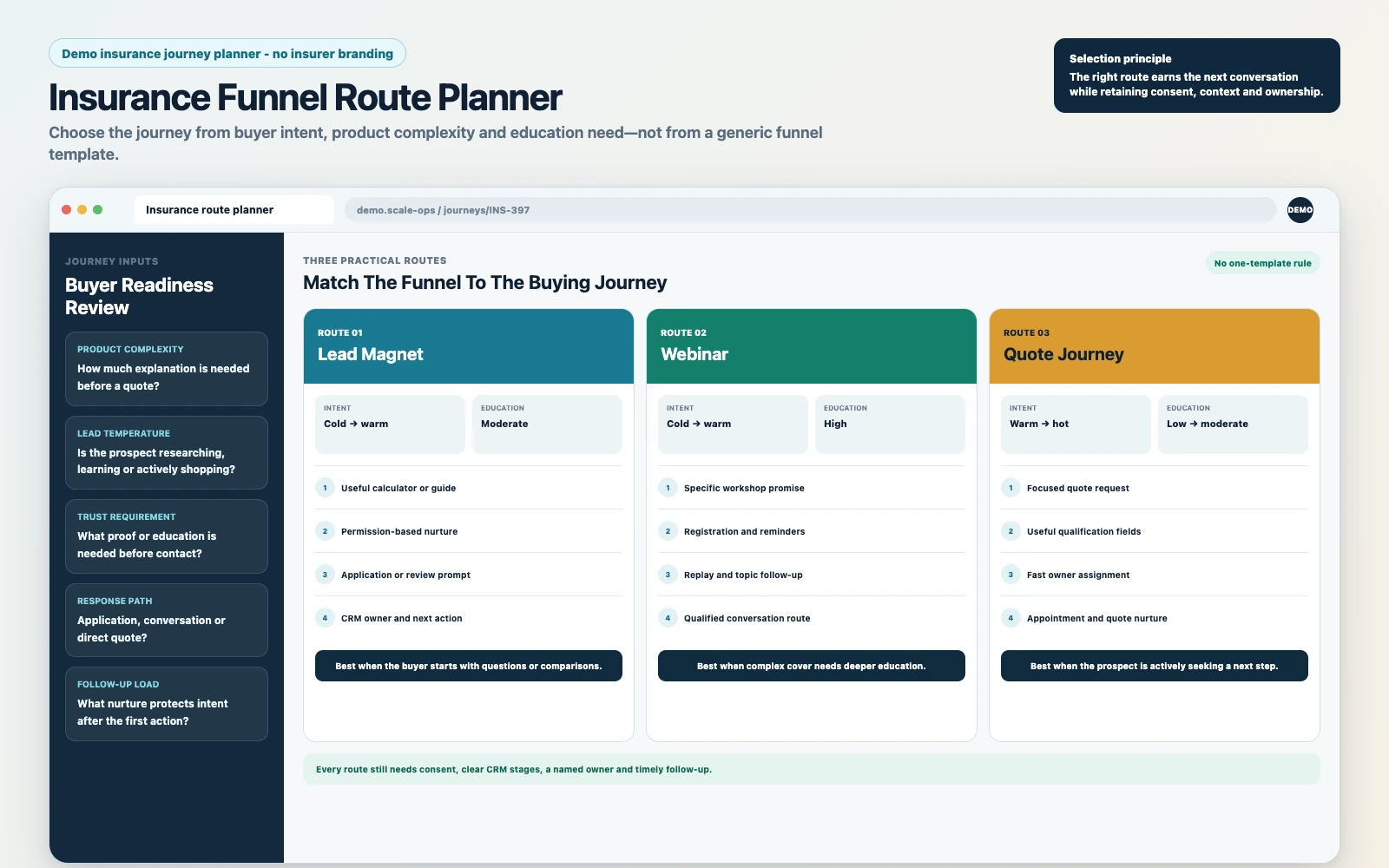
Match The Funnel To Buyer Readiness
Choose the funnel using product complexity, lead temperature and follow-up needs.
Give Complex Decisions Enough Context
Lead-magnet, webinar and quote funnels support different insurance buying journeys.
Connect Every Response To An Owner
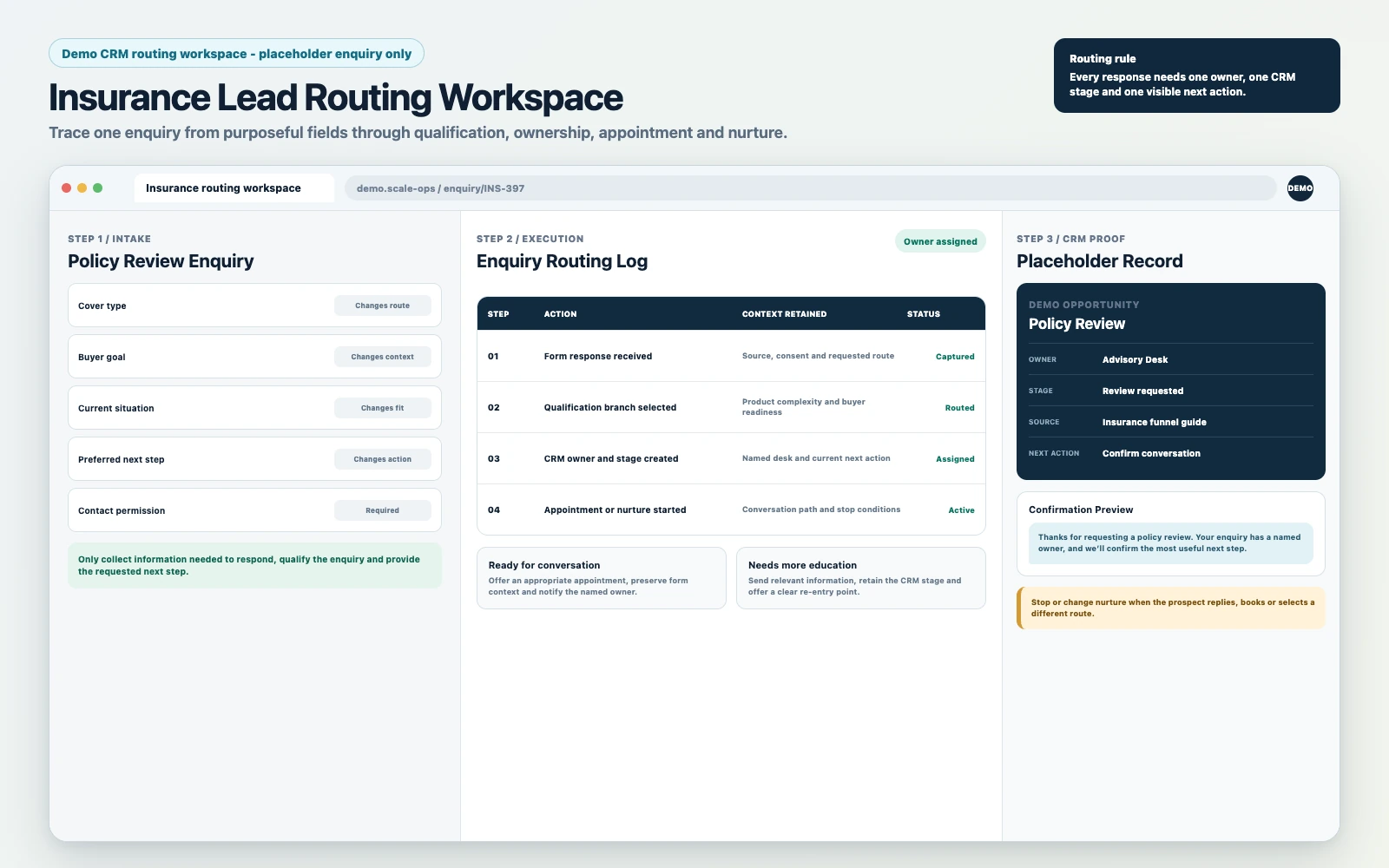
Qualification, CRM routing, appointment booking and nurture fit together.
Measure Qualified Momentum, Not Raw Leads
Diagnostic metrics reveal the real source of weak performance.
An insurance agent sales funnel is a structured system that guides prospects from initial awareness through to becoming paying clients. Unlike traditional cold calling or referral-only approaches, a well-designed funnel automates lead generation, nurtures relationships, and converts prospects at scale. For insurance agents competing in crowded markets, the right funnel architecture can mean the difference between feast and famine.
For the wider strategy, start with how an insurance agent sales funnel creates reliable policy sales, then use how to build trust before the first call to shape the proof, education and follow-up each funnel needs.
Quick Answer
The best insurance agent sales funnel depends on how much education and trust the prospect needs before requesting a quote or conversation. Use a lead-magnet funnel for early research, a webinar funnel for complex education and a quote funnel for higher-intent prospects. In every case, connect the form to clear CRM routing, timely follow-up and a measurable next step.
TL;DR
- Choose the funnel around buyer readiness, not the latest template.
- Keep the three core routes: lead magnet, webinar and quote.
- Route every response into a defined CRM stage and owner.
- Measure qualified conversations and policy opportunities, not raw leads alone.
Insurance Funnel Decision Table
| Funnel | Best Fit | Lead Temperature | Education Need | Follow-Up Requirement |
|---|---|---|---|---|
| Lead magnet to application | Products where prospects begin with questions or comparisons | Cold to warm | Moderate | Segmented email/SMS nurture before application or call |
| Webinar or workshop | Complex cover, business insurance or topics requiring explanation | Cold to warm | High | Registration reminders, replay and topic-specific follow-up |
| Quote funnel with nurture | Prospects already seeking a price, review or next step | Warm to hot | Low to moderate | Fast routing, appointment prompts and quote follow-up |
Why Insurance Agents Need a Sales Funnel
Most insurance agents struggle with inconsistent lead flow. They depend on referrals, purchased leads that rarely convert, or time-intensive networking that doesn’t scale. A sales funnel solves this by creating a predictable system that works while you’re meeting clients or handling renewals.
The core benefit is automation paired with personalisation. Prospects enter your funnel through targeted content or ads, receive value upfront, and are nurtured through email sequences and retargeting until they’re ready to book a consultation. This approach filters out tire-kickers and delivers warmer leads who already understand your value proposition.
Funnel Example 1: The Lead Magnet to Application Funnel
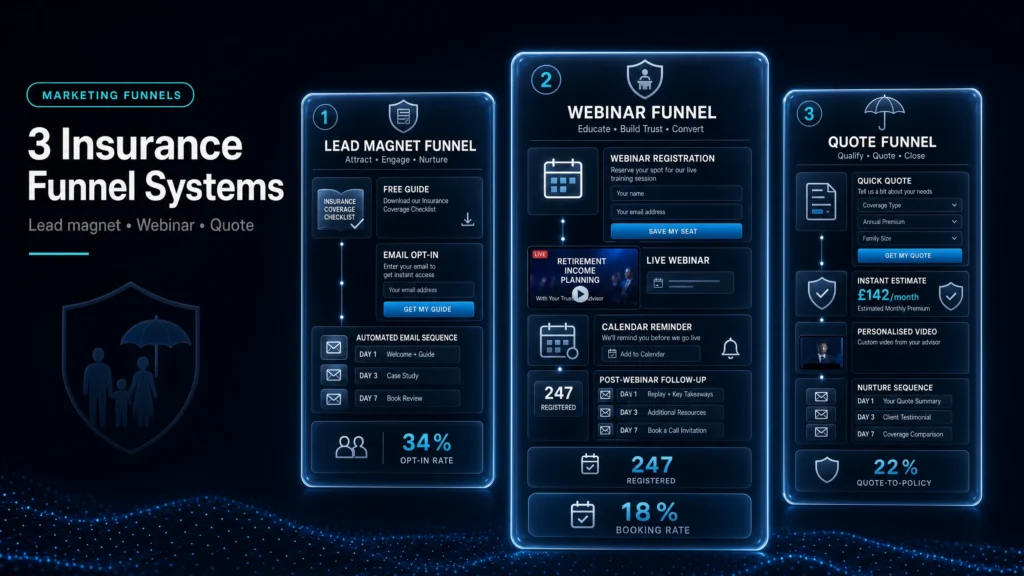
This funnel starts with a high-value lead magnet designed to solve a specific problem your ideal client faces. For insurance agents, effective lead magnets include:
- A life insurance needs calculator
- A downloadable guide on reducing business insurance costs
- A checklist for reviewing existing coverage gaps
- A comparison tool for health insurance plans
The prospect lands on a dedicated page, enters their email to access the resource, and immediately receives the promised asset. Behind the scenes, they’re added to an automated email sequence that delivers additional value while positioning you as the trusted advisor.
The sequence typically includes educational content about common insurance mistakes, client success stories, and eventually a clear call to book a free policy review or consultation. The key is to provide genuine value at each touchpoint rather than pushing for a sale immediately.
This insurance agent sales funnel works particularly well for agents targeting specific niches like small business owners, young families, or retirees, because the lead magnet can be tailored to address their unique concerns.
Funnel Example 2: The Webinar or Workshop Funnel
For agents selling more complex products like whole life insurance, annuities, or commercial policies, a webinar funnel builds authority and allows for deeper education before the sales conversation.
The structure follows this sequence:
- Run targeted ads or organic content promoting a free workshop on a specific topic
- Drive registrations to a landing page with a clear value proposition
- Send reminder emails leading up to the event to maximise attendance
- Deliver the webinar with 70% education and 30% pitch for a consultation
- Follow up with attendees through segmented email sequences based on engagement
- Retarget no-shows with replay access and alternative conversion paths
This funnel works because it positions you as an educator first and salesperson second. Prospects who attend a 45-minute webinar have demonstrated serious interest and are far more qualified than cold leads. The time investment also creates reciprocity, making them more likely to take the next step.
Topics that perform well include retirement income planning, tax-advantaged insurance strategies, estate planning with life insurance, and navigating Medicare options. The more specific and outcome-focused your topic, the better your conversion rates.
Funnel Example 3: The Quote Funnel with Nurture Sequence
This is the most direct approach and works well for commoditised insurance products like auto, home, or term life insurance where prospects are actively shopping.
The funnel begins with a simple quote form embedded on your website or hosted on a standalone landing page. Unlike generic quote tools, this version captures enough information to provide a ballpark estimate while also qualifying the lead.
After submitting the form, prospects receive an instant estimate along with a personalised video or email from you explaining the next steps. This human touch differentiates you from faceless comparison sites and builds immediate rapport.
The critical component is what happens next. Not everyone who requests a quote is ready to buy immediately. Your automated follow-up sequence should include:
- Educational content about coverage options and common exclusions
- Social proof through testimonials or case examples
- Reminders about the quote with easy scheduling links
- Retargeting ads that reinforce your unique value proposition
This insurance agent sales funnel converts best when you segment leads based on their quote details and tailor follow-up messaging accordingly. Someone requesting a high-value policy needs different nurturing than a budget-conscious shopper.
Key Components Every Insurance Sales Funnel Needs
Regardless of which funnel model you choose, certain elements are non-negotiable for success.
Traffic Sources That Convert
Your funnel only works if qualified prospects enter it. Effective traffic sources for insurance agents include Google Ads targeting high-intent keywords, Facebook and Instagram ads with detailed demographic targeting, SEO-optimised content that ranks for buyer-intent searches, and strategic partnerships with complementary professionals like mortgage brokers or financial advisors.
Landing Pages That Focus Attention
Every funnel stage needs a dedicated landing page with a single clear objective. Remove navigation menus, limit choices, and make the desired action obvious. Your headline should speak directly to the prospect’s pain point or desired outcome, not your credentials.
Email Sequences That Build Trust
The fortune is in the follow-up. Most prospects won’t convert on first contact, so your email automation needs to nurture relationships over weeks or months. Mix educational content with personal stories and clear calls to action. Track open rates and click-through rates to optimise messaging over time.
CRM and Pipeline Management
A funnel without proper tracking is just guesswork. Use a CRM system that integrates with your marketing tools to track every lead from first touch to closed policy. This visibility allows you to identify bottlenecks, calculate true cost per acquisition, and scale what works.
Common Mistakes That Kill Insurance Funnel Performance
Even well-designed funnels fail when agents make these critical errors.
The first is asking for too much information too soon. Long forms kill conversion rates. Collect only what you need to provide value at each stage, then gather additional details during the sales conversation.
Another mistake is generic messaging that could apply to any agent. Your funnel content should reflect your specific expertise, ideal client, and unique approach. Bland, corporate language doesn’t build trust or differentiate you from competitors.
Many agents also neglect speed-to-lead. When someone requests a quote or books a consultation, a prompt acknowledgement helps preserve intent and makes the next step clear. Automation can send the immediate confirmation, but a named owner and response-time expectation are still needed for meaningful follow-up.
Finally, agents often abandon leads too quickly. Insurance is a considered purchase with long decision cycles. A prospect who doesn’t convert in week one might be ready in month three. Persistent, value-driven follow-up separates top performers from everyone else.
How to Choose the Right Funnel for Your Insurance Business
The best funnel depends on your product mix, target market, and current business stage.
If you’re selling straightforward products to price-conscious consumers, the quote funnel with strong follow-up is your fastest path to results. It aligns with existing buyer behaviour and can generate leads quickly with paid traffic.
For agents focused on high-value or complex products requiring significant education, the webinar funnel builds authority and pre-qualifies serious prospects. It requires more upfront work but delivers higher-quality conversations.
The lead magnet funnel offers the most flexibility and works across product types. It’s ideal for building an audience over time and can feed prospects into multiple product offerings based on their interests and behaviours.
Most successful agents eventually run multiple funnels simultaneously, each targeting different segments or products. Start with one, optimise until it’s profitable, then layer in additional funnels to diversify your lead sources.
A Practical Insurance Funnel Implementation Sequence
- Choose one audience and product journey. Avoid mixing unrelated needs on one landing page.
- Define the conversion event. Decide whether the next step is a download, registration, quote request, application or booked conversation.
- Write the minimum qualification questions. Collect details that affect routing and readiness without creating unnecessary friction.
- Build CRM routing and ownership. Assign each response to a pipeline stage, owner and response-time expectation.
- Create the follow-up path. Match messages to the action taken and the questions a prospect is likely to have next.
- Test the full journey. Submit a real test lead, confirm notifications, booking, nurture, stage movement and source attribution.
Insurance Funnel Diagnostics
| Issue | Likely Cause | Fix | Metric To Watch |
|---|---|---|---|
| Downloads but few applications | The lead magnet does not create a relevant next step | Add a product-specific bridge and segmented nurture | Application rate by lead magnet |
| Registrations but low attendance | Weak reminder and pre-event context | Add calendar confirmation, reminders and a clear learning promise | Attendance and replay rate |
| Quote requests but slow contact | Unclear ownership or manual routing | Route immediately by product, location or agent availability | First-response time |
| High lead volume but poor fit | Traffic and qualification do not match the offer | Tighten targeting and add only decision-relevant questions | Qualified conversation rate |
| Unknown source of policy opportunities | Attribution is lost between form and CRM | Persist source data and standardise opportunity stages | Opportunities by source |
Which Insurance Funnel Should An Agent Choose?
An insurance agent should choose a funnel by matching buyer readiness to the amount of education required before the next conversation. A lead-magnet funnel suits prospects who are researching a risk, policy type or comparison and need useful guidance before applying. A webinar or workshop funnel works when the topic is complex enough to benefit from structured explanation, examples and live or recorded questions. A quote funnel is better for prospects already showing clear intent and expecting a fast response. Whichever route is chosen, the funnel should collect only decision-relevant information, record consent appropriately, route the lead to a named owner and trigger follow-up that reflects the action taken. The CRM should show source, product interest, qualification, appointment status and opportunity stage. That structure helps the agent improve the buying journey without implying that automation replaces professional advice, suitability checks or required compliance processes.
Measuring What Matters in Your Insurance Sales Funnel
You can’t improve what you don’t measure. Track these metrics to optimise performance:
Cost per lead tells you how much you’re spending to get someone into your funnel. This varies by traffic source and targeting, but you need a baseline to evaluate profitability.
Lead-to-appointment rate shows how effectively your nurture sequences convert prospects into sales conversations. Low rates indicate messaging problems or poor lead quality.
Appointment-to-close rate reflects your sales effectiveness once you’re in conversation. If this is low, the issue isn’t your funnel but your sales process or offer positioning.
Customer lifetime value determines how much you can afford to spend acquiring clients. Insurance agents with strong retention and cross-selling see much higher lifetime values, allowing for more aggressive funnel investment.
Review these metrics monthly and run small tests to improve each stage. Even modest improvements compound over time into significant revenue increases.
Conclusion
An effective insurance agent sales funnel transforms how you generate and convert leads. Whether you implement a lead magnet approach, webinar funnel, or quote-based system, the goal remains the same: create a predictable, scalable process that delivers qualified prospects consistently.
The right funnel is the one that matches buyer readiness, routes the enquiry correctly and gives the agent a useful, measurable follow-up path.
FAQs
When is each insurance funnel type most useful?
A lead-magnet funnel suits prospects who are still researching, while a webinar supports decisions that need more explanation. A quote funnel fits prospects already showing clearer intent and expecting a direct next step.
How much information should an insurance funnel form collect?
Collect only information that changes qualification, routing or the next action. Additional details can be gathered during the sales conversation when they are actually needed.
What should happen after an insurance enquiry arrives?
The enquiry should receive a prompt acknowledgement, enter a defined CRM stage and reach a named owner. The next route should match the action taken, such as booking, application or relevant nurture.
Which measurements matter more than raw lead volume?
Qualified conversations, policy opportunities and movement from enquiry to appointment show whether the funnel is creating useful demand. Source and CRM-stage data help reveal where momentum is being lost.
