Quick Answer
An in-house funnel build works when the offer is simple, traffic volume is low and the CRM handoff is straightforward. A sales funnel agency becomes the better option when conversion, tracking, follow-up and sales operations need to move together.
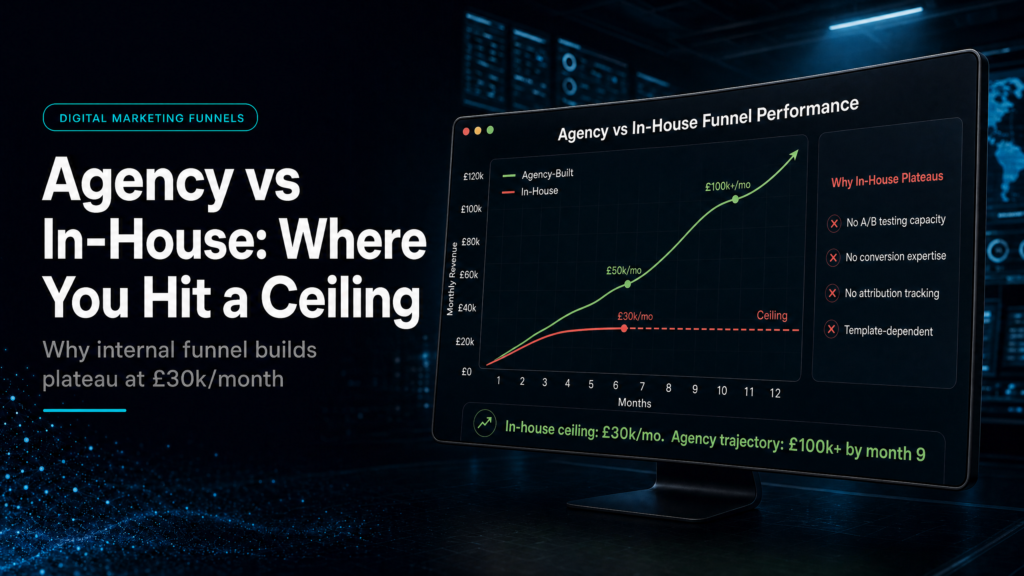
Internal teams often start with the right instinct: move fast and build the first version. The ceiling appears when every improvement needs copy, design, CRM logic, automation, analytics and sales feedback at the same time.
This is a support guide for the canonical sales funnel agency hiring checklist. Use it to narrow the decision, then use the checklist when you are ready to compare partners.
If the bottleneck is the funnel model rather than the team, run this funnel agency pressure check before deciding whether an internal build or a specialist partner is the right next move.
TL;DR
- In-house is fine for simple tests and early proof.
- Agency support helps when funnel complexity starts crossing into CRM, reporting and sales operations.
- The biggest in-house gap is usually not design. It is the operational handoff after conversion.
- A specialist build should leave your team with clearer reporting, not a black box.
Sales funnel agency vs in-house decision table
| Decision point | Weak sign | Strong sign | What SCALE checks |
|---|---|---|---|
| Speed | Internal team ships slowly because every part competes for time | Agency has a defined build and QA process | Whether the project can launch without dragging core staff away |
| Expertise | Copy, design, CRM and reporting are split across people | One system owner connects the whole journey | Whether handoffs are designed before launch |
| Tracking | Analytics is added after the page goes live | Tracking is built into forms, fields and stages | Whether attribution survives real traffic |
| Optimisation | Changes are opinion-led | Changes come from source, stage and conversion evidence | Whether weekly decisions are evidence-based |
Where in-house builds work well
In-house builds are useful for early validation. If the offer is still changing, the traffic source is small, and the goal is learning, internal speed can beat external process.
- Early offer tests.
- Simple landing pages.
- Low-volume campaigns where manual follow-up is acceptable.
Where the ceiling appears
The ceiling appears when the funnel needs coordinated changes across copy, layout, fields, pipeline stages, automations and reporting. That is when a page project becomes a revenue operations project.
- Source data is inconsistent.
- Sales feedback does not reach the page.
- Follow-up timing is manual or uneven.
- No one owns end-to-end QA.
How to choose without overbuying
Do not hire an agency just because you can. Hire when the cost of slow learning, missed leads or unclear attribution is greater than the cost of a specialist build.
- Check current leak points first.
- Define the result you need.
- Ask for the build process and reporting path before price.
Implementation process
- List the funnel tasks your team currently handles internally.
- Identify which tasks are blocking speed, accuracy or conversion.
- Trace one recent lead from source to outcome and document every manual step.
- Decide what should remain internal and what needs specialist build support.
- Scope the agency build around the handoffs your team cannot keep owning.
- Keep weekly reporting internal so the business still controls the decisions.
Common problems and fixes
| Decision point | Weak sign | Strong sign | What SCALE checks |
|---|---|---|---|
| Slow launch | Too many internal owners | Create one build owner and deadline | Time to launch |
| Tracking gaps | Analytics added too late | Map fields and events before build | Known-source rate |
| Lead leakage | Manual follow-up | Add speed-to-lead workflows | Contact rate |
| Unclear ROI | No source-to-stage data | Report by source, stage and outcome | Pipeline value by source |
What this means for revenue
The right decision is not agency versus in-house forever. It is who should own the next constraint. If the constraint is revenue-system architecture, a focused sales funnel agency can move faster than a stretched internal team.
SCALE looks at the whole commercial path: the landing page, the funnel promise, CRM fields, pipeline stages, calendar routing, speed-to-lead automation, source tracking, and reporting. A good funnel is not just a page. It is the operating system behind the page.
Want SCALE to inspect the funnel, CRM and follow-up system before you commit? Book a free Growth Systems Audit.
FAQs
When should we keep funnel building in-house?
Keep it in-house when the funnel is simple, traffic is low, and your team can reliably handle copy, page changes, CRM updates, tracking and follow-up.
When should we hire a sales funnel agency?
Hire when the funnel touches multiple systems, lead leakage is expensive, reporting is unclear, or your team cannot improve conversion quickly enough alongside normal work.
Will an agency replace our internal marketing team?
It should not. A good agency gives the internal team a cleaner system, better reporting and a stronger conversion path to manage.
