
If you’re running a digital marketing agency, you already know that selling your services is fundamentally different from selling products. The decision cycle is longer, the investment is higher, and prospects need to trust you with their revenue before they’ll sign a contract. That’s why building a sales funnel for digital marketing agency services isn’t just helpful—it’s essential for predictable growth.
Most agencies rely on referrals, cold outreach, or hoping their website converts. But a properly structured funnel systematically moves prospects from awareness to booked calls to signed contracts, often generating significant revenue in compressed timeframes when executed correctly.
If the funnel also depends on GoHighLevel, the build needs clean CRM stages, follow-up rules and attribution before traffic scales. Use the GoHighLevel expert guide to check when a funnel should be rebuilt by a specialist rather than patched inside a generic template. SCALE builds GoHighLevel CRM, funnel and automation systems for businesses that need better lead quality, faster follow-up and clearer attribution.
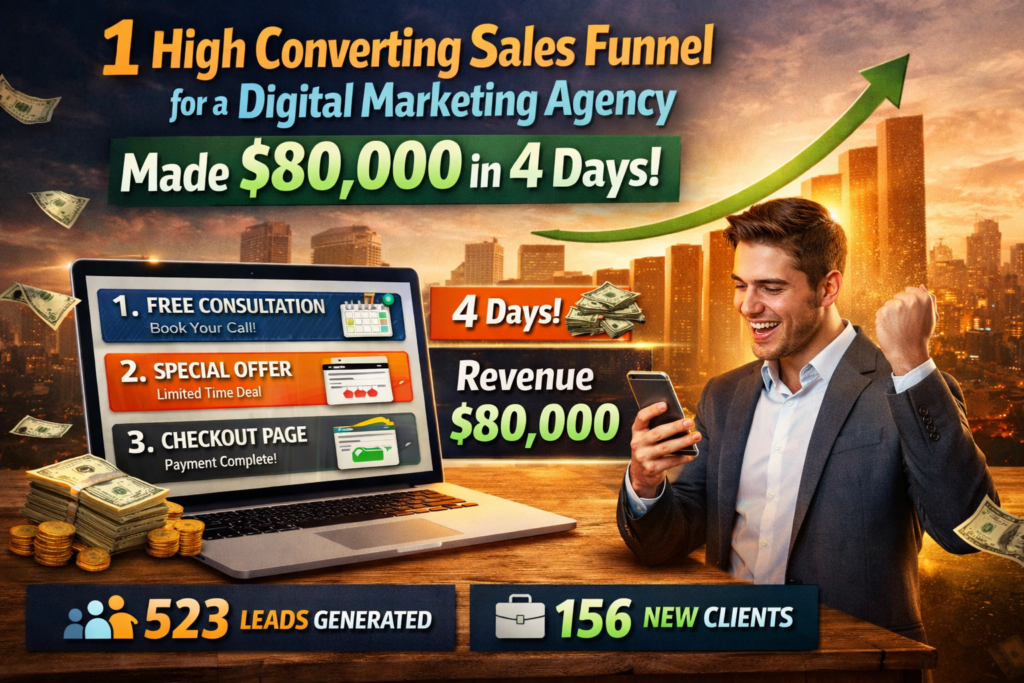
How Our Highest Converting Sales Funnel for a Digital Marketing Agency Generated Us $80,000 in 4 Days…
A well-designed agency sales funnel doesn’t need months to prove itself. When the offer is clear, the targeting is precise, and the funnel mechanics work together, results can happen quickly. In one recent example, a digital marketing agency launched a funnel promoting a specific service package—SEO audits with implementation—and generated $80,000 in signed contracts within four days of going live.
This wasn’t luck. It was the result of understanding exactly what a sales funnel needs to do for an agency, and building each stage to move prospects toward a buying decision.
What Makes a Sales Funnel for Digital Marketing Agency Services Different
Agency services are high-consideration purchases. Your prospects aren’t buying a $47 course or a SaaS subscription they can cancel next month. They’re committing to an ongoing relationship that could cost thousands per month and directly impact their business performance.
This means your funnel needs to do more than capture emails. It needs to:
- Establish authority and demonstrate expertise quickly
- Qualify prospects so you’re not wasting time on calls with businesses that can’t afford your services
- Address objections and build trust before the sales conversation
- Make booking a call feel like the logical next step, not a high-pressure commitment
- Deliver enough value that prospects arrive on calls already half-sold
The funnel that generated $80,000 in four days did all of this through a combination of paid traffic, a high-value lead magnet, automated email sequences, and a frictionless booking process.
The Core Components of a High-Converting Agency Sales Funnel
Traffic Source and Targeting
The funnel started with paid ads on Facebook and LinkedIn, targeting business owners in specific industries where the agency had proven case studies. The targeting was narrow—companies with 10-50 employees in e-commerce and professional services—because broad targeting dilutes message-market fit.
The ad creative focused on a single pain point: wasted ad spend with no clear attribution. It promised a free audit that would identify exactly where money was being lost and how to fix it.
The Lead Magnet and Landing Page
Instead of a generic PDF or checklist, the lead magnet was a live audit. Prospects filled out a detailed questionnaire about their current marketing, which served two purposes: it provided the information needed to deliver a genuinely useful audit, and it qualified leads by requiring effort upfront.
The landing page was direct. It explained what the audit included, showed examples of findings from previous audits, and made it clear this was for businesses currently spending on marketing but not seeing ROI. No fluff, no hype—just a clear value proposition for a specific audience.
Email Nurture Sequence
After opting in, prospects entered a five-email sequence over seven days. Each email delivered a specific insight related to common marketing problems the agency solved:
- Why most agencies can’t prove ROI (and how to fix your tracking)
- The attribution problem costing you 30% of your ad budget
- How to audit your funnel for conversion leaks in 15 minutes
- Case study: How one client cut acquisition costs by 40% in 60 days
- Your audit is ready—here’s what we found (personalized)
Each email included a soft call-to-action to book a strategy call, but the primary goal was to build authority and demonstrate the agency’s depth of knowledge. By email five, prospects had received their personalized audit and were primed for a conversation.
The Booking and Sales Process
The calendar booking page included a short application form. This wasn’t about creating false scarcity—it was about ensuring the agency only spoke with qualified prospects who had budget, authority, and a genuine need.
Questions included current monthly marketing spend, primary business goal for the next 90 days, and what success would look like. This information allowed the sales team to personalize each call and arrive prepared with relevant insights.
The calls themselves weren’t traditional sales pitches. They were strategy sessions where the agency walked through the audit findings, explained the recommended fixes, and presented a clear implementation plan with pricing. Because prospects had already consumed multiple touchpoints of valuable content, the close rate was significantly higher than cold outreach or generic discovery calls.
Why This Sales Funnel for Digital Marketing Agency Services Worked
The $80,000 in four days came from eight signed contracts. The funnel generated 247 leads, 89 booked calls, 34 completed calls, and 8 closes. That’s a 23% close rate from completed calls—well above industry average for agency services.
Several factors contributed to this performance:
Specificity of offer: The funnel wasn’t selling “digital marketing services.” It was selling a solution to a specific problem for a specific audience. This made the messaging sharper and the value proposition clearer.
Qualification built into the process: By requiring effort at multiple stages—detailed questionnaire, email engagement, application form—the funnel filtered out tire-kickers and attracted serious prospects.
Value delivery before the sale: The personalized audit wasn’t a gimmick. It provided genuine insights prospects could act on even if they didn’t hire the agency. This built trust and demonstrated capability.
Automation where it matters: The email sequence, booking system, and CRM workflows were fully automated using GoHighLevel. This allowed the agency to run the funnel without manual intervention until the sales call stage.
Clear path to purchase: Every stage of the funnel had one job and one next step. There was no confusion about what prospects should do or why they should do it.
Building Your Own Agency Sales Funnel
You don’t need a massive budget or complex tech stack to build an effective sales funnel for your digital marketing agency. You need clarity on who you serve, what problem you solve, and how to demonstrate your expertise before asking for the sale.
Start by identifying your best clients—the ones who pay well, get results, and refer others. Identify the 3 “Whats”:
- What industry are they in?
- What problem did they hire you to solve?
- What objections did they have before signing?
Build your funnel around that specific use case. Create a lead magnet that addresses the core problem. Write emails that educate and build authority. Design your sales process to qualify and convert the right prospects.
The technical implementation matters less than the strategy. Whether you use GoHighLevel, ClickFunnels, or a combination of WordPress and ActiveCampaign, the principles remain the same: attract the right people, deliver value, qualify interest, and make buying easy for those who are ready.
Common Mistakes That Kill Agency Funnel Performance
Even well-designed funnels fail when agencies make these errors:
Trying to serve everyone: A funnel that targets “small businesses” or “companies that need marketing” will underperform against one that targets “e-commerce brands doing $500K-$3M annually who struggle with customer retention.”
Weak lead magnets: Generic checklists and tip sheets don’t qualify leads or demonstrate expertise. Your lead magnet should require some expertise to create and deliver genuine value.
No qualification mechanism: If you’re taking calls with anyone who books, you’re wasting time. Build qualification into your forms and email sequences.
Selling too early: Prospects need to trust you before they’ll buy from you. If your first email is a pitch, you’ve lost them.
Ignoring follow-up: Most prospects won’t buy on the first call. Have a systematic follow-up process for nurturing opportunities that aren’t ready yet.
Measuring What Matters in Your Agency Funnel
Track these metrics to understand funnel performance and identify improvement opportunities:
- Cost per lead from each traffic source
- Lead-to-booking conversion rate
- Booking-to-show rate
- Show-to-close rate
- Average contract value
- Customer acquisition cost
- Time from lead to close
The funnel that generated $80,000 had a cost per lead of $32, meaning the total ad spend was approximately $7,900. With $80,000 in signed contracts, that’s a 10x return on ad spend in four days—before accounting for the lifetime value of those clients.
But the real value wasn’t just the immediate revenue. It was proving that the agency had a repeatable system for generating qualified opportunities on demand, independent of referrals or inbound luck.
Conclusion
A properly built sales funnel for digital marketing agency services transforms how you acquire clients. Instead of hoping for referrals or grinding through cold outreach, you create a systematic process that attracts qualified prospects, demonstrates your expertise, and converts them into paying clients.
The $80,000 in four days wasn’t an anomaly—it was the result of understanding what agency buyers need to see before they’ll commit, and building a funnel that delivers it. Whether you’re just starting to build your funnel or optimizing an existing one, focus on specificity, qualification, and value delivery. The technical details matter less than the strategic foundation.
Want SCALE to build this for your business?
Book a free Growth Systems Audit and we will show you where your funnel, CRM and follow-up system are leaking revenue.
Learn more below:
