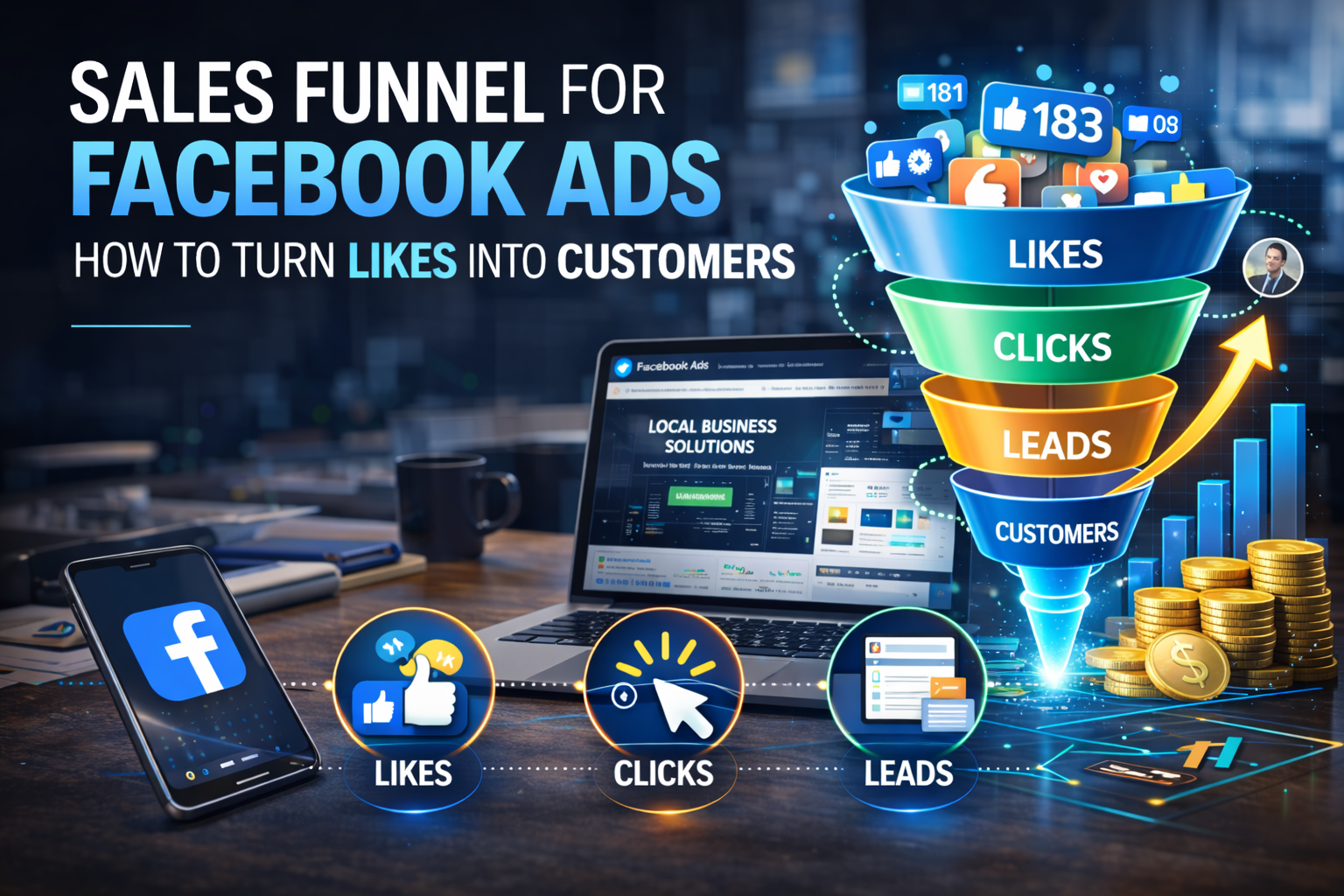
If you’re running Facebook ads to sales funnels and wondering why your likes aren’t translating into customers, you’re not alone. The secret isn’t just in creating eye-catching ads—it’s in building a strategic sales funnel that guides potential customers from their first interaction to final purchase. Let’s dive into how successful brands structure their Facebook ad funnels to maximize conversions.
What Is a Facebook Ads Sales Funnel?
A Facebook ads sales funnel is a multi-stage marketing system designed to move users through different phases of awareness, consideration, and decision-making. Unlike traditional advertising that pushes for immediate sales, a well-constructed funnel nurtures relationships and builds trust before asking for the purchase.
Think of it as a journey: not everyone who sees your ad is ready to buy immediately, some people are just discovering your brand, and others might be comparing options. Your funnel addresses each stage with targeted messaging and offers.
The Three Core Stages of a Facebook Ads Sales Funnel
Top of Funnel (TOFU): Awareness Stage
At the awareness stage, your goal is to introduce your brand to cold audiences who’ve never heard of you. These ads focus on education, entertainment and value rather than direct selling.
Effective top-of-funnel content includes:
- Educational blog posts or videos that solve common problems
- Engaging content that showcases your brand personality
- Free resources like guides, templates, or quizzes
- Behind-the-scenes content that builds brand story
- User-generated content and testimonials
The key metric here isn’t conversions—it’s engagement and reach. You’re building an audience for retargeting in later stages.
Middle of Funnel (MOFU): Consideration Stage
Now you’re targeting people who’ve interacted with your brand—they’ve watched your videos, visited your website, or engaged with your content. These warm audiences need more information to move closer to purchase.
Middle-of-funnel strategies include:
- Detailed product demonstrations and tutorials
- Case studies and customer success stories
- Comparison guides that position your solution
- Webinars or live Q&A sessions
- Lead magnets in exchange for email addresses
At this stage, you’re building trust and authority while addressing objections and showcasing your unique value proposition.
Bottom of Funnel (BOFU): Conversion Stage
The bottom of the funnel targets hot audiences—people who’ve added items to cart, visited pricing pages, or downloaded your lead magnet. These users are closest to purchase and need that final push.
Conversion-focused tactics include:
- Special discount offers and limited-time promotions
- Free trial or money-back guarantee messaging
- Cart abandonment retargeting campaigns
- Customer testimonials and social proof
- Direct product ads with clear calls-to-action
Building Your Facebook Ads Funnel: A Step-by-Step Framework
Creating an effective sales funnel requires strategic planning and execution. Follow this proven framework to build your own conversion machine:
- Define your customer avatar: Understand who you’re targeting, their pain points, desires, and objections at each stage
- Create stage-specific content: Develop ad creative and messaging tailored to awareness, consideration, and conversion
- Set up Facebook Pixel: Install tracking to monitor user behavior and create custom audiences for retargeting
- Build custom audiences: Create segments based on engagement levels, website visitors, video views, and past purchasers
- Design your ad sequences: Map out which ads users see based on their previous interactions
- Optimize your landing pages: Ensure each ad leads to a relevant, conversion-optimized destination
- Test and refine: Continuously A/B test ad creative, copy, audiences, and offers to improve performance
Common Facebook Ads Funnel Mistakes to Avoid
Even experienced marketers make critical errors that sabotage their funnel performance. Here are the most common pitfalls:
Skipping the warming phase: Pushing for immediate sales from cold audiences rarely works. People need multiple touchpoints before trusting a brand enough to purchase.
Inconsistent messaging: Your ads should tell a cohesive story throughout the funnel. Disconnected messaging confuses potential customers and breaks trust.
Ignoring retargeting: Most conversions happen after multiple interactions. If you’re not retargeting engaged users, you’re leaving money on the table.
Poor audience segmentation: Showing conversion ads to cold audiences or awareness content to hot leads wastes budget and frustrates users.
Advanced Funnel Optimization Strategies
Once you’ve mastered the basics, these advanced techniques can significantly boost your funnel performance:
Implement exclusion audiences: Prevent ad fatigue by excluding people who’ve already converted or moved to the next stage. This improves ad relevance and reduces wasted spend.
Use dynamic product ads: Automatically show users the exact products they viewed on your website, creating highly personalized retargeting experiences.
Create lookalike audiences: Let Facebook find new cold audiences that share characteristics with your best customers, improving top-of-funnel efficiency.
Leverage video sequencing: Show a series of videos that tell a story, with each video targeting people who watched a certain percentage of the previous one.
Measuring Funnel Success: Key Metrics to Track
Different funnel stages require different success metrics. Here’s what to monitor at each level:
Top of Funnel Metrics: Cost per thousand impressions (CPM), engagement rate, video view completion rate, click-through rate (CTR), and cost per engagement.
Middle of Funnel Metrics: Landing page conversion rate, cost per lead, email opt-in rate, content download rate, and webinar registration rate.
Bottom of Funnel Metrics: Return on ad spend (ROAS), cost per acquisition (CPA), conversion rate, average order value, and customer lifetime value.
Real-World Funnel Example: E-commerce Brand
Let’s look at how a successful e-commerce brand might structure their funnel:
Stage 1 – Awareness: Run engaging video ads showcasing lifestyle content related to their products. Target interests and demographics. Goal: Build a warm audience of video viewers.
Stage 2 – Consideration: Retarget video viewers with product-focused content, customer testimonials, and educational posts about product benefits. Goal: Drive traffic to the website and product pages.
Stage 3 – Conversion: Show special offers, discounts, and social proof to website visitors and cart abandoners. Use dynamic product ads for specific items viewed. Goal: Convert browsers into buyers.
Stage 4 – Retention: Target past purchasers with cross-sell and upsell campaigns, new product announcements, and loyalty programs. Goal: Increase customer lifetime value.
The Role of Email in Your Facebook Funnel
While Facebook ads drive initial awareness and engagement, email marketing is crucial for nurturing leads through the funnel.
Smart brands use Facebook ads to build email lists and then use automated sequences to warm leads and drive conversions.
This hybrid approach gives you a direct communication channel that doesn’t depend on Facebook’s algorithm or ad costs, making your funnel more sustainable and profitable long-term.
Conclusion
A well-designed Facebook ads sales funnel is the difference between burning through ad budget and building a profitable, scalable customer acquisition system. By understanding the customer journey and delivering the right message at the right time, you can transform casual browsers into loyal customers.
Start by mapping your current funnel—or creating one if you don’t have a structured approach yet. Focus on one stage at a time, test relentlessly, and refine based on data. Remember, the most successful brands didn’t build perfect funnels overnight; they continuously optimized based on results.
The question isn’t whether you need a sales funnel for your Facebook ads—it’s how quickly you can implement one to start turning those likes into revenue.
Want us to set this up for your business?
Book a FREE call with us to see how we can help by visiting: https://scale-agency.co/
Learn more below:
