
In this guide, we’ll cover:
The practical pieces that decide whether this funnel becomes a useful revenue system or another disconnected marketing asset.
Before chasing another KPI, compare the build against these agency funnel system examples so lead quality, CRM stages and follow-up pressure are designed together.
QUALITY
Cheap Leads Can Hide Expensive Problems
The funnel should measure whether leads become sales opportunities.
PIPELINE
Stages Reveal The Real Leak
CRM stages show whether the issue is capture, nurture, booking or close.
AUTOMATION
Follow-Up Protects KPI Gains
Speed-to-lead and reminders turn interest into booked conversations.
REPORTING
Revenue Visibility Beats Vanity Metrics
KPIs matter most when they connect source to revenue.
The strongest marketing agency sales funnel systems make KPI improvement visible at every handoff, not just at the lead form.
Quick Answer
Marketing agency sales funnel systems improve KPIs when they connect the full path from attention to booked call, sales follow-up and retained revenue. The real KPI lift comes from better qualification, cleaner CRM stages, faster response and clearer attribution – not just more traffic.
TL;DR
- Strong funnel KPIs start with lead quality, not cheap volume.
- Pipeline stages should show where prospects stall.
- Automation needs ownership, stop rules and appointment reminders.
- Reporting should connect traffic source to booked and closed revenue.
- A GoHighLevel expert checklist protects the funnel from front-end-only optimisation.
Funnel KPI Decision Table
| KPI | Weak version | Stronger version | Fix |
|---|---|---|---|
| Cost per lead | Cheap leads with low sales intent | Qualified leads with clear source and next step | Track quality, not just volume |
| Booked call rate | Manual chase and weak reminders | Fast routing plus appointment nurture | Automate handoff and reminders |
| Revenue attribution | Clicks and leads only | Booked, showed and closed by source | Connect CRM outcomes to reporting |
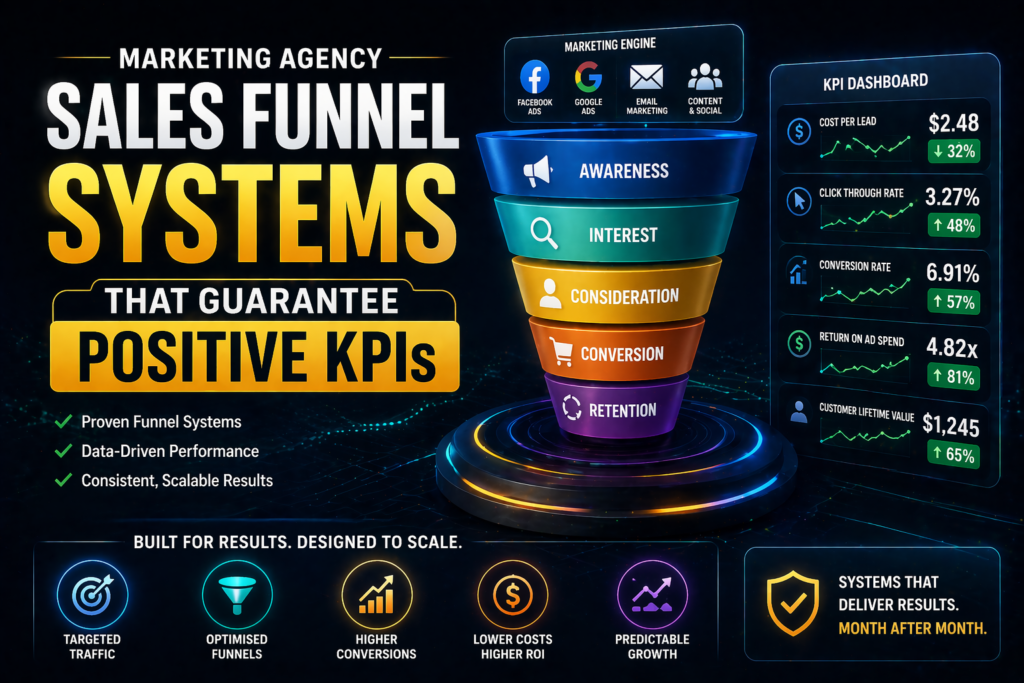
A strong marketing agency sales funnel does more than generate leads. It gives the agency a repeatable path from attention to booked calls to retained revenue, with clear checkpoints that improve KPI performance over time. In practice, agencies that hit stronger KPIs usually are not working harder. Instead, they are running a better funnel.
If you want SCALE to diagnose where your funnel is leaking lead quality or slowing conversion, book a free Growth Systems Audit and we will show you what needs tightening across traffic, nurture and close.
Why Marketing Agency Sales Funnel Systems Struggle Early
Marketing agencies face a unique problem: they’re expected to be experts at generating leads for clients, yet many struggle to generate quality leads for themselves. The irony isn’t lost on anyone.
In practice, the issue usually comes down to three things. First, agencies often lack a clear positioning statement, so their messaging appeals to everyone and resonates with no one. Next, they treat their own marketing as an afterthought, prioritising client work over internal systems. Finally, they confuse activity with strategy by posting on LinkedIn or running ads without a cohesive funnel architecture that nurtures and converts.
As a result, a marketing agency sales funnel solves this by creating a structured pathway that moves prospects from awareness to decision without requiring constant manual intervention. In other words, it is the difference between chasing leads and attracting them.
The Core Components of a High-Converting Marketing Agency Sales Funnel
Building a funnel that actually works requires more than a landing page and a contact form. You need a system that qualifies, educates, and converts at each stage.
Marketing Agency Sales Funnel: Top of Funnel Lead Capture
This is where prospects first encounter your agency. At this stage, the goal is not to sell. Instead, it is to capture attention and collect contact information from people who match your ideal client profile.
Effective top-of-funnel assets include:
- SEO-optimised content that ranks for high-intent keywords your prospects are searching
- Lead magnets like audits, templates, or strategy guides that solve a specific problem
- Paid ads targeting decision-makers in your niche with a clear value proposition
- Webinars or workshops that demonstrate expertise while collecting registrations
The key is to offer something valuable enough that a business owner willingly exchanges their email address for it. Generic “newsletters” don’t cut it anymore. You need specificity and immediate utility.
Marketing Agency Sales Funnel: Middle of Funnel Nurture and Qualification
Once someone enters your funnel, the next phase is about building trust and filtering out poor-fit prospects. Here, automation becomes critical.
At this point, your nurture sequence should accomplish several things simultaneously. It needs to educate prospects on why your approach works, demonstrate your expertise through case studies or frameworks, address common objections before they arise, and subtly qualify leads based on engagement and fit.
Meanwhile, email sequences, retargeting ads, and content hubs all play a role here. The goal is to stay present without being pushy while moving engaged prospects toward a conversation and letting unqualified leads self-select out.
Marketing Agency Sales Funnel: Bottom of Funnel Conversion and Onboarding
This is where your marketing agency sales funnel transitions from marketing to sales. By this stage, prospects should already understand what you do, believe you can help them, and be ready to discuss working together.
Your conversion mechanism might be a strategy call, a paid audit, or a proposal process—but whatever it is, it needs to be frictionless and clearly defined. Confusion kills conversions, so remove any ambiguity about what happens next.
After conversion, your onboarding process becomes part of the funnel experience. A smooth handoff from sales to delivery reinforces the decision to work with you and reduces buyer’s remorse.
How to Structure Your Marketing Agency Sales Funnel for Predictable Growth
Theory is useful, but execution is what separates agencies that grow from those that stagnate. Here’s a step-by-step framework for building your funnel.
- Define your ideal client profile with precision. Not just industry or company size, but the specific problems they’re facing and the outcomes they’re willing to pay for. Your entire funnel should speak directly to this person.
- Map the buyer journey from their perspective. What questions do they have at each stage? What objections will they raise? What proof do they need to see? Your content and messaging should answer these in sequence.
- Build your lead magnet around a specific outcome. Instead of “10 Marketing Tips,” offer “The Exact Lead Generation System We Use to Book 15 Sales Calls Per Week.” Specificity converts.
- Create an email nurture sequence that educates and qualifies. Five to seven emails over two weeks is a solid starting point. Each email should deliver value while moving the prospect closer to a decision.
- Implement lead scoring and segmentation. Not all leads are equal. Use engagement data to identify hot prospects and route them to sales faster, while continuing to nurture colder leads.
- Optimise your booking and sales process. Make it easy to schedule a call. Use a clear application or questionnaire to qualify leads before they hit your calendar. Respect everyone’s time.
- Measure, test, and refine continuously. Track conversion rates at each stage. Identify where prospects drop off and fix those leaks. Small improvements compound over time.
Automation and Technology Stack for Agency Funnels
You can’t scale a marketing agency sales funnel without the right tools. Manual follow-up doesn’t work when you’re trying to grow.
At a minimum, you need a CRM that tracks every interaction, email automation that nurtures leads without manual intervention, landing page software that converts traffic into contacts, and analytics that show you exactly where prospects are getting stuck.
Platforms like GoHighLevel are particularly well-suited for agencies because they combine CRM, email, SMS, booking, and pipeline management in one system. This eliminates the need to stitch together multiple tools and gives you a single source of truth for every prospect.
The goal isn’t to automate everything—it’s to automate the repeatable parts so your team can focus on high-value activities like strategy calls and client delivery.
Common Mistakes That Kill Marketing Agency Sales Funnels
Even well-intentioned agencies make critical errors that sabotage their funnels. Avoiding these pitfalls will save you months of wasted effort.
First, many agencies try to appeal to everyone. A funnel that targets “small businesses” or “companies that need marketing” will underperform every time. Specificity creates resonance, whereas generality creates indifference.
Second, some agencies neglect follow-up. Most prospects do not convert on the first touch, or even the fifth. Therefore, if you are not nurturing leads over weeks or months, you are leaving money on the table.
Another common mistake is overcomplicating the funnel. You do not need seventeen touchpoints and a dozen lead magnets. Instead, you need a clear path from problem to solution. Complexity creates friction, and friction kills conversions.
Finally, agencies often fail to qualify leads early. Not every prospect is a good fit, and that is fine. If you try to close everyone, you waste time and damage your close rate. Build qualification into your funnel so poor-fit prospects self-select out.
Measuring Success: KPIs That Actually Matter
A marketing agency sales funnel is only valuable if it delivers measurable results. Vanity metrics like page views or email open rates don’t pay the bills. Focus on the numbers that directly impact revenue.
Start by tracking cost per lead across each acquisition channel. Know how much you are spending to get someone into your funnel, and compare that to the lifetime value of a client. If your CAC is higher than your LTV, you have a problem.
Next, monitor conversion rates at each funnel stage. What percentage of visitors become leads? What percentage of leads book a call? What percentage of calls become clients? These ratios tell you exactly where to focus your optimisation efforts.
Then measure time to conversion. How long does it take for a lead to become a client? Shortening this timeline without sacrificing quality increases your cash flow and reduces the risk of prospects going cold.
Finally, track client acquisition cost and payback period. If it takes twelve months to recoup your acquisition cost, your funnel may be too expensive to scale. Aim for a payback period of three to six months for sustainable growth.
Scaling Your Funnel Without Sacrificing Quality
Once your marketing agency sales funnel is converting consistently, the next challenge is scaling it without breaking what’s working.
Start by increasing traffic to your proven funnel. If your conversion rates are solid, more traffic means more clients. This might mean increasing ad spend, doubling down on SEO, or expanding into new channels.
Next, test variations systematically. Change one element at a time—your headline, your lead magnet, your email sequence—and measure the impact. Small improvements across multiple touchpoints compound into significant gains.
Consider adding a self-service or lower-touch option for smaller clients. Not every prospect needs a full-service retainer. Offering a productised service or DIY option can capture leads that would otherwise slip through your funnel.
Finally, build a feedback loop between sales and marketing. Your sales team hears objections and questions that your marketing should address. Use that intelligence to refine your messaging and content continuously.
For stronger context, compare this with why every marketing agency needs a sales funnel to grow and six marketing agency sales funnel examples built for booked appointments. Those pages make it easier to see which systems improve KPI quality instead of just creating more activity.
Conclusion
A well-built marketing agency sales funnel system turns acquisition into a measurable operating model. It improves lead quality, pipeline visibility and follow-up discipline so KPI gains are not dependent on constant manual effort.
SCALE’s perspective is that KPIs only become useful when the CRM, funnel and automation are joined together. If sales cannot see source, stage, owner and outcome, the funnel is still guessing.
FAQs
Which funnel KPIs matter most for agencies?
Lead quality, booked call rate, show rate, cost per qualified lead and close rate usually matter more than raw lead volume.
Why do agency funnels struggle early?
Most struggle because the positioning is broad, follow-up is manual and CRM stages do not show where prospects stall.
How does automation improve funnel KPIs?
Automation protects speed-to-lead, reminders, segmentation and stop conditions. That reduces missed opportunities and improves conversion from captured lead to booked call.
What should reporting show?
Reporting should connect source, campaign, funnel stage, booked call, show rate and closed revenue. Leads alone are not enough.
When is a GoHighLevel expert useful?
A GoHighLevel expert is useful when the agency needs CRM, funnel, automation and reporting to work as one system.
