
Quick Answer: Which Agency Funnels Can Reduce Sales Pressure?
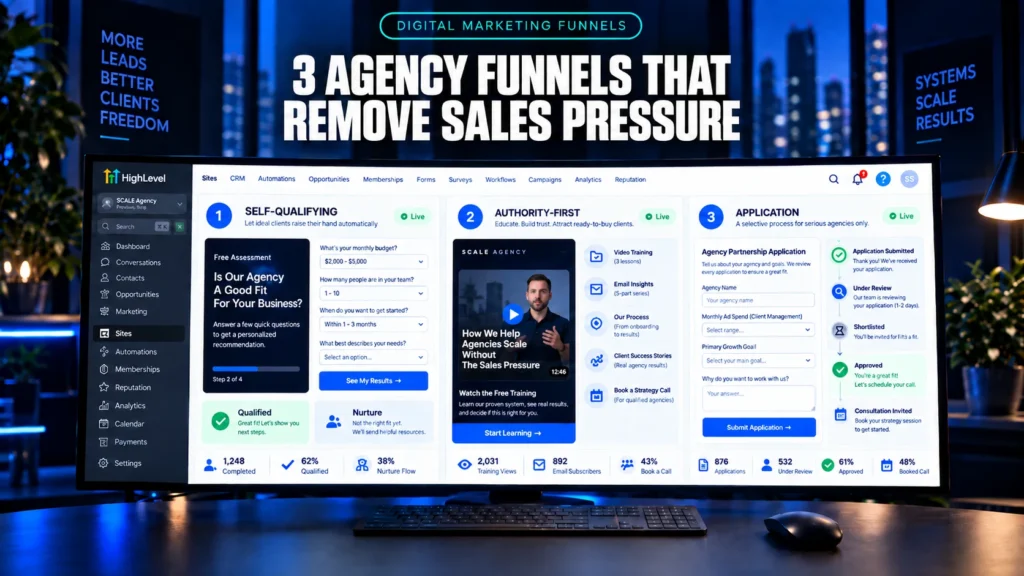
Three useful sales funnel agency systems are a self-qualifying funnel, an authority-first funnel and an application funnel. Use self-qualification to screen for fit before booking, useful education to prepare buyers who need more context, and an application review when suitability and delivery capacity need a human decision. Each system should make the next step clearer—not promise that every lead will buy.
TLDR
- Poor-fit calls: make eligibility clear and route enquiries using decision-relevant questions.
- Repeated explanations: help buyers understand the problem, your approach and its limits before the call.
- Limited capacity: review applications before offering a consultation; be honest about availability.
- Choose one primary route. Add another only when there is a distinct buyer need.
- Measure the whole handoff: qualified bookings, attendance, sales outcomes and the time your team spends screening.
What You Will Learn
Choose the funnel that addresses your sales bottleneck, then connect its questions, content and follow-up to a useful next action.
Check Fit Before The Calendar
Collect the answers that change the next step, without turning an enquiry into an interrogation.
Prepare The Conversation
Use helpful explanations and relevant evidence to resolve the questions that keep repeating.
Review Before Inviting
Give complex enquiries an owner, a review decision and a clear expectation of what happens next.
Test The Handoff
Check replies, bookings and exceptions, then measure whether the system is saving useful sales time.
Ready To Turn This Into A Working System?
Let us custom-build a conversion system for you, or install our top 5 performing GHL systems yourself, completely free.
Install Our Top 5 GHL Systems (FREE) Have SCALE Build It For You, Done For You.
To define fit and routing in more detail, use the agency lead qualification process.
Which Agency Funnel Fits The Sales Problem?
Start with the conversations your team is having, not the number of funnel pages you could build. Are calls wasted on unsuitable enquiries? Do suitable buyers need the same explanation repeatedly? Or do you need to review a project before committing delivery time?
| What Is Slowing Sales? | Primary Funnel | What Happens Before The Call? | Watch Out For |
|---|---|---|---|
| Too many enquiries do not meet basic criteria | Self-qualifying | Fit questions route the enquiry to booking, clarification or another relevant next step. | Rejecting useful prospects because a question or rule is too rigid. |
| Suitable buyers lack understanding or confidence | Authority-first | Useful content explains the approach, evidence and limitations. | Delaying a ready buyer behind unnecessary content. |
| Projects need review before a consultation is useful | Application | A named person checks suitability and capacity before inviting the applicant. | An application queue nobody owns. |
These are operating models, not mutually exclusive templates. An educational guide can lead to a short fit check, for example. Keep the primary route obvious and make each extra step justify the effort it asks of the buyer.
1. The Self-Qualifying Lead Funnel

A self-qualifying funnel makes basic fit visible before someone books. It suits a business receiving enquiries that vary widely in service need, budget, location or timing. The aim is not simply fewer leads: it is fewer unnecessary calls without excluding people you could help.
Build The Route Around Decisions
- Attract the right enquiry. The ad or content should describe a specific problem and the service you actually provide.
- Explain eligibility on the page. State relevant limits before asking someone to complete a form.
- Ask only what changes the next action. Service needed, implementation timing and an appropriate budget range may be useful; irrelevant questions add friction.
- Provide distinct outcomes. Offer booking when the stated criteria are met, request clarification when answers are incomplete, and give unsuitable enquiries a clear explanation.
- Pass the context forward. The person taking the call should see the answers and why the lead reached them.
For example, a prospect may fit your service but need to start later. That is different from someone requesting a service you do not offer. A suitable later-stage prospect could receive relevant follow-up if they want it; an unsuitable enquiry should not enter a repeated sales sequence by default.
HighLevel’s survey conditional logic documentation describes answer-based messages, redirects and branching. Check the actual survey and test the rule order. The documentation notes that v2 rules apply to newly created or cloned surveys and are not included in account snapshots—so do not assume an imported system has working qualification rules.
What to verify: submit a suitable, unsuitable and incomplete enquiry. Confirm the displayed next step, saved answers and assigned owner. A form response is a starting point for qualification, not proof that the prospect is ready to buy. The lead qualification guide explains how to check that evidence.
2. The Authority-First Funnel

An authority-first funnel prepares buyers who need more understanding before a useful sales conversation. Rather than repeating a pitch, it answers the questions that help someone judge whether your approach fits their situation.
Teach What The Buyer Needs To Decide
Choose one question that repeatedly comes up on calls. For an agency, that might be why more traffic will not repair a broken booking process, what a CRM implementation includes, or what information is needed before quoting a project.
- Entry content: a focused guide, walkthrough or assessment that helps with that question.
- Follow-up: relevant examples and practical next steps, with permission and an easy way to stop.
- Evidence: a genuine case breakdown or a clearly identified demonstration, including the limits of what it proves.
- Invitation: an optional next step for someone who wants help applying the approach.
A useful walkthrough can show how an enquiry reaches a responsible person and what happens after a reply. That demonstrates a process. It does not, by itself, establish a conversion uplift or prove the same setup will work for every business.
Keep a direct enquiry route for readers who are already ready. Someone should not have to watch every video or complete an email sequence to ask a relevant question. When they do respond, use what they tell you; a content click alone does not reveal their budget, authority or buying intent.
What to verify: a reader can find the explanation, understand the next step and reach a person with their context intact. Review whether sales calls are becoming more specific. More downloads or views alone do not establish better sales readiness.
Connect The Funnel To A Useful Next Step
Start with our GHL systems, then adapt the questions, routing and follow-up to your offer. Test each path before sending live enquiries through it.
3. The Application Funnel

An application funnel adds a deliberate review before a consultation. Use it when the work needs a closer suitability check, delivery capacity is genuinely limited, or a useful call requires more preparation than a short fit form provides.
The distinction from self-qualification is the decision owner. A simple fit check can direct an enquiry using clear rules. An application may need a person to judge the project, resolve uncertainty and decide whether the team can deliver it.
- Explain the offer and process. Say who the service is for, what you need to know and what happens after submission.
- Collect decision-relevant context. Ask about the problem, desired outcome, existing system, timing and constraints. Explain why sensitive commercial information is needed.
- Acknowledge the application. Give an honest review expectation rather than an automatic promise of acceptance.
- Assign a reviewer. Record the decision and the reason: invite, clarify, revisit later or decline.
- Send the appropriate next step. A consultation invitation should include enough context for both the applicant and the person hosting it.
Do not invent scarcity or make someone “apply” merely to receive a standard sales pitch. A more demanding process can deter suitable buyers. Use the lightest review that genuinely helps you decide, and keep a way to ask questions before submitting.
What to verify: test an application that needs clarification as well as one that is accepted or declined. Check that each reaches its reviewer, receives the correct response and leaves the queue in the correct state. An unowned application is another follow-up problem, not a premium buying experience.
Separate The Application From The Confirmation
In the preserved Funnels & Conversions journey, the VSL and application page gave prospects the offer context before the booked-call confirmation prepared them for the conversation. Use that distinction when planning your own agency funnel: an application collects useful context, while a confirmation explains what happens after the booking. The saved pages do not, by themselves, prove which automation accepted an application or qualified a lead. Define and test those rules for your own process rather than assuming a calendar confirmation establishes fit.
How To Implement The Funnel Without Adding More Pressure
Write the operating rules before adding automation. For each route, name the entry point, information collected, decision owner, next action and stopping condition. Make those rules understandable to the people using the system, not only to its builder.
| Test | Expected Behaviour | Evidence To Check |
|---|---|---|
| Suitable enquiry | The correct booking or review step appears. | Saved answers, source, owner and next action. |
| Incomplete or conflicting answers | The enquiry reaches a clarification route. | A named person can see what is missing. |
| Repeat submission | The record is handled deliberately without conflicting follow-up. | Contact history and workflow entries. |
| Reply or booking | Obsolete invitations stop and the relevant conversation or appointment process takes over. | Actual messages and workflow history. |
| Opt-out or decline | The applicable follow-up stops. | Recorded preference or decision and no inappropriate next message. |
HighLevel’s workflow settings guide explains re-entry and Stop on Response. Check them for each workflow; one setting is not a substitute for testing bookings, replies and other exit conditions across the whole journey.
Use controlled test records, record the expected and actual outcome, and repeat failed paths after a correction. If outside help is needed, give your GoHighLevel implementation expert the operating rules and acceptance checks—not just a list of pages to create.
Is The Funnel Actually Reducing Sales Pressure?
Compare like-for-like periods and keep lead sources visible. A change in traffic quality, offer or sales coverage can affect results independently of the funnel. Review the numbers alongside actual enquiries and sales conversations.
| Signal | Check First | Useful Measure |
|---|---|---|
| Poor-fit calls continue | Are the criteria relevant, visible and applied correctly? | Qualified attended calls ÷ all attended calls. |
| The same basic questions recur | Does the content answer them, and can buyers find it? | Recurring questions recorded during sales calls. |
| Applications are abandoned | Is the process clear and the form proportionate? | Completed applications ÷ recorded starts, using consistent tracking. |
| Good applications wait too long | Does each have an available reviewer and next action? | Time from submission to a recorded review decision. |
| Bookings rise but sales do not | Inspect fit, attendance, offer and sales follow-up. | Won opportunities and revenue alongside booking volume. |
A higher qualification rate can hide a loss of good prospects if the filter becomes too strict. Keep absolute volumes and declined reasons alongside percentages. Also track the time your team spends screening and preparing: less sales pressure should be visible in the work, not just in a dashboard.
If you are comparing build partners, the sales funnel agency hiring checklist helps turn these requirements into questions. For broader funnel formats, see the agency sales funnel examples.
Build Around The Sales Problem You Actually Have
Have SCALE connect the right funnel, qualification rules and follow-up for your business. Start by agreeing the bottleneck, the scope and how the finished journey will be tested.
Conclusion: Make The Next Decision Easier
Choose self-qualification for basic fit, authority-first content for understanding and trust, or an application review for suitability and capacity. Connect the chosen route to a responsible person and test what happens when an enquiry changes state. A funnel can prepare a better conversation; it does not remove the need to listen, judge fit and deliver on the offer.
FAQs
What is the difference between a self-qualifying funnel and an application funnel?
A self-qualifying funnel uses clear fit questions to direct the next step. An application funnel usually adds a human review before a consultation. Choose based on the decision that needs to be made, not the label on the form.
Can a new agency use an authority-first funnel without case studies?
Yes. Useful explanations, a transparent process and clearly identified demonstrations can help buyers understand your approach. Be honest about the experience you have. Do not present a demonstration, stock image or hypothetical result as client proof.
Should every lead complete an application before booking?
No. An application adds effort for the buyer and work for your team. Use it when reviewing the project first makes the consultation more useful. A straightforward enquiry may need only a short fit check or a direct booking route.
Can these three funnels work together?
Yes, when each step has a purpose. An educational guide might lead to a fit check, with complex enquiries sent for review. Start with one primary route and avoid making every prospect complete every possible stage.
Can GoHighLevel support these agency funnel systems?
GoHighLevel provides components such as pages, surveys, CRM records, calendars and workflows that can support these routes. The exact rules, permissions and integrations still need to be configured and tested in your account. A template alone is not a verified end-to-end system.
How do you know whether a funnel is reducing sales pressure?
Look at qualified attended calls, review turnaround, recurring questions and sales outcomes alongside screening time and lead volume. Keep the definitions consistent and inspect real enquiries before attributing a change to the funnel.
