Skip to article
Start the GHL Challenge

Uncategorized

Sales Funnel Agency: The Hiring Checklist for a High-Converting Build | SCALE

Get a Bespoke GHL System Build Your Own GHL System
Abstract SCALE growth system showing connected CRM, funnel, automation, and revenue pathways.

Sales Funnel Agency: The Hiring Checklist for a High-Converting Build

Quick answer

Hire a sales funnel agency when you need more than “a page and a form”: you need offer-message fit, fast speed-to-lead, clean CRM pipeline stages, automation that actually routes leads, and attribution you can trust. The right agency proves this with a build plan, diagnostic checklist, and reporting tied to revenue outcomes.

TL;DR

  • If the agency can’t explain your speed-to-lead and follow-up logic in plain language, don’t hire them.
  • Demand a pipeline map (stages + definitions + owner actions) before any page design starts.
  • Require attribution you can audit: UTM rules, lead source fields, and “what counts as a conversion” definitions.
  • Templates are fine for layout; they fail when your routing, calendars, and automations aren’t tailored to your sales process.
  • Ask for a handover package: SOPs, naming conventions, access list, and “break glass” troubleshooting steps.
  • Choose a GoHighLevel specialist when you want CRM + funnels + automation to work as one revenue system.
  • If you’re spending on ads, prioritize tracking + follow-up over “prettier pages” to stop paying for leads you never contact.

Who this is for

  • Local service businesses (med spas, dental, home services) running Meta/Google leads and missing follow-up windows
  • Coaches, consultants, and high-ticket service providers selling via booked calls
  • Agency owners building funnels for clients and needing a repeatable GoHighLevel delivery standard
  • Founders with a “Frankenstack” (forms, calendars, email, SMS, CRM) and no single source of truth
  • Operators who need pipeline visibility: lead source, stage conversion, and revenue reporting
  • Teams migrating into GoHighLevel and worried about breaking existing lead flow
  • Businesses spending on ads but unable to answer: “Which campaign produced closed revenue?”

Decision table: which build path fits your business?

Option Best fit Risk Speed Revenue visibility When to choose it
DIY / internal build Founder-led teams with time, a clear offer, and someone who can own CRM hygiene High: missed follow-up, inconsistent tracking, “works on my machine” automations Slow to medium Low to medium (often fragmented across tools) When you have low ad spend, simple routing, and can commit weekly ops time to testing and reporting
Cheap freelancer / template implementer Single landing page + basic form + basic email follow-up Very high: brittle setup, no attribution, no pipeline definitions, poor handover Fast Low (usually vanity metrics only) When you need a short-term stopgap and you can accept re-building later
Specialist GoHighLevel expert / SCALE-style growth systems build Businesses that need CRM, funnels, automation, lead follow-up, and reporting to work together Medium (reduced with discovery + documentation + QA) Medium to fast (because the build is structured) High (pipeline + source + conversion definitions + reporting) When leads are valuable, speed-to-lead matters, and you want clear attribution and operational control
Area Weak setup looks like Strong setup looks like
Lead capture One generic form, no validation, no routing rules Form fields aligned to qualification, routing rules by service/geo/intent, spam controls
Calendar One calendar for everyone, no buffers, no reminders Calendar by offer/team, buffers, reschedule rules, reminders, show-up sequence
Follow-up One email, no SMS, no missed-call text-back Multi-channel sequence, missed-call text-back, task creation, escalation rules
Pipeline Stages like “New / Contacted / Closed” with no definitions Stages with entry/exit criteria, owner actions, SLA timers, and reporting
Attribution “Facebook” as a source for everything UTM capture, source/medium/campaign, first-touch vs last-touch notes, audit trail
Problem What it usually means Commercial risk Fix Metric to watch
Leads submit but don’t get contacted No SLA, weak notifications, no task creation, unclear ownership Paying for leads you never speak to Assign owner on creation, create tasks, escalate after X minutes, add missed-call text-back Time-to-first-attempt; contact rate
“Good leads” but low booked rate Calendar friction, unclear CTA, form too long, wrong offer framing High CPL with low appointment volume Two-step flow, simplify form, tighten headline/CTA, add proof near CTA Landing page CVR; form-to-book rate
High booked rate but low show rate Weak reminders, no pre-frame, poor scheduling rules Wasted sales time and capacity SMS/email reminders, confirmation page with expectations, reschedule logic, pre-call content Show rate; reschedule rate
Pipeline is messy and reporting is unreliable Stages not defined, reps move deals inconsistently, missing required fields Bad decisions on spend and hiring Stage definitions, required fields, automation to enforce hygiene, weekly pipeline audit Stage conversion rates; stale opportunities
Lead source is “unknown” or always “website” UTMs not captured, inconsistent naming, form not passing parameters Scaling the wrong campaigns UTM capture fields, hidden fields on forms, naming conventions, source mapping rules % leads with valid source/medium/campaign
Automation sends messages at the wrong time No stop conditions, timezone issues, missing branching logic Brand damage and opt-outs Add stop-on-reply/book/contact, timezone normalization, quiet hours, QA edge cases Reply rate; unsubscribe/STOP rate
Duplicate contacts and split conversations Multiple forms/tools creating new records, no dedupe rules Missed context, double texting, lower close rate Standardize entry points, dedupe process, consistent phone/email capture, merge rules Duplicate rate; conversation response time

What a sales funnel agency should actually build (not just “a funnel”)

Most buyers think they’re hiring a sales funnel agency to “make a landing page.” That’s how you end up with a pretty page that converts on paper but fails in reality because leads don’t get routed, contacted, qualified, or tracked.

A high-converting build is a revenue system made of five parts that must work together:

  • Offer-message fit: the promise, proof, and friction removal that makes the right people raise their hand.
  • Conversion path: page structure, form logic, calendar logic, and confirmation steps.
  • Speed-to-lead: instant response + persistent follow-up until contact is made.
  • Sales pipeline: stages with definitions, owners, and required actions.
  • Attribution + reporting: lead source capture, stage conversion, and revenue visibility.

What to check (buyer checklist)

  • Do they start with a pipeline map and lead lifecycle, or do they start with design?
  • Can they describe exactly what happens after a form submit: who gets notified, how fast, what the lead receives, and what happens if no one responds?
  • Do they define “conversion” beyond a form submit (booked call, show, qualified, closed)?
  • Do they build one system (CRM + funnels + automation) or stitch tools together with fragile zaps?

Why it matters commercially

If your funnel “converts” but your team doesn’t contact leads quickly, you pay for leads you never speak to. If your CRM stages are vague, you can’t forecast revenue or diagnose where deals stall. If attribution is messy, you scale the wrong campaigns and cut the right ones.

Weak vs strong setup

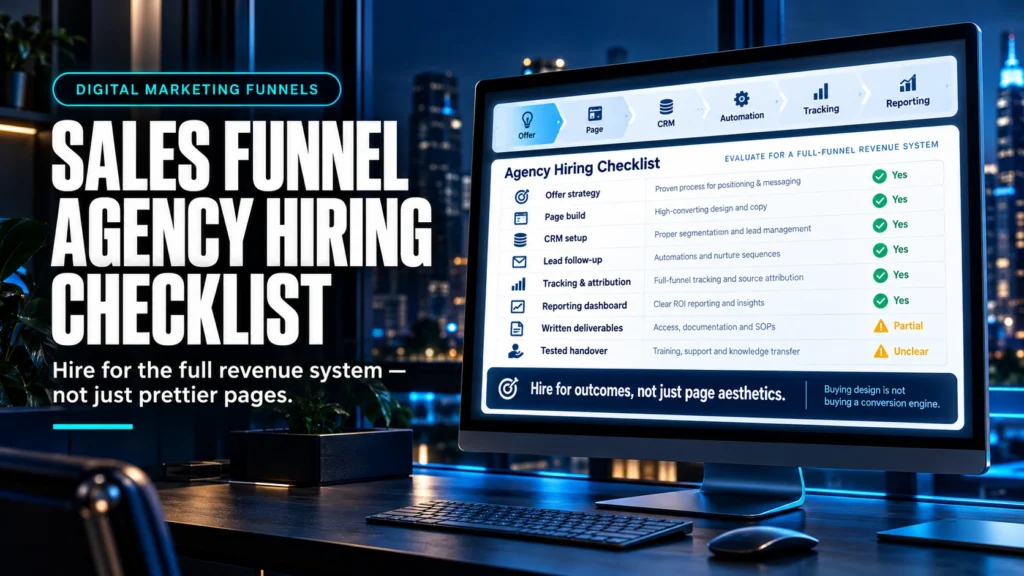
The hiring checklist: 12 non-negotiables for a high-converting build

Use this as your interview script. A real sales funnel agency will have crisp answers, examples, and a documented process. A template implementer will talk about “design,” “copy,” and “automation” without being able to specify logic.

1) They define your lead lifecycle and pipeline stages before building pages

Check: Ask them to draft your pipeline stages and definitions in the first week.

Why it matters: Your funnel is only as good as the system that processes leads. Pipeline stages are the backbone of follow-up, reporting, and accountability.

Diagnose: If your team can’t agree what “Qualified” means, your reporting is already broken.

Weak: “We’ll set up a pipeline later.”

Strong: “Here are stages, entry criteria, required actions, and SLA timers.”

What SCALE would fix: Stage definitions, ownership, and automation triggers tied to stage movement (not vibes).

2) They engineer speed-to-lead (and prove it)

Check: Ask: “What is your target speed-to-lead, and how do you enforce it in GoHighLevel?”

Why it matters: The first minutes after inquiry are where contact rates are won or lost.

Diagnose: Pull a sample of 20 leads and measure time-to-first-attempt and time-to-first-contact.

Weak: A single email notification to the owner.

Strong: Instant SMS/email to lead, internal notifications, auto-dial or task creation, escalation if no action.

What SCALE would fix: Missed-call text-back, round-robin assignment, SLA timers, and “no response” escalation paths.

3) They build routing rules that match how you sell

Check: Ask them to explain routing for: service line, geography, language, budget, and urgency.

Why it matters: Wrong rep + wrong offer = low show rate and low close rate, even with “good leads.”

Diagnose: Look for leads sitting unassigned or booked into the wrong calendar.

Weak: Everything goes to one inbox and one calendar.

Strong: Conditional routing: form answers and UTM data determine pipeline, owner, and calendar.

What SCALE would fix: Custom fields + workflow branches + assignment logic + calendar-specific reminders.

4) They treat attribution as a build requirement, not a “nice to have”

Check: Ask: “How do you capture UTMs into GoHighLevel and keep them attached to the contact and opportunity?”

Why it matters: If you can’t trust source data, you can’t scale spend confidently or cut waste.

Diagnose: Compare ad platform leads vs CRM leads. If counts differ, you have tracking gaps.

Weak: Source is manually selected by staff or defaults to “website.”

Strong: UTMs captured on first touch, stored in fields, and reported by stage and revenue.

What SCALE would fix: UTM capture, consistent naming conventions, and reporting views that tie source to pipeline outcomes.

5) They can show you their QA checklist (and it includes edge cases)

Check: Ask for their pre-launch QA list. It should include mobile, form errors, calendar conflicts, and notification failures.

Why it matters: Funnels fail in edge cases: double submissions, timezone issues, spam, and broken redirects.

Diagnose: Run test leads from multiple devices and sources (organic, paid, direct) and verify every step.

Weak: “We tested it once.”

Strong: Documented QA with screenshots, test contacts, and pass/fail criteria.

What SCALE would fix: A repeatable QA protocol and a “test lead” naming convention so you can audit later.

6) They design the page around conversion mechanics, not aesthetics

Check: Ask them to justify each section of the landing page: what objection it addresses and what action it drives.

Why it matters: Pretty pages don’t pay bills. Clarity, proof, and friction removal do.

Diagnose: If your page has long paragraphs, vague claims, and no proof near the CTA, expect low conversion.

Weak: Hero image + generic headline + form at the bottom.

Strong: Clear promise, who it’s for, proof elements, process, FAQs, and CTA placement aligned to intent.

What SCALE would fix: Message hierarchy, CTA density, and form placement based on traffic temperature.

7) They build follow-up sequences that match your sales motion

Check: Ask: “What’s the follow-up schedule for the first 10 minutes, 24 hours, and 7 days?”

Why it matters: Most revenue leaks happen after the lead opts in: no contact, weak persistence, or inconsistent handoff.

Diagnose: Audit your last 50 leads: how many got 5+ touches across channels?

Weak: One email and a hope.

Strong: Multi-touch, multi-channel, with stop conditions when contact is made or appointment is booked.

What SCALE would fix: Workflow logic with guardrails: stop-on-reply, stop-on-book, and reactivation paths.

8) They implement deliverability basics (so your emails land)

Check: Ask what they do for SPF, DKIM, and domain setup, and how they warm up sending.

Why it matters: If your emails go to spam, your “automation” is theatre.

Diagnose: Look at open rates, bounce rates, and whether replies are coming in.

Weak: Sending from a brand-new domain with no authentication.

Strong: Authenticated domain, sensible sending volume, and clear segmentation.

What SCALE would fix: Domain authentication guidance and sequence design that doesn’t trigger spam filters.

9) They build reporting that answers operator questions

Check: Ask them to show a sample dashboard: leads by source, booked rate, show rate, close rate, and time-to-contact.

Why it matters: Owners don’t need more metrics; they need the few that drive decisions.

Diagnose: If you can’t answer “Which campaign produced qualified appointments last week?” you’re flying blind.

Weak: Reporting limited to page views and form submissions.

Strong: Pipeline conversion reporting and attribution tied to outcomes.

What SCALE would fix: A reporting layer that connects ad spend, lead source, pipeline stage, and revenue.

10) They document everything (handover is part of the deliverable)

Check: Ask what you receive at handover: SOPs, loom walkthroughs, naming conventions, and admin access list.

Why it matters: If only the agency can operate the system, you’re locked in and fragile.

Diagnose: If your team is afraid to touch automations, you don’t have a system—you have a black box.

Weak: “It’s all in the account.”

Strong: Written SOPs + diagrams + change log.

What SCALE would fix: Operational documentation so your team can run the machine.

11) They can explain what they won’t do (scope boundaries)

Check: Ask: “What’s out of scope, and what would trigger a change order?”

Why it matters: Funnel projects fail when expectations are fuzzy: copywriting, creative, ad management, CRM cleanup, and migration often get assumed.

Diagnose: If the proposal is one page with vague deliverables, expect scope creep and delays.

Weak: “Unlimited revisions.”

Strong: Clear deliverables, revision limits, and acceptance criteria.

What SCALE would fix: A build spec that protects timeline and outcomes.

12) They have a rollout and testing plan (not a “big bang” launch)

Check: Ask how they launch: staged rollout, parallel run, or full cutover.

Why it matters: A funnel is a live revenue line. You don’t want to discover a broken form after spending on ads.

Diagnose: If they can’t describe a test plan with pass/fail criteria, you’re the QA team.

Weak: “We’ll publish it and see.”

Strong: Controlled launch, test traffic, and monitoring.

What SCALE would fix: A rollout sequence that reduces risk while you validate conversion and follow-up.

How to interview a sales funnel agency (questions that expose weak operators)

Most agencies can talk confidently about “funnels.” Fewer can talk about operations. Use these questions to force specificity.

Questions about systems (GoHighLevel, CRM, automation)

  • “Show me the pipeline stages you’d use for our business and what triggers stage movement.”
  • “What happens if a lead submits the form but doesn’t book?”
  • “What happens if a lead books but doesn’t show?”
  • “How do you prevent duplicate contacts and messy conversations?”
  • “How do you handle round-robin assignment and rep availability?”

Questions about tracking and attribution

  • “Which UTMs do you require, and where do they get stored in the CRM?”
  • “How do you reconcile ad platform leads with CRM leads?”
  • “What’s your definition of a qualified lead and a qualified appointment?”
  • “Can we see a dashboard that ties lead source to pipeline outcomes?”

Questions about commercial outcomes

  • “Which metric do you improve first: conversion rate, contact rate, show rate, or close rate—and why?”
  • “What are the top three reasons funnels fail after launch?”
  • “What do you need from us to make this succeed (sales scripts, offer constraints, capacity)?”

The implementation process

  1. Revenue goal and constraints: define target CPL/CPA, capacity (appointments per week), service area, and sales team coverage hours.
  2. Offer-message fit workshop: clarify who it’s for, the core promise, proof assets available, and the top 5 objections to neutralize on-page.
  3. Funnel architecture: choose the conversion path (lead form vs calendar-first vs two-step), map the pages, and define the “thank you” and next action.
  4. GoHighLevel CRM structure: create pipelines, stages, stage definitions, required fields, and ownership rules (including round-robin if needed).
  5. Lead capture build: forms/surveys with validation, custom fields, consent language, and routing logic based on answers and UTMs.
  6. Calendar and scheduling logic: calendars per offer/rep, buffers, availability windows, timezone handling, reschedule/cancel rules, and confirmation pages.
  7. Automation and lead follow-up: workflows for new lead, booked, no-show, unresponsive, and reactivation; include stop conditions (reply/book/contacted) and escalation rules.
  8. Speed-to-lead enforcement: internal notifications, tasks, missed-call text-back, and SLA timers that alert when leads aren’t contacted fast enough.
  9. Attribution setup: UTM capture, lead source mapping, campaign naming conventions, and a plan for first-touch vs last-touch interpretation.
  10. Tracking and conversion events: define what counts as a conversion (submit, book, show, qualified, closed) and ensure events are measurable end-to-end.
  11. Reporting and dashboards: build views for owners (revenue visibility) and for reps (daily tasks, pipeline hygiene, follow-up queues).
  12. QA and test leads: run test submissions from multiple devices and sources; verify routing, notifications, calendar booking, and conversation threading.
  13. Controlled rollout: launch with monitoring, then scale traffic; keep a rollback plan if a critical step fails.
  14. Handover and SOPs: deliver documentation, admin access, naming conventions, and a change log so your team can operate without guesswork.

Common problems and how to fix them

Want a second set of eyes on your CRM, funnel or follow-up system?

Book a free Growth Systems Audit and SCALE will show you where your current setup is leaking leads, visibility or revenue.

What this means for revenue

Hiring the right sales funnel agency is less about “conversion rate” in isolation and more about revenue throughput: how many leads become conversations, how many conversations become booked calls, and how many booked calls become closed revenue.

The revenue chain most businesses break

  • Lead quality: If your offer and targeting are misaligned, you’ll attract the wrong intent and your close rate collapses.
  • Contact rate: If you don’t reach leads quickly and persistently, your booked calls drop even if the page converts.
  • Show rate: If reminders and pre-framing are weak, your calendar fills with no-shows and your team loses selling time.
  • Pipeline visibility: If stages aren’t defined, you can’t forecast, coach reps, or diagnose bottlenecks.
  • Attribution: If you can’t tie lead source to outcomes, you’ll keep funding campaigns that look good at the top and fail at the bottom.

Commercially sharp examples (how leaks show up)

Example 1: “We need more leads.” You may not need more leads. You may need faster follow-up. If your median time-to-first-attempt is hours, improving speed-to-lead can increase contact rate without increasing ad spend.

Example 2: “Facebook leads are bad.” Often the issue is routing and qualification. If all leads go to the same calendar with no pre-qualification, you’ll book low-intent calls that never show. Fix the form logic, confirmation, and reminders before you change platforms.

Example 3: “Our CRM is a mess.” That’s usually a stage-definition problem. When reps interpret stages differently, your “conversion rate” is fiction. Define stages, enforce required fields, and automate hygiene.

What to measure weekly (owner dashboard)

  • Leads by source/medium/campaign
  • Landing page conversion rate (by traffic source)
  • Time-to-first-attempt and time-to-first-contact
  • Booked rate, show rate, and qualified rate
  • Close rate and revenue by lead source

SCALE perspective

Most businesses don’t fail because they chose the wrong page builder. They fail because they built a funnel without building the operating system around it: CRM structure, lead routing, automation, and attribution.

Here’s what we see repeatedly when auditing accounts:

  • Funnels built in isolation: the page “works,” but the CRM doesn’t enforce ownership, and leads sit untouched.
  • Automation without guardrails: sequences keep firing after a lead books, replies, or becomes a customer.
  • Attribution that can’t be trusted: UTMs aren’t captured, sources are overwritten, and reporting becomes a debate.
  • Pipeline stages that don’t match reality: stages are too generic, so you can’t diagnose where deals stall.
  • No handover: the business becomes dependent on the builder for every change.

SCALE builds GoHighLevel CRM, funnel and automation systems for businesses that need better lead quality, faster follow-up and clearer attribution. Practically, that means we start with lifecycle and reporting requirements, then build the funnel to feed a system that can be operated, audited, and improved.

What “different” looks like in the build

  • Definitions first: stages, SLAs, and conversion definitions before design.
  • Routing as a first-class feature: the right lead goes to the right person and the right calendar automatically.
  • Attribution you can audit: UTM capture + consistent naming + reporting tied to pipeline outcomes.
  • Operational handover: SOPs and change logs so your team can run the system.

FAQs

What should a sales funnel agency deliver besides a landing page?

A complete delivery should include funnel pages (and variants if needed), forms/surveys, calendars, CRM pipeline stages, automation workflows for new leads and booked calls, internal notifications and tasking, attribution (UTM capture + lead source fields), reporting dashboards, QA testing, and a documented handover.

How do I know if I need a GoHighLevel specialist vs a general funnel builder?

If your problem includes follow-up, routing, pipeline visibility, or attribution, you need a GoHighLevel specialist (or equivalent systems builder). General funnel builders often stop at the page layer. When leads are valuable and you run ads, the CRM + automation layer is where most revenue leaks happen.

What’s a reasonable timeline for a high-converting funnel + CRM build?

For a single core offer, a structured build commonly takes a few weeks depending on approvals, assets, and complexity (multiple locations, multiple reps, multiple offers). The key is not the calendar time; it’s whether the agency has a staged rollout, QA, and reporting in place before scaling traffic.

What metrics should I ask the agency to improve first?

Start with speed-to-lead (time-to-first-attempt), contact rate, and booked rate. These are often the fastest wins because they’re operational. Then improve show rate with reminders and pre-framing. Finally, optimize close rate with qualification, sales process, and offer refinement.

How do I prevent being locked into an agency after the build?

Require documentation: pipeline definitions, workflow maps, naming conventions, access lists, and SOPs for common changes (editing forms, updating calendars, pausing sequences). Also ensure you own the GoHighLevel account (or have full admin access) and that assets are built in your environment.

Can a funnel work without attribution and reporting?

It can “work” in the sense that leads come in, but you won’t know what to scale or cut. Without attribution, you’ll make budget decisions based on incomplete data. At minimum, capture UTMs into the CRM and report outcomes by source so you can tie spend to pipeline movement and revenue.

What are red flags when hiring a sales funnel agency?

Red flags include: starting with design before defining pipeline and follow-up, vague promises without a build spec, no QA checklist, no plan for routing and speed-to-lead, no attribution plan, and no handover documentation. If they can’t explain what happens after a lead submits, they’re not building a revenue system.

Want SCALE to build and optimise this for you?

Book a free Growth Systems Audit and we will show you where your website, funnel, CRM and follow-up stack are still leaking revenue.

Disclosure: We may earn a commission if you sign up for GoHighLevel through the link below. It does not increase your price. If you use our link, we will unlock SCALE’s exclusive bonuses for you at no extra cost.

Start your 14-day free trial here and unlock exclusive free bonuses from SCALE that are not available anywhere else: Try GoHighLevel

If you want a sales funnel agency that actually improves outcomes, hire for systems thinking: GoHighLevel CRM structure, funnels that match intent, automation with guardrails, lead follow-up that enforces speed-to-lead, and attribution that ties lead source to pipeline and revenue. That’s the difference between “we launched a funnel” and “we built a machine,” and it’s exactly how SCALE approaches growth systems.

Keep building your system

Related SCALE: Playbooks

| SCALE Quick answer If you want predictable pipeline and cleaner reporting, the fastest path is to design your GoHighLevel CRM, funnels,…