
In this guide, we’ll cover:
A local-business view of how GoHighLevel CRM improves pipeline visibility without adding enterprise CRM overhead.
For local businesses, the CRM migration checklist keeps pipeline stages, lead sources and follow-up status visible when the team moves from scattered tools into GoHighLevel.
Which Leads Are Actually Moving?
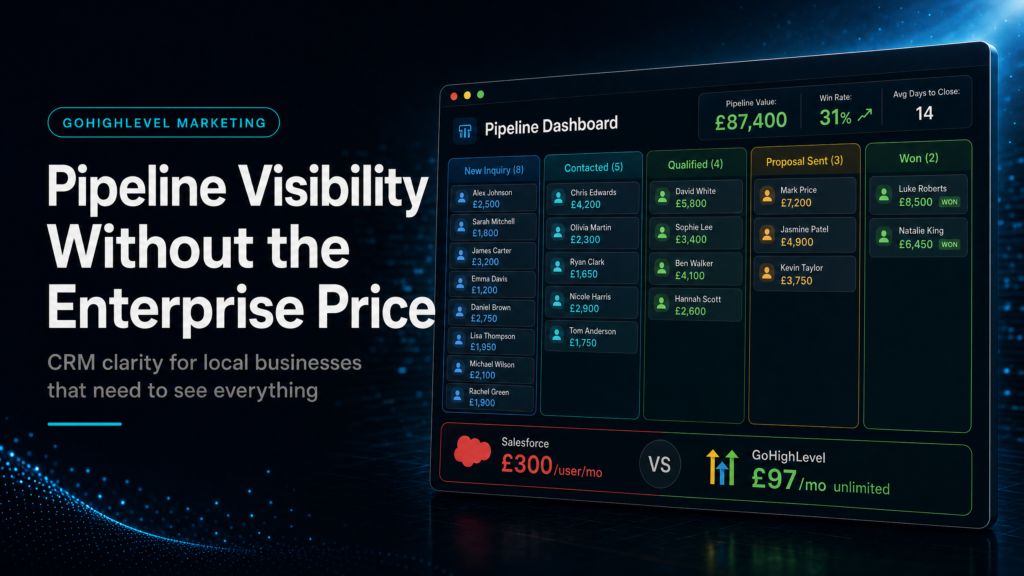
Pipeline visibility should show more than a list of contacts. It should show where each local enquiry sits and what action is due next.
Why Does Enterprise CRM Feel Too Heavy?
Most local businesses do not need enterprise complexity. They need simple contact records, fast routing, booking visibility and practical reporting.
Where Does The Next Conversation Stall?
A CRM only protects revenue when tasks, calls, SMS, email and calendar outcomes are connected to the pipeline.
Can You Trace A Sale Back To Source?
Pipeline visibility becomes useful when lead source, campaign, appointment and closed revenue are visible from the same record.
“The best CRM for a local business is the one that shows who owns the lead, what happens next and which source created revenue.”
GoHighLevel CRM for local business works best when it turns scattered lead activity into a visible pipeline. The point is not to store more contacts. The point is to see source, owner, stage, follow-up and revenue movement without enterprise CRM weight.
For a local business, the CRM should answer four questions quickly: where did the lead come from, who owns it, what stage is it in, and what needs to happen next?
SCALE builds GoHighLevel CRM, funnel and automation systems for businesses that need better lead quality, faster follow-up and clearer attribution. Local pipeline visibility is usually the first layer to fix.
When visibility problems are tied to routing, attribution and owner handoff, the hire a GoHighLevel expert checklist helps decide whether the build needs specialist control.
Quick Answer
GoHighLevel CRM for local business improves pipeline visibility by connecting lead capture, contact records, opportunity stages, owner assignment, calendars, follow-up and source reporting. It is most useful when a local team needs simple sales visibility without paying for an enterprise CRM that staff will not use consistently.
TL;DR
- Local businesses need pipeline visibility more than complex CRM administration.
- Every new lead should have a source, owner, stage and next action.
- GoHighLevel works well when forms, calls, calendars and follow-up need to stay connected.
- The CRM should show booked calls, no-shows, stage movement and lost reasons, not just contact volume.
- If source data is missing, the business cannot confidently scale ads or cut weak channels.
Local Business CRM Decision Table
Use this table to decide whether GoHighLevel CRM is the right pipeline layer for the business.
| CRM Option | Best Fit | Risk | When To Choose It |
|---|---|---|---|
| Spreadsheet | Very small teams with low lead volume. | Leads are easy to miss and follow-up is hard to measure. | Only when the business is not yet running paid lead generation. |
| Enterprise CRM | Larger teams with complex sales governance. | Too much admin can stop local staff using it properly. | Choose when reporting depth and custom governance matter more than speed. |
| GoHighLevel CRM | Local businesses needing CRM, calendars, forms, messaging and pipeline visibility together. | Template setup can still fail if stages, sources and owner rules are not customised. | Choose when lead capture, follow-up and revenue visibility need to work in one operating system. |
Who Is This For?
- Local service businesses managing leads from forms, calls, ads and referrals.
- Teams with contacts in multiple tools but no trusted sales pipeline.
- Operators who need better booked-call, no-show and close-rate visibility.
- Businesses trying to reduce software cost without losing revenue reporting.
- Agencies building client systems that must be easy for local staff to use.
Why Local Businesses Outgrow Spreadsheets
Spreadsheets can work when lead volume is low and the owner handles every conversation. They break when multiple staff, ad channels, locations or service lines create more handoffs than one person can remember.
A CRM should remove the guessing. When a lead enters, the business should know the source, owner, stage and next action. If that information is missing, follow-up depends on memory instead of process.
What GoHighLevel CRM Should Show
The pipeline should reflect sales reality. A local business may need stages such as New Lead, Attempting Contact, Booked, No-Show, Quote Sent, Won, Lost and Unqualified. Each stage needs a definition, not just a label.
Then the CRM needs source and ownership fields. Without those, the business can see activity but not accountability. Good visibility shows which leads need action, which source created them and which stage is blocking revenue.
How Pipeline Visibility Protects Revenue
Pipeline visibility protects revenue by showing problems early. When new leads are not contacted, response time is the leak. If booked calls do not show, reminders or pre-frame may be the leak. Where quotes do not close, sales process or offer fit may be the leak.
That is why the CRM should connect to follow-up and calendars. A standalone contact database cannot show the full path from enquiry to booked conversation to won work.
What To Check Before Switching
Before switching, map the current lead sources, forms, calls, calendars, pipeline stages, owner rules, tags and reporting definitions. Do not import messy contacts into a new system and call it a CRM rebuild.
Test one complete journey first: a lead arrives, the source is captured, an owner is assigned, follow-up fires, a booking is created, the stage changes and the outcome is visible in reporting.
Conclusion
GoHighLevel CRM for local business is strongest when it gives the team a practical operating view of leads, bookings, follow-up and revenue.
The win is not enterprise complexity. The win is consistent pipeline visibility: every lead has a source, owner, stage and next action so the business can protect response speed and make better growth decisions.
FAQs
Is GoHighLevel CRM good for local businesses?
Yes, when the local business needs forms, calls, calendars, follow-up, pipeline stages and source reporting in one connected system instead of scattered tools.
What should a local business track inside GoHighLevel CRM?
Track lead source, owner, service needed, pipeline stage, appointment status, first response time, booked calls, won revenue and lost reasons.
Can GoHighLevel replace a separate CRM?
It can replace a separate CRM when the sales process depends on lead capture, calendars, SMS/email follow-up and pipeline visibility. Complex enterprise teams may still need deeper CRM governance.
What is the biggest CRM mistake local businesses make?
The biggest mistake is using the CRM as a contact list instead of a pipeline operating system. Every lead should have a source, owner, stage and next action.
