
In this guide, we’ll cover:
What Does DIY Miss Before Launch?
DIY builds often start with pages and workflows, but the expensive decisions are fields, stages, routing, reporting and what happens when buyers behave unpredictably.
If the DIY decision is really about CRM ownership, field hygiene and pipeline reporting, compare it with the GoHighLevel CRM replacement guide before choosing the cheaper route.
Where Does The Cheap Build Leak Later?
A build can look complete while source data, ownership rules and stop conditions remain too weak for real sales volume.
When Does Expert Implementation Pay Back Faster?
A consultant can be cheaper in practice when the build prevents missed calls, broken handoffs and reporting gaps before paid traffic scales.
Which Route Fits Your Team Right Now?
The right choice depends on lead value, sales complexity, team capacity and whether the business can afford a learning-curve rebuild.
The DIY question is not whether you can click the buttons. It is whether the system will still work when real leads, real sales handoffs and real reporting pressure arrive.
Quick Answer
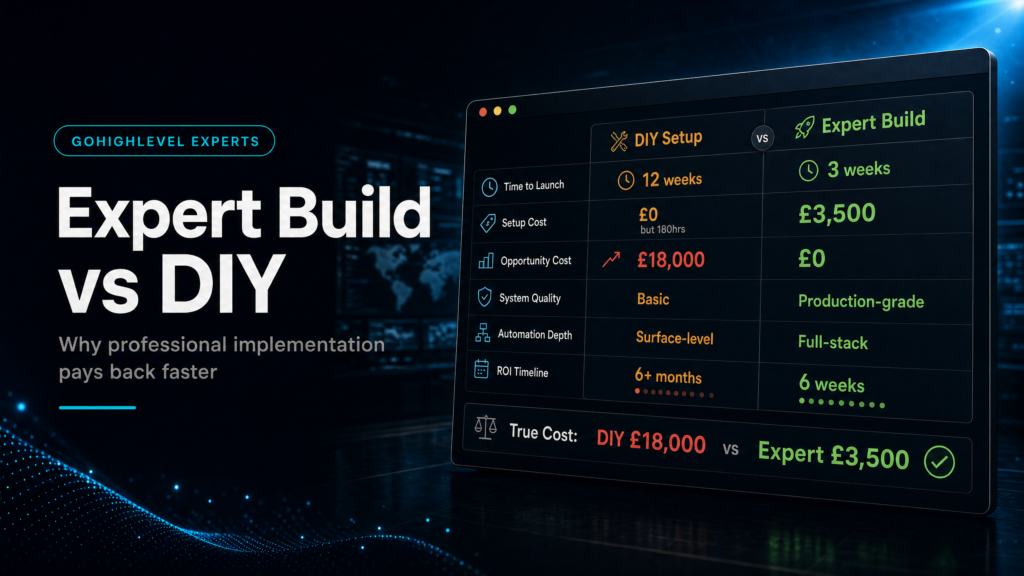
A Go High Level consultant vs DIY decision comes down to risk, speed and revenue visibility. DIY can work for simple offers with low lead volume, but expert implementation usually pays back faster when routing, attribution, follow-up, calendar show rates and sales reporting need to work before paid traffic increases.
Use the GoHighLevel expert hiring hub for the wider specialist decision and the Go High Level consultant checklist before choosing a consultant build.
TL;DR
- DIY is viable when the offer is simple, lead volume is low and the team can test every workflow properly.
- A consultant pays back faster when missed leads, weak attribution or sales handoffs would cost more than the build.
- Templates help you launch, but they rarely match your exact offer, pipeline, team and reporting needs.
- The real implementation work is CRM architecture, routing, stop rules, source capture and QA.
- SCALE recommends choosing based on revenue risk, not software confidence.
Stack This Post With These Related Guides

Start with the GoHighLevel expert hiring hub for the wider specialist signal, then use the Go High Level consultant checklist to evaluate consultant-specific implementation questions.
Consultant Vs DIY Decision Table
| Route | Best Fit | Hidden Risk | When To Choose It |
|---|---|---|---|
| DIY Build | Simple business, one offer, low lead volume and time to test. | Broken fields, unclear stages, weak stop rules and inconsistent reporting. | Choose it when speed is less important than learning the platform. |
| Template Implementer | Early-stage teams that need a basic launch quickly. | Looks complete but may not fit the sales process or revenue model. | Choose it when the build is temporary and the business accepts later rebuild work. |
| Go High Level Consultant | Teams using ads, multiple offers, sales reps or high-ticket lead paths. | Poor consultant selection can still create a generic build. | Choose it when missed leads, poor attribution or slow follow-up are already expensive. |
| SCALE DFY Build | Businesses that need CRM, funnel, automation and reporting built around revenue movement. | Under-scoping discovery or QA before launch. | Choose it when the system has to protect sales visibility before traffic scales. |
Why DIY Looks Cheaper Before The Sales Process Is Tested
DIY builds feel attractive because the software gives you forms, funnels, workflows, calendars and pipelines in one account. The problem is that those pieces only become valuable when they match how the business sells.
If the team cannot explain lead ownership, pipeline movement, missed-call recovery and source reporting before launch, DIY speed can turn into later clean-up.
Where Consultant Implementation Creates Payback
A consultant should reduce the risk of building the wrong operating system. That means translating the sales process into fields, stages, automations, notifications, QA checks and reporting views that a team can actually use.
For migration-heavy builds, compare the scope against the GoHighLevel implementation pre-migration checklist before changing live systems.
How To Decide Without Overbuilding
The decision does not need to be emotional. Estimate the value of a missed qualified lead, then compare that with the cost of delayed response, broken reporting or a rebuild after the first campaign starts running.
- Use DIY when the team has time to learn and test every lead path.
- Use a consultant when sales complexity is already higher than a template can handle.
- Use a DFY build when the system must support paid traffic, attribution and sales management from day one.
What To Ask Before You Choose A Consultant
Ask how they map fields, tags, pipeline stages, source data, booking outcomes and stop conditions. The answer should sound like a revenue process, not a list of software features.
If the build includes funnels and paid traffic, the GoHighLevel sales funnel pre-launch checklist will also help you check the launch controls.
Conclusion
The consultant vs DIY decision is really a risk decision. DIY can be sensible when the business is simple, but expert implementation pays back faster when every lead needs clean routing, timely follow-up and reliable revenue reporting.
SCALE’s view is that GoHighLevel should be built around sales reality. The faster the business wants to scale demand, the more important it is to get the architecture right before launch.
- Choose DIY for low-risk learning and simple lead paths.
- Choose a consultant when sales handoffs and attribution matter.
- Choose a DFY build when the system needs to protect revenue before traffic scales.
FAQs
Is it better to hire a Go High Level consultant or build DIY?
DIY is better for simple, low-risk builds where the team has time to learn and test. A consultant is better when routing, attribution, follow-up and reporting need to work quickly because missed leads are expensive.
Why does expert implementation pay back faster?
Expert implementation can prevent rebuilds, missed follow-up, weak source tracking and unclear pipeline ownership. Those problems often cost more than the consultant when paid traffic or high-ticket sales are involved.
Can I start DIY and hire a consultant later?
Yes, but document fields, tags, workflows and pipeline logic carefully. A messy DIY build can take longer to audit and repair than a clean consultant-led setup.
What should I ask a Go High Level consultant before hiring?
Ask how they map your sales process, protect source data, assign owners, stop automations after replies or bookings, and report revenue movement from lead source to close.
