In this guide, we’ll cover:
A high-ticket funnel is not one landing page. It is the architecture that connects offer fit, qualification, CRM routing, follow-up, sales ownership and reporting.
Offer Fit
Does The Funnel Match How You Sell?
The first check is whether the page, form and calendar match the sales motion, price point and buying risk behind the offer.
CRM Routing
Can The Right Person Follow Up Fast?
Architecture has to decide who owns the lead, what stage it enters, what task is created and which message goes out first.
Reporting
Will You Know What Produced Revenue?
Without clean attribution, the business can see form fills but not the source, quality, show rate or sales result behind them.
“The best funnel building agency architecture protects the whole path from first click to closed deal.”
Quick Answer
A funnel building agency architecture checklist should prove that the funnel captures qualified demand, routes every lead into the right GoHighLevel pipeline stage, triggers fast follow-up, and reports source-to-close outcomes. If the agency only shows page design, copy and a calendar embed, it has not proven the architecture needed for a high-ticket revenue system.
TL;DR
- High-ticket funnels need more than attractive pages; they need offer, CRM, calendar, follow-up and attribution architecture.
- The key checks are qualification fields, pipeline stages, lead ownership, speed-to-lead rules, no-show recovery and revenue reporting.
- For this cluster, this support post should feed the canonical funnel building agency revenue vs aesthetics guide rather than compete with it.
- SCALE builds GoHighLevel CRM, funnel and automation systems for businesses that need clearer lead quality, faster follow-up and measurable revenue flow.
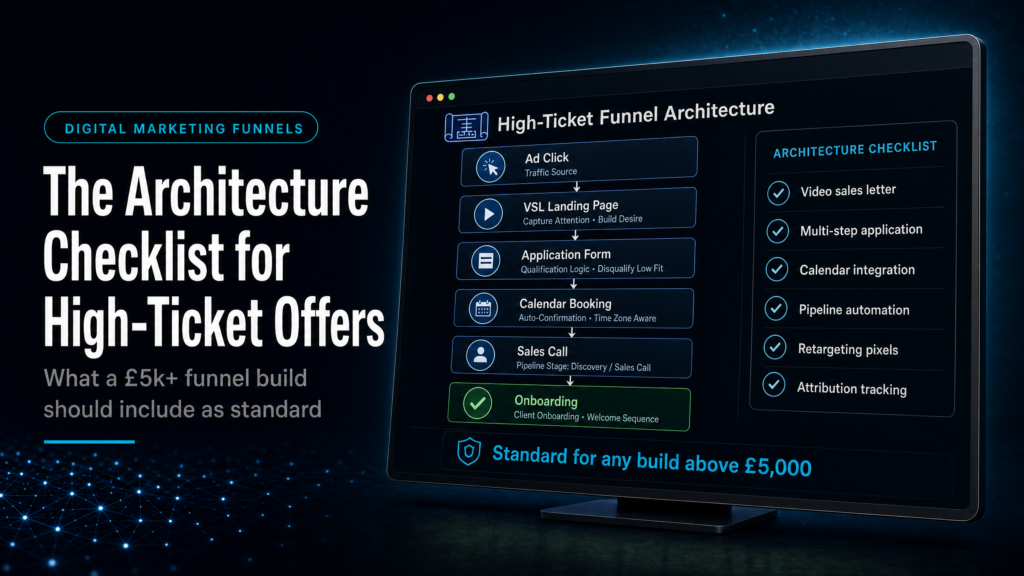
Architecture Checklist Table
| Layer | What To Check | Why It Matters |
|---|---|---|
| Offer Fit | One clear conversion event, qualification criteria and sales motion. | Prevents the funnel from creating low-fit calls that waste sales capacity. |
| Lead Capture | Short forms, hidden source fields and routing data captured before the calendar step. | Gives the CRM enough context to route and report correctly. |
| Pipeline | Event-based stages such as New Lead, Contacted, Booked, Showed, Won and Lost. | Turns vague pipeline labels into measurable sales operations. |
| Follow-Up | Immediate SMS/email, call task, owner assignment and no-show recovery. | Protects contact rate and show rate after the lead has already cost money. |
| Reporting | Source, campaign, booked call, show, close and revenue visibility. | Lets the business scale the right traffic instead of guessing from lead volume. |
Start With The Sales Motion Before Any Page Build
A high-ticket funnel should begin with the way the business sells. A one-call close, a two-call sales process, a local consultation and a premium application funnel all need different friction, proof and follow-up rules.
The architecture checklist starts by defining the primary conversion event. That might be a booked call, qualified application, paid deposit or request for proposal. Once that event is clear, the funnel can decide what information to capture, what to show on the thank-you page and what automation should fire next.
If a funnel building agency skips this step, it usually gives every visitor the same call-to-action and every lead the same follow-up. That creates volume, but not necessarily qualified pipeline. For a high-ticket offer, better architecture often means fewer unqualified calls and more sales time spent with the right buyers.
Build The CRM Pipeline Around Real Events
The GoHighLevel pipeline should mirror what actually happens in sales. Stages like “Hot” and “Warm” are too subjective. Better stages are tied to events: new lead, attempting contact, contacted, booked, showed, no-show, follow-up, closed won and closed lost.
Each stage needs an owner and a next action. A new lead should create a contact record, opportunity, owner assignment and task. A booked call should trigger confirmations and reminders. A no-show should move into a recovery path. A closed-lost opportunity should capture a reason so the team can improve targeting and sales messaging.
This is where funnel architecture becomes enforceable. The page can create demand, but the CRM decides whether that demand becomes a managed sales opportunity.
Protect Speed-To-Lead And No-Show Recovery
Paid traffic and referral demand lose value quickly when response time is slow. A high-ticket funnel should have clear speed-to-lead rules for business hours, after-hours leads and missed calls. The goal is not to automate every conversation; the goal is to make sure the right human knows what to do next.
A strong setup creates immediate SMS and email confirmation, a call task for the owner, reminders before the appointment and a no-show recovery workflow. Stop rules matter too. If someone books, replies or is marked unqualified, they should not keep receiving the wrong chase sequence.
For SCALE, this is one of the fastest ways to improve funnel economics. If the business already has traffic, better follow-up can raise contact, booked and show rates without needing more ad spend.
Make Attribution Useful Enough For Decisions
Attribution is not just a marketing dashboard. It is the system that tells the business which source created qualified calls and closed revenue. A funnel building agency should capture UTMs, source fields and campaign information in a way that survives the form, calendar and CRM handoff.
The reporting layer should answer practical questions: which channel produces booked calls, which campaign creates the best show rate, which lead type closes, and which follow-up path needs work. Without this, the business may scale campaigns that produce cheap leads but poor revenue.
The architecture checklist should include source normalization, hidden tracking fields, opportunity source reporting and weekly review rhythm. If “unknown” is the largest source in the CRM, the funnel is not ready to scale.
Conclusion
A funnel building agency architecture checklist is useful because it shifts the conversation away from page design and toward revenue operations. The right agency should be able to explain how the offer, form, calendar, CRM, automation, attribution and reporting fit together.
SCALE approaches high-ticket funnel builds as operating systems: clear qualification, clean pipeline stages, fast follow-up, and reporting that connects source to sales outcomes. That is what gives a business confidence to scale demand without creating more operational noise.
- Use the architecture checklist before approving a build.
- Make the canonical revenue system the centre of the cluster.
- Judge the agency by follow-up and reporting, not only creative polish.
FAQs
What should a funnel building agency architecture include?
It should include offer-to-funnel fit, qualification fields, landing page flow, GoHighLevel pipeline stages, owner assignment, follow-up workflows, calendar logic, source tracking and revenue reporting.
Why is CRM architecture important for high-ticket funnels?
High-ticket funnels usually convert through calls, not instant checkout. CRM architecture makes sure each lead is owned, followed up, moved through the right stage and measured against booked calls and revenue.
Should a funnel builder start with design or pipeline mapping?
Pipeline mapping should come first. Design matters, but the page should support the sales process, qualification rules and follow-up system rather than exist as a disconnected landing page.
What is the biggest warning sign before hiring a funnel agency?
The biggest warning sign is when the agency only talks about page design, templates and copy, but cannot explain lead routing, speed-to-lead, attribution, no-show recovery or pipeline reporting.
How does SCALE approach this type of funnel build?
SCALE maps the sales motion first, then builds the GoHighLevel CRM, funnel, automation and reporting layer around that path so the business can see lead quality, follow-up performance and revenue movement.
