
GoHighLevel Expert Questions Before Hiring

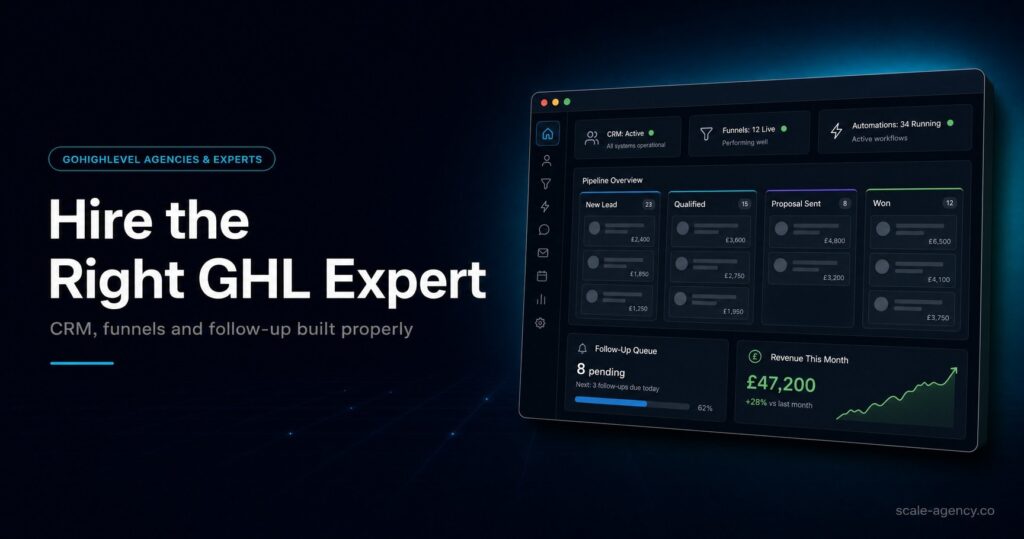
Hire the right GoHighLevel expert featured image showing a premium CRM command centre with funnels, automations, pipeline and revenue dashboard

Scroll breakdown

In this guide, we’ll cover:

01

Platform knowledge

Why the best hire can explain system architecture, not just where buttons live inside GoHighLevel.

Architecture
Commercial fit
Implementation risk
02

Technical depth

Where migration, custom fields, webhooks and workflow failure handling reveal real implementation experience.

Fields
Webhooks
QA process
03

Revenue thinking

How attribution, pipeline logic and speed-to-lead thinking show whether the expert understands commercial outcomes.

Pipeline
Attribution
Follow-up
04

Proof filter

What case studies, numbers and references matter when your business model needs a serious operating system.

Case study
Metrics
References
05

Hiring outcome

Pick the architect who protects you from rebuilds, messy CRM data and slow follow-up after launch.

Less rework
Cleaner CRM
Better calls

“The right questions expose genuine implementation depth before a weak build can cost you leads, reporting accuracy and sales momentum.”

Hiring a GoHighLevel expert is not just a platform decision. It is a revenue infrastructure decision that affects lead routing, pipeline visibility, client onboarding, reporting accuracy and how quickly your team can follow up when a serious prospect raises their hand.

SCALE builds GoHighLevel CRM, funnel, and automation systems for businesses that need better lead quality, faster follow-up, and clearer attribution.

This guide gives you the questions to ask before you hire so you can separate genuine system architects from basic implementers. Then, use it to test technical depth, commercial thinking, migration discipline, proof quality and the support model before you commit budget.

For the parent guide, start with the GoHighLevel expert checklist. This article stays narrower: the questions to ask before you hire, so you can test technical depth, proof quality and commercial fit.

Key takeaway

Before hiring a GoHighLevel expert, verify their technical implementation experience, API integration skills, and conversion optimization track record with businesses similar to yours. In practice, the right questions focus on workflow architecture, data migration, and measurable client outcomes rather than certifications or generic platform knowledge.

Quick verdict

Evaluation Category Red Flags Green Flags
Experience Level Only mentions basic setup and templates Discusses custom API integrations, webhook architecture, and complex automation logic
Client Portfolio Cannot share specific results or case studies Provides detailed metrics: conversion rates, revenue attribution, automation performance
Technical Depth Focuses on features and interface navigation Explains data structure decisions, custom field strategy, and system scalability
Strategic Approach Starts with platform capabilities Starts with business model analysis and revenue architecture
Post-Launch Support Vague “ongoing support” promises Specific SLAs, optimization protocols, and performance monitoring frameworks

Who this is for

  • Agency owners scaling to seven or eight figures who need enterprise-grade CRM architecture without enterprise software costs
  • High-ticket coaches and consultants with complex sales processes requiring sophisticated pipeline management and client onboarding automation
  • Service businesses migrating from fragmented tech stacks (ClickFunnels, ActiveCampaign, Calendly, Stripe) to unified infrastructure
  • Marketing agencies white-labeling GoHighLevel who need expert-level implementation for demanding clients
  • Entrepreneurs who have attempted DIY GoHighLevel setup and realized they need professional architecture to avoid costly rebuilds
  • Business owners who understand that CRM implementation is strategic infrastructure, not a technical task to delegate to the cheapest freelancer

The Real Cost of Hiring the Wrong GoHighLevel Expert

Most businesses approach GoHighLevel hiring backwards. Instead, they look for someone who “knows GoHighLevel” when they should be searching for someone who understands revenue architecture, conversion optimization, and systems thinking. The platform is merely the implementation layer.

A poorly implemented GoHighLevel system creates technical debt that compounds over time. As a result, you end up with orphaned contacts, broken automation sequences, inconsistent data structures, and workflows that work individually but fail as a system. The cost is not just the rebuild. It is also the lost revenue, missed deals, and team confusion that damage day-to-day performance.

For the broader scaling risk, compare this with when a GoHighLevel expert starts paying back, especially if your current setup is already creating rebuild pressure.

When evaluating candidates, you are not hiring a GoHighLevel button-pusher. Instead, you are hiring an architect who will design the central nervous system of your revenue operations. Therefore, the questions you ask must reveal whether they think like an architect or like a technician following tutorials.

Pro Tip: If a candidate’s first question is not about your business model, sales process, and revenue goals, they are approaching the engagement tactically rather than strategically. Strategic experts diagnose before they prescribe.

Technical Implementation Questions That Separate Experts from Novices

The technical depth of a GoHighLevel expert reveals itself in how they handle edge cases, data quality, and system scale. In practice, these questions expose their real-world implementation experience.

Custom Field Architecture and Data Structure

Ask candidates to explain their approach to custom field strategy. Often, novices create fields only when a new need appears. By contrast, experts design field groups upfront based on reporting needs, segmentation plans, and integration dependencies. They also understand that every custom field affects automation logic, reporting accuracy, and system performance.

Specifically, ask: “How do you decide between custom fields, tags, and opportunities for tracking client data?” A strong answer should mention clean data structure, the limits of tags versus fields, and the performance impact of too many custom fields in a large account.

API Integration and Webhook Management

GoHighLevel’s power multiplies when it connects with external systems. For that reason, ask candidates to walk you through a complex integration they have built. Then, listen for specifics: webhook authentication, error handling, rate limits, and data transformation logic.

A revealing question is: “How do you handle webhook failures and ensure data consistency between GoHighLevel and external systems?” Ideally, experts will discuss retry logic, logging, fallback steps, and reconciliation. In other words, they know integrations fail, so failure management must be part of the build from day one.

Workflow Automation Logic and Conditional Branching

Automation is where most DIY implementations break down. For example, ask candidates to describe the most complex workflow they have built and how they debugged it when it failed. As a result, the answer reveals their systems thinking and troubleshooting method.

Request specifics about how they handle timing delays, conditional logic with multiple variables, and workflow versioning when business processes change. In addition, experts maintain workflow documentation, use clear naming rules, and build workflows that team members can understand and modify.

Question Category What You Are Really Testing Expert-Level Answer Indicators
Data Migration Experience with messy real-world data and cleanup protocols Discusses deduplication strategies, data validation rules, staged migration approaches, and rollback plans
Email Deliverability Understanding of technical infrastructure beyond platform features References domain warming, SPF/DKIM/DMARC configuration, sender reputation monitoring, and engagement-based sending strategies
Reporting and Analytics Ability to translate business questions into data architecture Explains custom reporting limitations, when to use external analytics tools, and how to structure data for meaningful attribution
Multi-Location or Agency Setup Experience with complex organizational structures Discusses snapshot strategy, permission hierarchies, white-label configuration, and cross-location reporting challenges

Business Outcome Questions That Reveal Strategic Thinking

Technical competence is necessary, but it is not enough. Therefore, the expert you hire must understand how GoHighLevel implementation drives business outcomes. These questions assess strategic thinking and commercial awareness.

Revenue Attribution and Conversion Tracking

Ask how they approach revenue attribution in GoHighLevel. After all, attribution is not automatic. It requires deliberate data architecture. A strong expert should explain how they track lead sources, campaign performance, sales cycle length, and revenue per pipeline stage.

A diagnostic question is: “How would you set up GoHighLevel to answer the question: Which marketing channel generates the highest lifetime value clients?” Here, the answer should cover UTM capture, custom fields for source tracking, opportunity pipelines, and reporting methodology.

Conversion Rate Optimization Within the Platform

GoHighLevel is not just a CRM. It is also a conversion platform with forms, landing pages, and communication tools. So, ask candidates how they optimize conversion rates inside the system. Strong experts discuss A/B testing, form abandonment, follow-up sequence optimization, and the impact of response time on conversion.

If the candidate claims they can improve funnel performance, use these GoHighLevel expert KPI levers as a practical benchmark for the kind of conversion thinking they should be able to explain.

For instance, they should provide specific examples with numbers: “We reduced form abandonment by 34% by implementing a two-step form with conditional logic” or “We increased show rates by 22% by adding SMS reminders 24 hours and 2 hours before appointments.”

Scalability and System Performance

Your business will grow. Therefore, ask how they design systems that scale. Novices build for current needs. By contrast, experts build for 3x growth without architectural changes.

Specifically ask: “At what point does a GoHighLevel implementation start experiencing performance issues, and how do you architect around those limitations?” Experts know the practical limits: workflow complexity thresholds, contact database size considerations, API rate limits, and when to offload certain functions to external tools.

Warning: Be skeptical of candidates who claim GoHighLevel can do everything. Platform expertise includes knowing when to integrate external specialized tools rather than forcing GoHighLevel beyond its optimal use cases.

Process and Collaboration Questions

Implementation is not a one-time event. Instead, it is an ongoing collaboration. These questions reveal how the expert works with your team and handles the inevitable changes and challenges.

Discovery and Requirements Gathering

Ask candidates to describe their discovery process. Before touching the platform, experts map the business process. They interview stakeholders, document current workflows, identify pain points, and map desired future states.

Red flag: Candidates who provide fixed-price quotes without extensive discovery do not understand the complexity of custom implementation. They are pricing based on template deployment, not strategic architecture.

Training and Knowledge Transfer

Your team must operate the system after launch. Therefore, ask how they approach training and documentation. Good experts provide role-specific training, create video documentation for common tasks, and build systems that match your team’s skill level.

Request examples of training materials or documentation they have created for previous clients. The quality and clarity of these materials reveal their communication skills and commitment to client success beyond the initial build.

Ongoing Optimization and Support

Ask what happens after launch. At this stage, experts should explain that initial implementation is only the baseline. Optimization happens through iteration based on real performance data. They should also propose monthly performance reviews, quarterly workflow audits, and continuous improvement processes.

Discuss their support model explicitly. What response times do they commit to? How do they handle urgent issues versus enhancement requests? What does their retainer structure look like? Vague answers here create frustration later.

Portfolio and Proof Questions

Past performance often indicates future results. Therefore, these questions help you evaluate their track record with businesses similar to yours.

Industry-Specific Experience

Ask for case studies from your industry or business model. While GoHighLevel principles are universal, industry-specific details still matter. For example, an expert who has implemented systems for high-ticket coaching businesses understands application funnels, onboarding sequences, and client success workflows that differ from local service business builds.

Request specific metrics: conversion rate improvements, time savings from automation, revenue increases attributed to better pipeline management, or client retention improvements from systematic follow-up.

Problem-Solving Examples

Ask candidates to describe their most challenging GoHighLevel project and how they solved it. This reveals their problem-solving method, technical creativity, and resilience when obstacles appear.

Listen for how they handled scope changes, technical limitations, client communication during setbacks, and creative workarounds when standard approaches failed. Implementation never goes perfectly—you want someone who navigates challenges professionally.

References and Client Relationships

Request references from clients with similar business models and complexity levels. When speaking with references, ask specific questions: Did the implementation launch on time? How responsive was the expert to issues? Most importantly, did the system deliver the promised outcomes?

For CRM-stack context, this also connects to when a GoHighLevel sales funnel can replace your existing CRM stack, because the right expert should know where consolidation helps and where it creates risk.

Pay attention to the length of client relationships. Experts who maintain long-term optimization relationships with clients demonstrate that their implementations continue delivering value beyond the initial build.

Pricing and Engagement Structure Questions

How an expert prices their services reveals their positioning and how they perceive value. As a result, these questions clarify the commercial relationship before you commit.

Pricing Model and What It Includes

Ask for a detailed pricing breakdown. What is included in the base implementation? What costs extra? For example, are integrations, training, documentation, and post-launch support included or priced separately?

Experts typically use value-based or project-based pricing rather than hourly rates. In other words, they price based on outcomes and complexity, not time spent. Be cautious of extremely low prices because they often indicate inexperience or a template approach that will not serve your specific needs.

Timeline and Milestones

Request a realistic timeline with specific milestones. Usually, experts break implementations into phases: discovery, architecture design, build, testing, training, and launch. They also build buffer time for revisions and unexpected challenges.

Unrealistically short timelines indicate the expert does not understand your complexity or is overpromising to win the engagement. By contrast, quality implementation requires time for proper discovery, thoughtful architecture, and thorough testing.

Success Metrics and Guarantees

Ask how they define project success and what guarantees they offer. While no ethical expert guarantees specific revenue outcomes, they should still guarantee technical functionality, training completion, and system performance standards.

Discuss what happens if the system does not work as promised. What is their remediation process? This conversation reveals their confidence in their work and their commitment to client success.

SCALE perspective

Most businesses hire GoHighLevel experts based on platform certifications and portfolio size. However, this is backwards. After implementing GoHighLevel systems for dozens of high-ticket businesses, we have learned that the key difference is not platform knowledge. It is systems thinking and revenue architecture expertise.

The most common mistake is treating GoHighLevel implementation as a technical project rather than a strategic initiative. In practice, businesses hire implementers when they need architects. Often, they focus on features when they should focus on workflows. Then, they optimize for setup speed when they should optimize for long-term scalability and team adoption.

At SCALE, our approach starts with business model analysis, not platform capabilities. We map your entire revenue generation system—how leads enter, how they are qualified, how sales conversations happen, how clients are onboarded, and how retention and expansion occur. Only then do we architect the GoHighLevel implementation that supports that system.

We have rebuilt dozens of GoHighLevel implementations that technically worked but strategically failed. The common pattern is clear: the previous implementer built what the client asked for rather than what the business needed. In many cases, complex automations impressed people but did not convert. Worse, every feature was added before the right features were clarified. The build looked good in screenshots, but it did not improve client outcomes.

The questions in this article are not theoretical. They are the questions we ask ourselves on every engagement and the questions sophisticated clients ask us. Ultimately, the goal is not to find someone who knows GoHighLevel. The goal is to find someone who understands your business deeply enough to design the system architecture that will scale with you for years.

FAQs

How much should I expect to pay for professional GoHighLevel implementation?

Professional GoHighLevel implementation for a high-ticket business typically ranges from $3,000 to $15,000 depending on complexity, integrations, and custom automation needs. Meanwhile, agencies and businesses with multiple locations or white-label needs often invest $20,000 to $50,000 for enterprise-grade architecture. Hourly rates for qualified experts range from $150 to $300, though most work on project-based pricing that better aligns incentives with outcomes.

What certifications should a GoHighLevel expert have?

While GoHighLevel offers official certifications, they mainly validate platform knowledge rather than implementation expertise or strategic thinking. More important indicators include a portfolio of successful implementations in your industry, specific technical skills like API integration and webhook management, and measurable business outcomes. Therefore, ask for case studies and client references rather than relying only on certification status.

How long does a typical GoHighLevel implementation take?

A comprehensive GoHighLevel implementation for a high-ticket business typically takes 4 to 8 weeks from discovery to launch, including discovery and requirements gathering (1-2 weeks), system architecture and configuration (2-3 weeks), integration and automation build (1-2 weeks), and testing, training, and launch (1 week). Rushed implementations under 3 weeks usually indicate template deployment rather than custom architecture, while projects extending beyond 12 weeks may signal scope creep or inexperience.

Can I implement GoHighLevel myself or should I hire an expert?

DIY implementation is viable for simple use cases like basic contact management and appointment scheduling. However, it becomes risky for complex sales processes, multiple integrations, or business-critical automation. The decision point is whether your time is better spent building systems or running your business, and whether mistakes will cost more than expert fees. Most businesses that attempt DIY and later hire experts spend more total money and lose months of optimization time.

What is the difference between a GoHighLevel expert and a GoHighLevel agency?

A GoHighLevel expert is typically an individual consultant or small team specializing in implementation, while a GoHighLevel agency often provides broader services including strategy, marketing, funnel building, and ongoing management. As a result, experts are ideal for businesses with internal marketing teams that need technical implementation. Agencies suit businesses that want comprehensive done-for-you services. Pricing, accountability, and service scope differ significantly between the two models.

How do I know if a GoHighLevel expert understands my specific business model?

Ask the expert to explain the typical customer journey, sales process, and operational workflows for businesses like yours without you explaining it first. Then, request case studies from similar business models with specific metrics and outcomes. During discovery calls, evaluate whether they ask insightful questions about your revenue model, sales cycle, and growth constraints. Experts with relevant experience will show pattern recognition and anticipate challenges specific to your business type.

What ongoing support should I expect after GoHighLevel implementation?

Professional implementations should include at least 30 days of post-launch support for bug fixes and adjustment requests, training documentation, videos, and a clear path for ongoing optimization. Also, discuss response time commitments, how enhancement requests are handled versus bug fixes, and what metrics will be monitored to measure system performance. Avoid experts who disappear after launch without structured handoff and support protocols.

Hiring the right GoHighLevel expert requires more than checking platform certifications. You need to evaluate technical implementation capability, strategic business thinking, and a proven track record with measurable outcomes. The most critical gohighlevel expert questions before hiring assess custom field architecture, API integration experience, workflow automation logic, revenue attribution, and scalability planning. As a result, successful implementations depend on discovery, clear communication, realistic timelines, and ongoing optimization. By asking the questions in this guide, you can identify experts who think like architects, understand your business model, and deliver systems that scale without costly rebuilds.

Want to learn more about this?

Watch the video below:

Want SCALE to build and optimise this for you?

Book a free Growth Systems Audit and we will show you where your website, funnel, CRM and follow-up stack are still leaking revenue.

Disclosure: We may earn a commission if you sign up for GoHighLevel through the link below. It does not increase your price. If you use our link, we will unlock SCALE’s exclusive bonuses for you at no extra cost.

Start your 14-day free trial here and unlock exclusive free bonuses from SCALE that are not available anywhere else: Try GoHighLevel