Scroll breakdown
In this guide, we’ll cover:
Traffic Source
Why each funnel should start with the source, offer and buyer intent behind the visit.
Lead Capture
Where interest becomes a usable lead with enough context to qualify the next step.
Follow-Up Engine
How nurture protects profitability when buyers are not ready to convert immediately.
Long-Term Profit
What the system should create: cleaner pipeline, better conversion and repeatable revenue.
“A GoHighLevel sales funnel should be judged by how reliably it moves traffic into qualified pipeline and long-term profit.”
A strong GoHighLevel sales funnel stays profitable long term because the platform ties pages, automation, calendars and pipeline visibility together. The real value is not just building a funnel faster. It is being able to improve revenue without juggling disconnected tools.
SCALE builds GoHighLevel CRM, funnel, and automation systems for businesses that need better lead quality, faster follow-up, and clearer attribution.
If the funnel is meant to support paid traffic, booked calls and revenue reporting, a SCALE GoHighLevel expert build gives the page, CRM and follow-up system a cleaner commercial structure.
If you want SCALE to review whether your current funnel stack is actually helping margin, book a free Growth Systems Audit and we will show you where GoHighLevel can simplify your sales path.
Disclosure: We may earn a commission if you sign up for GoHighLevel through the link below.
If you want to build one of these funnel models inside the platform, try GoHighLevel here.
Why GoHighLevel Works for Sales Funnel Architecture
GoHighLevel consolidates tools that would normally require multiple subscriptions: landing pages, email and SMS automation, CRM, calendars, pipelines, and reporting. This integration matters because funnel performance depends on how well each stage communicates with the next. When your landing page, follow-up sequences, booking system, and deal pipeline exist in the same environment, you eliminate data gaps and can optimise based on complete customer journeys.
Most businesses don’t fail because their offer is weak. They fail because their funnel leaks at transition points—between ad click and opt-in, between lead and booking, between proposal and close. GoHighLevel reduces those leaks by keeping everything connected and automating the follow-up that most teams handle inconsistently.
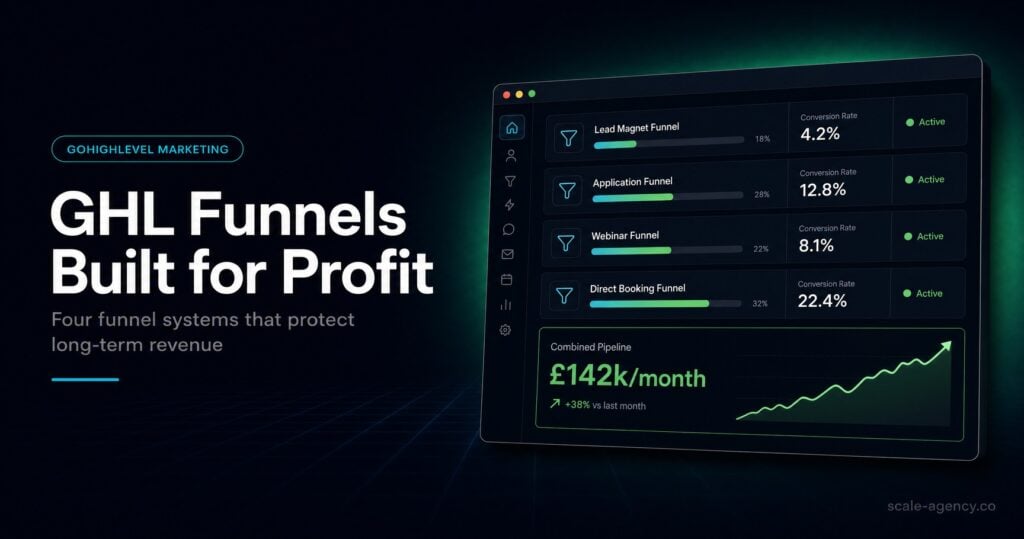
1. The Lead Magnet to Appointment Funnel
This is the most common GoHighLevel sales funnel for service businesses, agencies, and consultants. It trades value upfront for contact information, then uses automation to book qualified calls.
How It Works
- A landing page offers a lead magnet—audit, checklist, guide, or calculator—in exchange for name, email, and phone number.
- The contact enters a multi-channel nurture sequence combining email and SMS, delivering the lead magnet and introducing the core offer.
- Automated messages invite the lead to book a strategy call or demo using the integrated calendar.
- Reminders and follow-ups reduce no-shows and keep the conversation moving if they don’t book immediately.
- Once booked, the contact moves into a pipeline stage where the sales team can see history, engagement, and intent signals.
This funnel works because it separates curiosity from commitment. Not everyone who downloads your guide is ready to buy, but the automation continues nurturing until they are. GoHighLevel’s workflow builder lets you segment based on behaviour—who opened emails, who clicked links, who visited the booking page but didn’t schedule—and adjust messaging accordingly.
2. The Webinar Registration and Replay Funnel
Webinars remain one of the highest-converting formats for complex or high-ticket offers. A GoHighLevel sales funnel built around webinars automates registration, attendance, replay delivery, and post-event follow-up.
The funnel begins with a registration page that collects contact details and confirms the session time. GoHighLevel sends reminder emails and SMS leading up to the event, which significantly improves show-up rates. During the webinar, attendees receive a link to book a call or access a limited-time offer.
After the event, the funnel splits into two paths: attendees receive one sequence focused on booking or purchasing, while no-shows receive the replay with different messaging that acknowledges they missed it and creates urgency to watch. Both paths feed into the same pipeline, tagged by engagement level, so sales teams know who watched, how long, and whether they clicked the offer link.
This structure works because it respects timing. Not everyone converts live. The replay sequence captures those who were interested but unavailable, and the automation ensures no lead is forgotten simply because they didn’t attend.
3. The Application Funnel for Selective Offers
When your offer is high-ticket, capacity-limited, or requires qualification, an application funnel filters leads before they reach your calendar. This approach improves close rates and reduces wasted sales time.
The funnel starts with a landing page that frames the offer as exclusive or results-focused, then directs prospects to complete an application form. GoHighLevel’s form builder can include conditional logic, so the questions adapt based on previous answers. This creates a more conversational experience while collecting detailed information about budget, timeline, current situation, and goals.
Once submitted, the application triggers a workflow that scores the lead based on your criteria. Qualified applicants receive an invitation to book a call, while unqualified leads enter a nurture sequence or are directed to a lower-tier offer. The sales team sees the full application inside the CRM before the call, which allows for personalised conversations and faster closes.
This funnel protects your time and positions your offer as valuable. It also improves the quality of conversations because prospects have already invested effort and self-selected based on fit.
Building a GoHighLevel Sales Funnel That Converts Long-Term
Profitable funnels share common structural elements that go beyond the initial conversion. Here’s what separates a funnel that works once from one that generates revenue consistently:
- Multi-channel follow-up: Email alone isn’t enough. Combining email, SMS, and even voicemail drops increases response rates and keeps your message visible across channels prospects actually check.
- Behavioural triggers: Automation should respond to actions, not just time delays. If someone visits your pricing page three times, that should trigger a different message than someone who hasn’t opened an email in two weeks.
- Pipeline integration: Every funnel should feed into a visual pipeline where your team can see deal stage, last contact, and next action. This turns marketing activity into sales visibility.
- Reactivation sequences: Leads who don’t convert immediately shouldn’t disappear. Long-term nurture sequences that deliver value without pitching keep you top-of-mind until timing aligns.
- Reporting and attribution: GoHighLevel’s reporting shows which funnel stages lose the most leads, which sources produce the best customers, and which automations drive the most bookings. Use this data to optimise continuously.
4. The Tripwire to Core Offer Ascension Funnel
This funnel monetises traffic immediately with a low-cost offer, then ascends buyers into higher-value products or services. It’s particularly effective for businesses with a clear product ladder or tiered service model.
The entry point is a tripwire—a small, high-value offer priced low enough to remove friction. This could be a paid audit, a mini-course, a diagnostic session, or a starter package. The goal isn’t profit at this stage; it’s to convert a prospect into a customer and cover acquisition costs.
After purchase, the buyer enters an onboarding sequence that delivers the tripwire and introduces the core offer. Because they’ve already bought, trust is higher and the transition to a larger commitment feels natural. GoHighLevel tracks purchase behaviour and engagement, allowing you to time the upsell based on consumption and satisfaction signals.
This funnel works because it changes the relationship. A buyer is psychologically different from a lead. They’ve demonstrated intent, invested money, and are more likely to engage with follow-up. The tripwire also provides cash flow that offsets marketing costs, making the funnel more sustainable even before the core offer converts.
Technical Considerations When Building in GoHighLevel
GoHighLevel gives you flexibility, but that also means you need to make deliberate choices about structure. A few technical elements that impact funnel performance:
Use custom domains for landing pages rather than GoHighLevel subdomains. This improves deliverability, builds brand consistency, and increases trust. Set up proper DNS records including SPF, DKIM, and DMARC to ensure your emails reach inboxes.
Tag and segment aggressively. Every action a contact takes should apply a tag that informs future messaging. Tags let you build dynamic segments for retargeting, re-engagement, and personalised offers without manual list management.
Test your automations before launching. GoHighLevel’s workflow builder is powerful but can create unintended loops or conflicts if triggers overlap. Walk through each path manually and use test contacts to confirm timing, messaging, and transitions work as intended.
Integrate your payment processor directly if you’re selling products or accepting deposits. Native integration means purchase data flows into the CRM automatically, triggering fulfilment sequences and updating pipeline stages without manual entry.
When to Build vs. When to Hire
GoHighLevel is accessible enough for non-technical users to build basic funnels, but complexity scales quickly. If your funnel involves multiple conditional paths, advanced integrations, custom tracking, or high-stakes revenue, working with a team experienced in GoHighLevel architecture saves time and prevents costly mistakes.
The platform’s flexibility is both its strength and its risk. You can build almost anything, but that doesn’t mean every configuration will perform. Experienced builders understand conversion psychology, technical optimisation, and how to structure workflows that remain manageable as your business grows.
Consider building in-house if your funnel is straightforward, your team has time to learn the platform, and you’re comfortable iterating through trial and error. Hire expertise if speed matters, if your funnel is central to revenue, or if you need confidence that the system will scale without breaking.
For deeper context, compare this with how Facebook ads can be managed inside GoHighLevel and GoHighLevel website examples used by local businesses. Those examples show why the funnel performs better when the rest of the system also lives inside the platform.
If you want the practical operating side after the architecture is in place, read how to use GoHighLevel sales funnels to maximise KPIs. It covers the tracking, optimisation and follow-up moves that matter once the funnel is live.
Conclusion
A well-built GoHighLevel sales funnel doesn’t just capture leads—it creates a system that nurtures, converts, and retains customers with minimal manual intervention. The four funnel types covered here represent proven architectures that businesses use to maintain profitability regardless of market conditions or traffic fluctuations. Whether you’re booking appointments, selling webinars, qualifying applications, or ascending customers through a product ladder, GoHighLevel provides the infrastructure to automate the process and optimise based on real behaviour. The difference between a funnel that works temporarily and one that drives long-term growth is how well it integrates follow-up, segmentation, and pipeline management into a single, coherent system.
Want SCALE to build this for your business?
Book a free Growth Systems Audit and we will show you where your funnel, CRM and follow-up system are leaking revenue: https://scale-agency.co/
Learn more below:
