
Quick Answer: What Is the Difference Between an MQL and an SQL for Agencies?
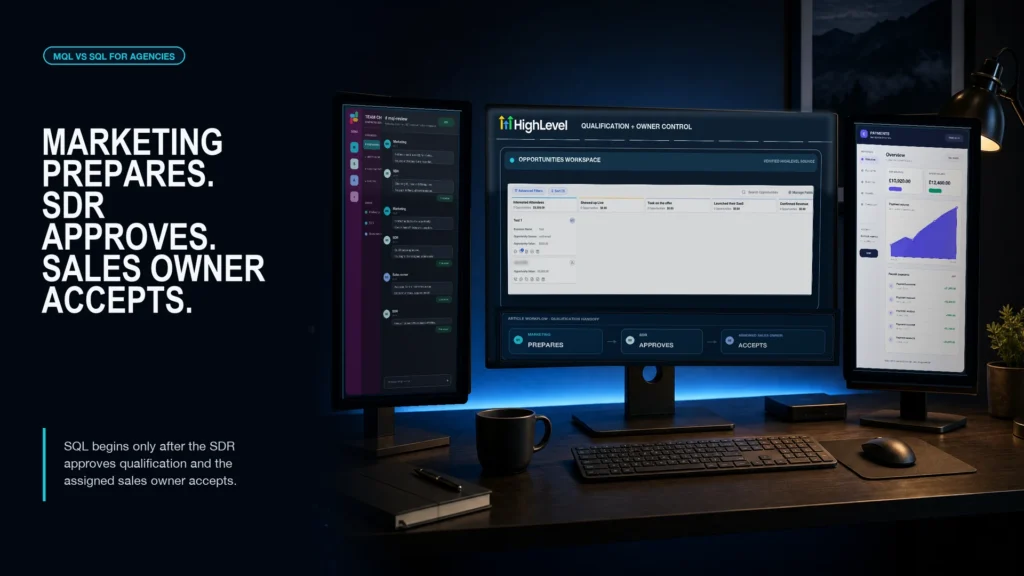
For an agency, an MQL is a marketing-owned lead with enough information and fit evidence to warrant qualification. An SQL is a sales-owned lead whose mandatory evidence is complete, whose initial qualification the SDR has approved and whose assigned sales owner has accepted for the approved sales step. Put simply: an MQL is ready to be checked; an SQL has been checked and accepted. A visit, download, form submission or calendar booking alone does not make a lead an SQL.
TL;DR
- An activity signal may start a review, but it cannot create an SQL without completed evidence, SDR approval and assigned-sales-owner acceptance.
- This guide uses an approved operating model with eight lifecycle rules, nine required CRM fields, three accountable roles and four non-SQL routes. These are operating-model counts—not performance results, industry benchmarks, conversion claims or promised outcomes.
- Keep the MQL marketing-owned until the evidence is ready; move only accepted SQLs to Sales.
- If the record is not ready, use Hold, Recycle, Reject or Nurture with a recorded reason and next action.
Complete the Lead Qualification Journey
You’re at step two: deciding MQL or SQL. Start by assessing the lead’s fit and evidence, then move accepted SQLs into the right pipeline stage.

POST OVERVIEW
Post Overview
| Guide section | Question it answers | Jump to |
|---|---|---|
| Definitions | Where does MQL end and SQL begin? | Start the Guide |
| Criteria and CRM fields | What evidence must exist and be recorded? | MQL vs SQL Criteria |
| Handoff rules | Who approves and accepts the transition? | Handoff Rules |
| Non-SQL routes and implementation | What happens when a record is not ready, and how should the workflow be tested? | Non-SQL Routes |
MQL vs SQL for agencies: the working definitions
Here is the shortest useful distinction: an MQL is ready for qualification; an SQL has completed qualification and been accepted by Sales.
Marketing-qualified lead (MQL)
An MQL has enough relevant information and fit evidence to warrant qualification, but it has not yet been accepted as a sales opportunity. Marketing owns this lifecycle stage and the evidence prepared for review.
In plain English, it is ready to be checked—not ready to be treated as an accepted sales opportunity.
Sales-qualified lead (SQL)
An SQL has complete mandatory evidence, a checked problem and fit, SDR approval of initial qualification, and explicit acceptance by an assigned sales owner for the approved sales step. Sales owns this lifecycle stage.
In plain English, it has been checked, accepted and given an approved next sales action.
These definitions describe the approved operating model used in this guide. They are not universal industry definitions or a promise of better conversion.
The criteria that separate an MQL from an SQL
The common mistake is treating activity as acceptance. A prospect can visit, download, submit a form or book a calendar slot and still be missing the evidence required for SQL.
Activity can create a review task, but it cannot record sales acceptance.
| Decision point | MQL | SQL |
|---|---|---|
| Required information | Complete enough to warrant qualification | Mandatory evidence complete |
| Fit review | Evidence prepared for review | Problem and fit checked |
| Qualification | Not yet approved as a sales opportunity | SDR has approved initial qualification |
| Acceptance | No sales acceptance yet | Assigned sales owner has explicitly accepted |
| Owner | Marketing | Sales |
| Next action | Qualification review | Approved sales step |

Use the table as six decision questions
- Are the required fields complete?
- Has the problem and fit been checked?
- Has the SDR approved initial qualification?
- Has the assigned sales owner accepted the SQL?
- Does the current owner match the lifecycle stage?
- Is the approved next action recorded?
The agency lead qualification process owns the fit evidence, score and route. This guide owns the lifecycle definition and the acceptance boundary between Marketing and Sales.
Ready to Build This Yourself?
Turn the framework in this guide into a live HighLevel workflow—connecting your forms, CRM, automation and follow-up in one place.
The nine CRM fields that make the lifecycle visible
Use the CRM fields below to see what is true, who owns the decision and what happens next. A lifecycle label without evidence, ownership and next action is only a status—not a control.

Evidence
- Source and consent: where the lead came from and the communication context.
- Qualification evidence: the relevant problem, need and fit information collected so far.
- Agency Fit Score and route: the existing approved score and A/B/C/Hold route, without a new threshold.
Ownership
- Lifecycle stage: the current MQL, SQL, Hold, Recycle, Reject or Nurture state.
- Current owner: Marketing before acceptance and Sales after the accepted SQL transition.
- Sales acceptance: the assigned sales owner’s explicit acceptance or return decision.
Decision and next action
- Decision reason: why the record progressed, paused or left the active route.
- Next action: the approved action that follows the lifecycle decision.
- Transition timestamp: when the recorded lifecycle decision changed.
Prefer Us To Build It For You?
We’ll turn the strategy in this guide into a custom conversion system built around your offer, audience and sales process.
The MQL-to-SQL handoff agreement
The CRM field can change in a second. Responsibility does not. A field change is not a handoff until the receiving role accepts responsibility.

Worked journey — synthetic record: Marketing completes the evidence and keeps ownership of the MQL. The SDR checks initial qualification and approves the record for sales review. The assigned sales owner then accepts the SQL or returns it with the missing requirement recorded.
- Marketing records source, consent, fit and qualification evidence.
- The SDR reviews the Agency Fit Score evidence and approves, rejects or recycles initial qualification.
- The SDR assigns an approved opportunity to a sales owner with the decision reason and proposed next action.
- The assigned sales owner accepts the SQL or returns it with the missing evidence or alternative route recorded.
- The CRM records the accepted lifecycle stage, owner, next action and transition timestamp.
Quick verdict: a lead becomes an SQL only after evidence, SDR approval and assigned-sales-owner acceptance. Activity alone is not acceptance.
The digital agency sales pipeline stages guide owns the wider sequence of pipeline decisions. This page stays focused on the MQL/SQL transition.
Four useful routes when the lead is not ready for SQL
Not ready is not one outcome. Keep Hold, Recycle, Reject and Nurture separate so the reason and next action stay visible.
- Hold
- Use this when required evidence is missing and the next step is to complete it.
- Recycle
- Use this when initial qualification needs to return to the prior owner for rework.
- Reject
- Use this when the available evidence does not support fit, and record the reason.
- Nurture
- Use this when fit may be present but timing requires a future action.
A calendar booking without the required evidence stays outside SQL. No proposal should be generated automatically because a record entered a field or a meeting was booked.
How to implement the model without over-automating it
Start with one synthetic test record, not a site-wide automation. The first useful test is whether every decision leaves evidence, an owner and a next action.
- Write the MQL and SQL definitions beside the lifecycle fields.
- Add the nine required CRM fields before building workflow logic.
- Map the existing Agency Fit Score and A/B/C/Hold route without inventing a new threshold.
- Move one synthetic record from Marketing to SDR review and assigned-sales-owner acceptance.
- Test the accepted SQL path and all four alternatives: Hold, Recycle, Reject and Nurture.
- Add reminders or routing only after the role decisions work. Automation may prompt the accountable role, but it must not record acceptance on that role’s behalf.
Choose the Route That Fits Your Business
Build it yourself in HighLevel, or bring in SCALE to take the complete system from initial strategy to live implementation.
Conclusion
Here is the decision rule: if the evidence is incomplete or the assigned sales owner has not accepted responsibility, the record is not an SQL. Keep the MQL marketing-owned while the evidence is prepared. Record SDR approval, sales acceptance and the next action before progression. When the record is not ready, use Hold, Recycle, Reject or Nurture instead of hiding it inside the active pipeline.
Frequently asked questions
What is the difference between an MQL and an SQL for an agency?
An MQL has enough information and fit evidence to warrant qualification but has not been accepted as a sales opportunity. An SQL has complete mandatory evidence, SDR qualification approval and assigned-sales-owner acceptance for the approved sales step.
Does a calendar booking make a lead an SQL?
No. A booking is an activity signal. The required evidence, SDR approval and assigned-sales-owner acceptance are still required.
Who owns an MQL?
Marketing owns the MQL stage and the evidence prepared for qualification.
Who accepts an SQL?
The assigned sales owner explicitly accepts the SQL after the SDR has approved initial qualification.
What happens when the evidence is incomplete?
Move the record to Hold or Recycle, record what is missing and assign the appropriate next action. Do not label it an SQL.