

What You Will Learn
Use this agency lead qualification process to separate evidence from assumptions, score commercial fit, route each lead by readiness and keep final decisions with a human reviewer.
What Evidence Should You Collect Before Scoring?
Record the commercial context, distinguish self-reported answers from corroborated evidence and make important gaps visible.
How Should You Score Fit Without Overstating Certainty?
Use transparent components and explicit penalties so every score can be traced to recorded evidence, risk and uncertainty.
What Should Happen Next For Each Lead?
Choose a shortlist, nurture, diagnostic or hold route according to fit, readiness and the evidence still required.
Which Decisions Must Remain Human?
Keep contact eligibility, outreach and proposal approval separate from the fit score so a person retains the final decision.
Quick Answer: What Is an Agency Lead Qualification Process?
An agency lead qualification process should capture commercial fit, verify the evidence behind the answers, score the opportunity using transparent criteria, route it by fit and readiness, and retain a human approval step. A score helps prioritise investigation. It is not automatic permission to contact a prospect, a prediction that the prospect will buy or authority to send a proposal.
TL;DR
- Qualification is a structured decision process, not a form followed by an automatic sales action.
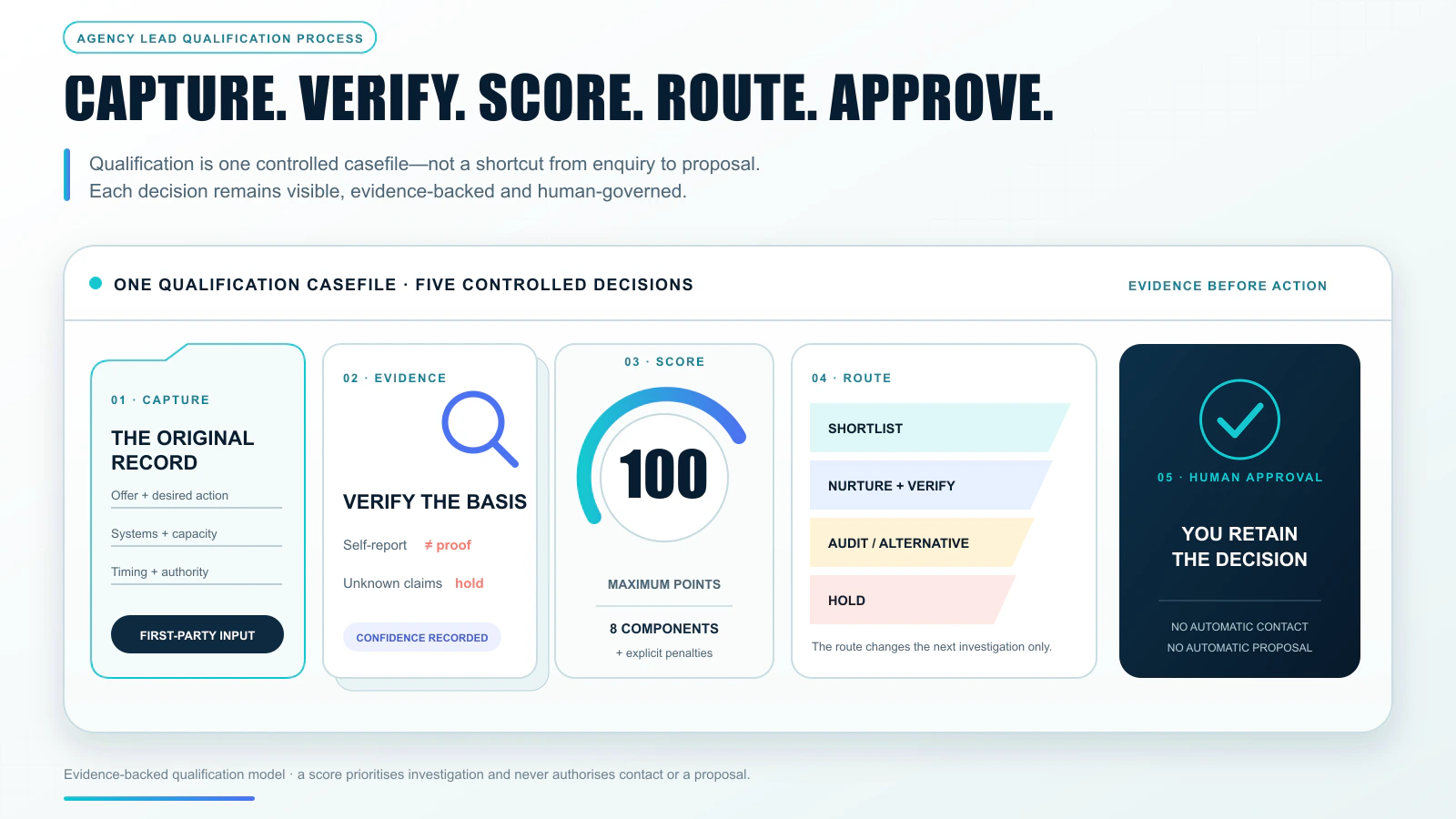
- Use five stages: Capture, Evidence, Score, Route and Approve.
- A transparent fit rubric should keep evidence quality, risk and uncertainty visible.
- Fit tiers change the next investigation step; they do not create automatic contact or proposal authority.
- Keep exceptions, outreach and proposal decisions under human review.
Why Agencies Need an Evidence-Gated Qualification Framework
A lead can look attractive for the wrong reasons. A polished website can hide weak economics. A large self-reported revenue figure may be unverified. A strong need for marketing support does not prove that the business has delivery capacity, decision authority or permission to be contacted. Treating every enquiry as equally ready creates avoidable research, follow-up and proposal work.
A useful agency lead qualification framework makes those distinctions visible. It records what the business says, what can be corroborated, what remains unknown and who owns the next decision. That makes the process easier to audit and reduces the risk of turning assumptions into facts.
This article presents a transparent qualification framework, not an industry benchmark, guaranteed sales method or automatic sales process. Use the numbers to organise investigation, then retain the final human decision for exceptions, contact action, commercial route and proposals.
The Five-Step Agency Lead Qualification Process
1. Capture the Commercial Context
Start with information that affects fit and delivery: the offer, the desired lead action, current acquisition routes, operating capacity, timing, systems and decision authority. Record the original source and first-party answers. Do not silently replace missing information with an estimate.
The objective is not to collect the largest possible form. It is to capture enough context to decide what evidence is needed next. Marketing or intake owns this first record, including source, consent or contact status and the difference between a prospect’s answer and an independently checked fact.
2. Separate Evidence From Assumptions
Mark whether each important answer is self-reported, corroborated or unresolved. Unsupported statements receive zero points or a hold where the uncertainty is material. Financial information should be stored as a range with an evidence basis and confidence level, never presented as verified fact when it is not.
This evidence step prevents a clean-looking score from hiding weak inputs. It also gives sales, strategy and operations a shared list of gaps to verify before a commercial decision is made.
3. Score Fit With Transparent Criteria
Apply the eight-component agency fit score and the explicit penalties shown below. The rubric is deliberately visible so you can understand why an opportunity moved up, down or into a hold state. A score is useful only when its components can be traced back to recorded evidence.
4. Route the Lead by Fit and Readiness
Use the resulting tier to choose the next investigation step: shortlist, nurture and verify, diagnostic or alternative route, or hold. Routing avoids forcing every enquiry into the same sales sequence. It also allows a promising but incomplete opportunity to remain visible without pretending it is proposal-ready.
5. Keep Human Approval Separate
Fit does not equal contact eligibility. Contact eligibility does not equal proposal approval. Keep those decisions as separate fields and require a human gate. A human reviewer retains approval over exceptions, contact action, the commercial route and any proposal decision.
Agency Lead Qualification Process Scoring Rubric
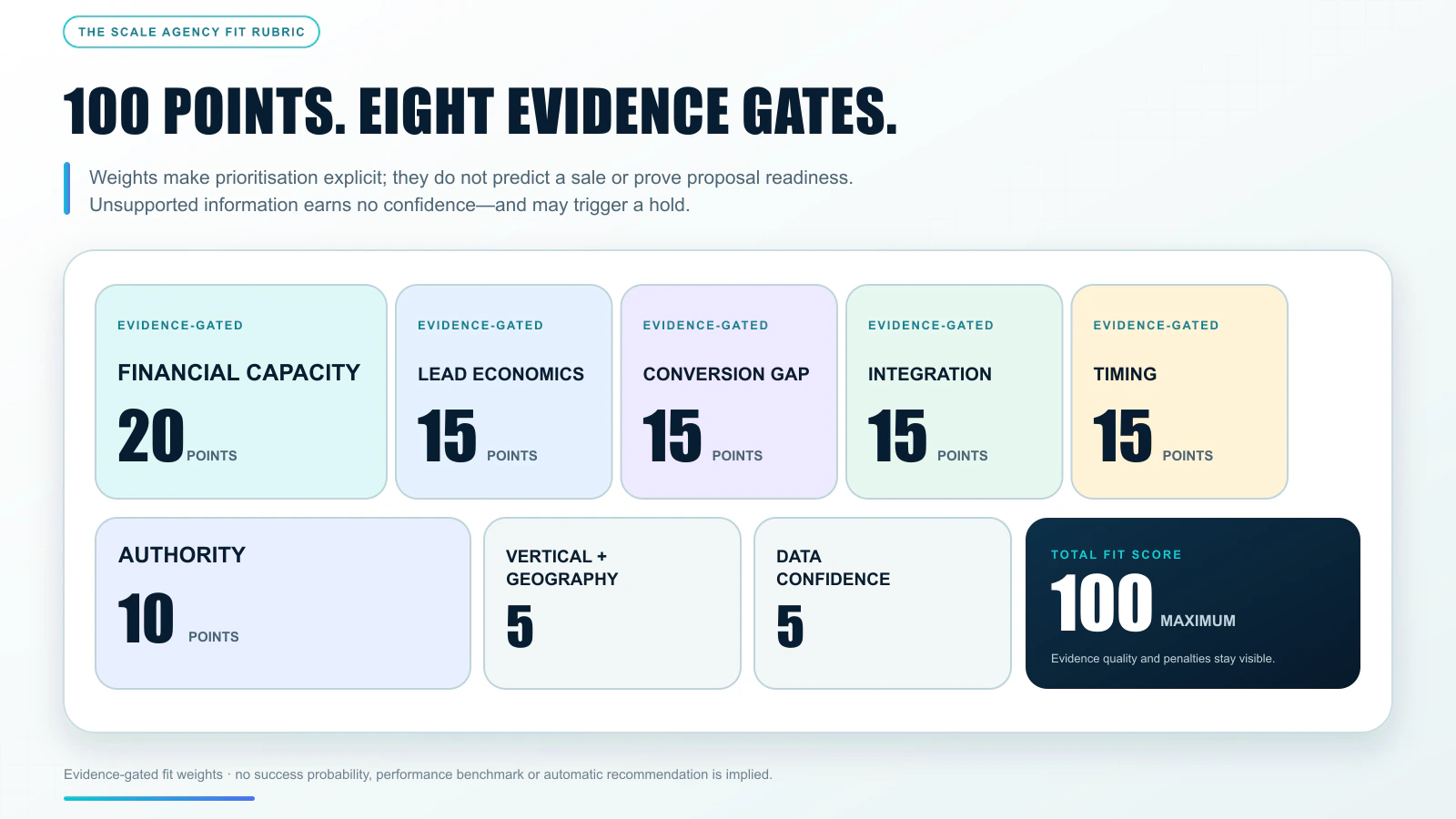
The rubric totals 100 points. It combines commercial capacity, lead economics, conversion and system gaps, timing, authority, service fit and data confidence. The weights provide a transparent prioritisation framework. They are not success probabilities or public market benchmarks.
| Component | Maximum | What It Examines |
|---|---|---|
| Financial capacity | 20 | Evidenced revenue range and ability to fund the work without presenting estimates as fact. |
| Lead-generation economics | 15 | Lifetime value, repeat purchase, margin, consultative sale, database and paid-lead dependence. |
| Digital conversion gap | 15 | Website, funnel, booking, follow-up, tracking, reputation and mobile gaps. |
| GoHighLevel consolidation or integration opportunity | 15 | Fragmented tools, missing CRM, disconnected systems and attribution needs. |
| Growth intent and timing | 15 | Active advertising, hiring, expansion, a new location, funding, leadership or strategic activity. |
| Decision-maker accessibility | 10 | Identifiable authority, a verified business contact and a permitted route. |
| Vertical, proof and geography fit | 5 | Relevance to available proof, delivery fit and a serviceable geography. |
| Data confidence | 5 | The quality, freshness and corroboration of the available information. |
Financial-Capacity Bands
The model assigns 20 points at £100,000 or more in monthly revenue, 16 at £50,000–£100,000, 12 at £30,000–£50,000 and 7 at £10,000–£30,000. Below £10,000 receives zero and a hold route unless a human reviewer approves an exception. These bands organise prioritisation; they do not state that a business at any band will buy, succeed or remain suitable after the remaining evidence is reviewed.
Priority Ordering
After fit is assessed, priority ordering uses this formula:
0.55 × Fit + 0.30 × Recent Intent + 0.10 × Contactability + 0.05 × Data Confidence
The formula keeps fit dominant while recognising that fresh intent, a valid contact route and reliable evidence affect which record should be investigated first. Contactability is not the same as contact permission; permission remains a separate decision.
Explicit Penalties
Apply penalties rather than hiding material risk inside a subjective note:
- Low operational capacity: −10.
- Low margin or poor unit economics: −10.
- Recent negative legal or reputation event: −10.
- Locked franchise decision-making: −8.
- Stale data: −5.
- Unverifiable contact details: −5.
- Vendor lock-in with no timing signal: −5.
- Current client or do-not-contact match: −100.
- Source-terms or compliance uncertainty: −100.
A −100 penalty creates a hold. It is not a cue to work around a restriction. Resolve the compliance question or stop.
Route Leads Without Treating Every Enquiry the Same
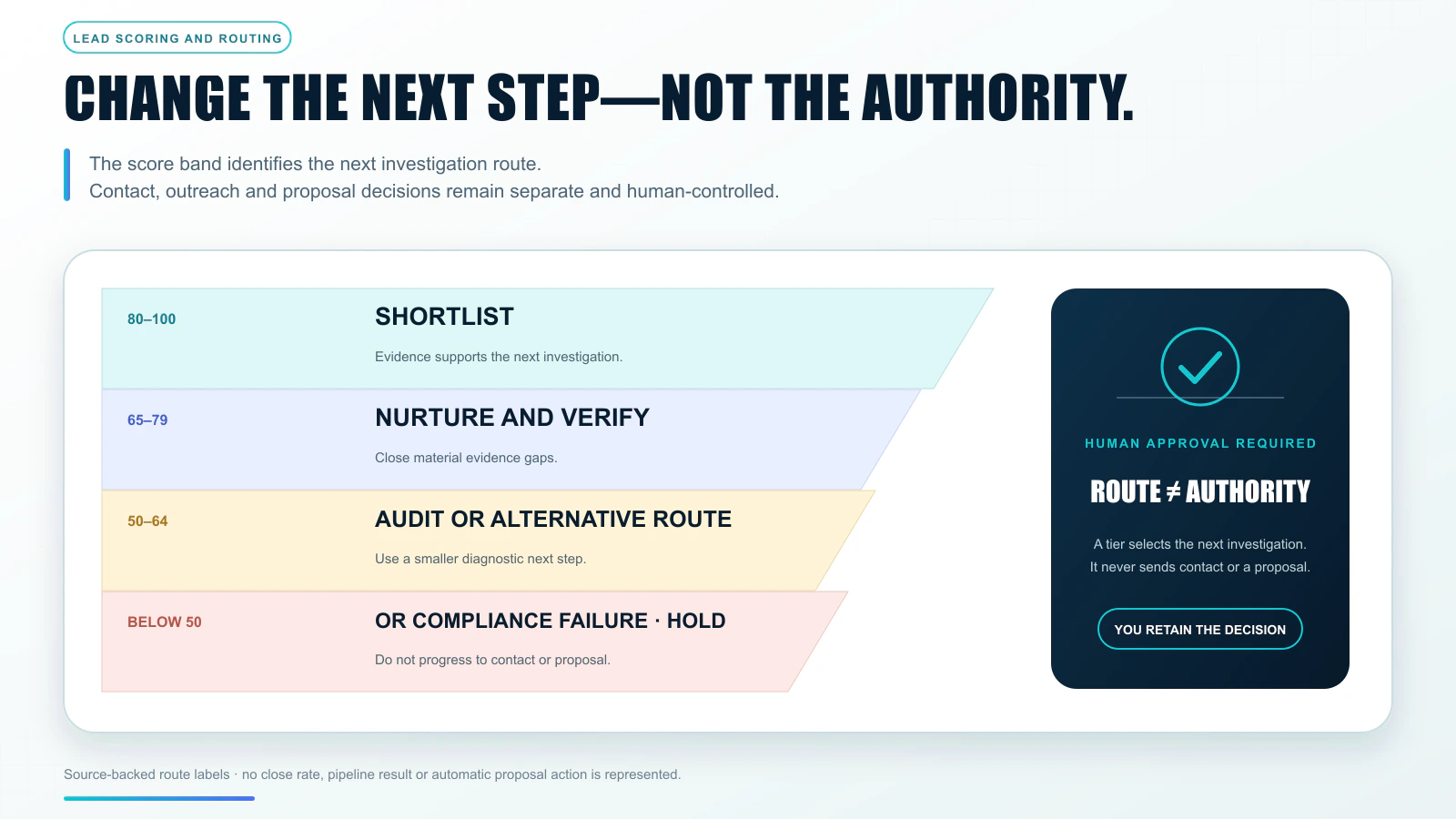
Lead scoring and routing should determine the next controlled action, not trigger an automatic commercial promise. The four routes below keep incomplete evidence and human approval visible.
| Route | Score | Next Action |
|---|---|---|
| Tier A | 80–100 | Executive shortlist; prepare a personalised audit and recommendation, subject to human approval. |
| Tier B | 65–79 | Nurture or qualified queue; close important evidence gaps before contact or proposal consideration. |
| Tier C | 50–64 | Monitor, diagnostic audit, smaller project or alternative qualification route. |
| Reject or Hold | Below 50 or compliance failure | No outreach export and no proposal. Resolve the hold or stop. |
The agency lead qualification process should record both the route and the reason. That creates a reviewable decision trail and makes it possible to revisit a lead when evidence or timing changes without rewriting the original history.
Need a second set of eyes on your qualification workflow?
Book a qualified process review to examine intake, evidence, scoring, routing and approval as one connected system.
Map the Framework Into CRM Fields
A useful CRM record separates identity, evidence, scoring, routing and approval. A practical field map contains the following 19 fields:
- Fit and routing: ICP Type, ICP Score, ICP Tier and Priority Score.
- Commercial evidence: Revenue Range, Revenue Confidence, Vertical, Digital Gap Score and Stack Fragmentation Score.
- Intent and evidence quality: Intent Signal, Intent Date, Data Confidence and Source URLs.
- Permission and ownership: Contact Eligibility, Lead Owner and Approval Status.
- Next-step context: Recommended Offer, Personalisation Hook and Graduation Candidate.
Do not use a single status field to carry all of those meanings. In particular, keep ICP Tier, Contact Eligibility and Approval Status separate. A lead can be a strong fit while contact remains unapproved.
The CRM should preserve source and decision evidence before automation is allowed to act.
Assign Clear Ownership at Every Stage
- Marketing or intake captures the original enquiry, source, contact status and first-party answers without converting assumptions into facts.
- Sales or a strategist validates the commercial problem, desired outcome, authority, timing, economics and evidence gaps.
- Operations or implementation validates delivery capacity, systems, access, integration risk and whether additional demand could be fulfilled.
- Human reviewer retains approval over exceptions, contact action, the commercial route and any proposal decision.
This division prevents one team from marking a lead “qualified” when only its own part of the picture has been checked. It also gives each unresolved field an accountable owner.
How to Implement the Framework Safely
- Define evidence states. Use labels such as self-reported, corroborated, unresolved and prohibited rather than a vague confidence note.
- Make penalties visible. Reviewers should be able to see why the score changed and which hold rule was triggered.
- Separate routing from outreach. A workflow may assign a review task, but it should not silently create contact permission.
- Require approval before commercial action. Keep the approval field empty until the named human gate has made the decision.
- Review changes over time. Preserve the original evidence and date new intent signals rather than overwriting the record.
Qualification works best when the wider acquisition system reduces pressure instead of pushing every enquiry toward an immediate proposal.
Common Qualification Failures to Avoid
- Scoring unverified claims as facts: store the claim, its source and its confidence before awarding points.
- Using fit as permission: a high score does not override consent, contact restrictions or approval rules.
- Ignoring delivery capacity: demand without fulfilment capacity can create a poor commercial fit.
- Hiding risk in notes: use explicit penalties and hold states so the risk affects the route.
- Automating the proposal: qualification may prepare evidence for a human decision; it should not make that decision.
Conclusion
A strong agency lead qualification process creates a traceable path from information to evidence, fit scoring, routing and human approval. It helps an agency spend attention where the commercial and operational fit is strongest while keeping uncertainty, permission and proposal authority visible. Use the rubric to structure investigation, not to manufacture certainty.
Frequently Asked Questions
What information should an agency collect before scoring a lead?
Collect the offer, desired lead action, acquisition routes, operating capacity, timing, systems, authority, source and contact status. Record which answers are self-reported and what evidence is still needed.
How should agencies separate lead fit from contact permission?
Use separate CRM fields for ICP Tier, Contact Eligibility and Approval Status. A strong fit score can prioritise review, but it must not change contact permission automatically.
What should happen to a medium-fit lead?
Tier B leads should be nurtured or verified while important evidence gaps are closed. Tier C leads may receive monitoring, a diagnostic audit, a smaller project or an alternative route, subject to human approval.
When should an agency reject or hold a lead?
Use a hold below 50 points or when a compliance failure, current-client or do-not-contact match, or unresolved source-terms issue is present. Resolve the hold or stop; do not work around it.
Should a high lead score automatically trigger a proposal?
No. A high score supports prioritisation and preparation. A human reviewer retains the final decision on exceptions, contact action, commercial route and any proposal.
Review Your Agency Qualification Process
If your intake, scoring, CRM routing and approval steps are disconnected, a qualified process review can examine the journey as one connected system.