
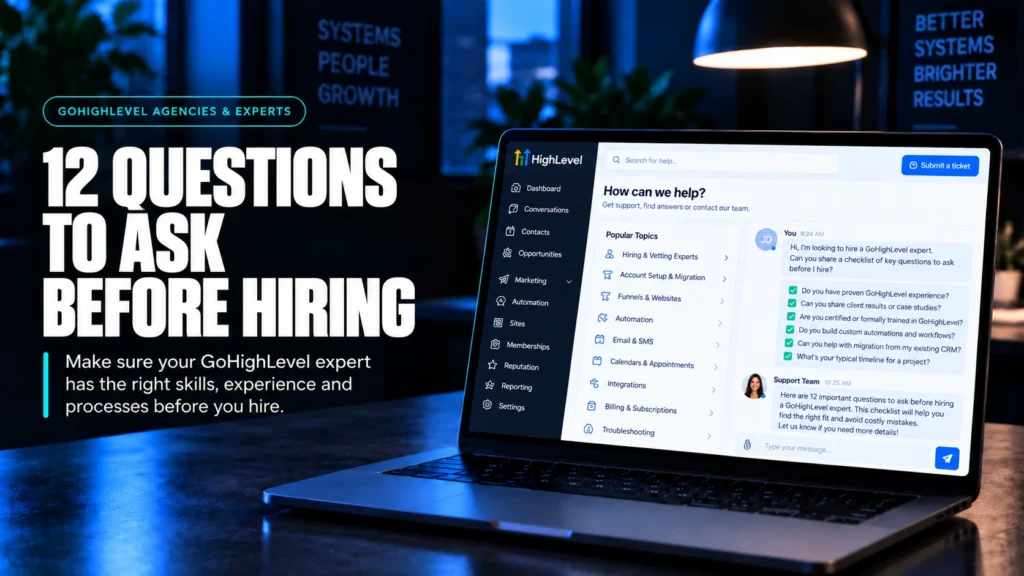
Quick Answer: What Should You Ask A GoHighLevel Expert Before Hiring?
The most useful questions to ask a GoHighLevel expert before hiring ask for evidence of process mapping, CRM decisions, testing, relevant results and handover. Give shortlisted providers the same brief, ask the twelve questions below and record each answer as verified, needs clarification or unsupported. This guide is for businesses interviewing providers, not job applicants preparing interview answers.
TLDR
- Ask the same core questions of each provider so their answers are comparable.
- Request redacted examples or a sandbox demonstration; do not ask for another client’s private data.
- Probe what happens with duplicate leads, replies during follow-up and access handover.
- For results claims, check the baseline, timeframe, measurement limits and the provider’s actual contribution.
- If you still need to define the project, use the GoHighLevel expert hiring checklist first.
What You Will Learn
Interviewing a shortlisted GoHighLevel provider? Use these twelve questions to compare their evidence, test their reasoning and record what still needs clarification before you hire.
Can They Map The Revenue Path First?
Request a sample process map and ask the provider to explain the decisions behind it, including responsibilities and exceptions.
What Breaks When The Account Gets Busy?
Use a duplicate-lead or reply-during-follow-up example to see whether the candidate can demonstrate a controlled test, not just describe a workflow.
Can They Explain The Risk They Removed?
Separate a provider’s contribution from other changes. Ask for the baseline, timeframe, limitations and evidence relevant to your project.
Will Your Team Still Own The System?
Ask to see an asset register, a handover sample and the steps your team would take if the provider were no longer available.
Can They Evidence The Work You Need?
Judge candidates against the same agreed scope. A narrow implementation task and a cross-system design project need different evidence, not different status labels.
Ready To Turn This Into A Working System?
Let us custom-build a conversion system for you, or install our top 5 performing GHL systems yourself, completely free.
Install Our Top 5 GHL Systems (FREE) Have SCALE Build It For You, Done For You.
For scope and provider-selection decisions, use the GoHighLevel expert hiring checklist. If migration is part of the interview, pair these questions with the GoHighLevel implementation checklist.
How To Use These Questions In A Provider Interview

Send each shortlisted provider the same brief and identify the parts they would own. For each relevant question, note their answer, the evidence shown and any unresolved dependency. Mark questions outside the agreed scope as not applicable rather than treating a specialist’s narrower remit as a failure.
Use a simple editorial checklist: verified means you have inspected evidence supporting the specific answer; needs clarification means a material detail or demonstration is outstanding; unsupported means the claim has not been backed by usable evidence. This is not a certification or a guarantee of future results.
Agree how gaps will be resolved before signing. A redacted document, controlled demonstration or reference shared with permission can be useful; access to confidential client records is not necessary.
Hiring Decision Table
Use these answer signals as interview prompts, not labels for a person’s job title or a substitute for checking their work.
| Question Area | Weak Answer | Strong Answer | What It Protects |
|---|---|---|---|
| Sales process | “We can build whatever you want.” | They explain a map covering lead source, qualification, owner, booking and exceptions. | Agreed scope |
| CRM data | They add tags and fields as requests appear. | They demonstrate field definitions, record rules and how a duplicate is handled. | Data consistency |
| Automation QA | They show a workflow but no test record. | They demonstrate expected and actual behaviour for submissions, replies and stop conditions. | Follow-up reliability |
| Proof | They show an uplift without context. | They explain the baseline, timeframe, contribution and measurement limitations. | Evidence quality |
Questions That Test Revenue Architecture
1. How Would You Map Our Sales Process Before Building?
Evidence to request: A redacted process map covering entry points, qualification, ownership and the next action.
Strong-answer signal: They ask which decisions your team has already made and identify gaps before proposing a build. Red flag: A template is offered without checking how your sales team works.
Follow-up: “Show me where an enquiry goes if it is unsuitable or nobody accepts ownership.”
2. Which Parts Of Our Funnel Should Go Into GoHighLevel?
Evidence to request: A proposed tool-and-data map showing what stays, what moves and which system owns each record.
Strong-answer signal: They explain dependencies, operating costs and tradeoffs for your scope. Red flag: “Move everything” without reviewing the current tools or business requirements.
Follow-up: “If we keep our existing payment or booking tool, how would you test the handoff and identify a failure?”
3. How Will You Prove The Build Is Helping Revenue?
Evidence to request: A proposed acceptance and measurement plan, including a baseline, review timeframe and who supplies the data.
Strong-answer signal: They separate delivery checks from business outcomes and explain attribution limits. Maintenance or risk-reduction work can succeed without a revenue lift. Red flag: Guaranteed revenue from installing software alone.
Follow-up: “Which outcome can your work influence, and what other changes could explain it?”
Questions That Expose Technical Depth

4. How Do You Decide Between Tags, Custom Fields And Opportunities?
Evidence to request: A small data dictionary and a controlled example showing how contact information and sales opportunities are represented.
Strong-answer signal: They can explain the purpose, owner and update rule for each item. Red flag: Tags accumulate without definitions or a reconciliation rule.
Follow-up — hypothetical duplicate-lead scenario: “The same person submits twice using the same email. Show what should happen to the contact, opportunity, owner and follow-up, then demonstrate the test.”
5. What Happens When A Workflow Fails?
Evidence to request: A redacted test record or sandbox demonstration showing a failed step, its detection and the recovery action.
Strong-answer signal: They distinguish a safe retry from an action that could duplicate a message or record, and name a person responsible for review. Red flag: “It never fails” or indiscriminate retries.
Follow-up — hypothetical reply scenario: “A lead replies while follow-up is pending. Show how you would test which messages stop, which tasks remain and who continues the conversation.”
6. How Do You Protect Speed-To-Lead?
Evidence to request: A timestamped test from submission to assignment and the intended first response, including an out-of-hours case.
Strong-answer signal: They distinguish an automated acknowledgement from a human response and explain escalation when the owner is unavailable. Red flag: Counting every automated message as a successful sales conversation.
Follow-up: “Who is alerted if the lead is still unassigned or untouched at the agreed threshold?” The speed-to-lead implementation guide covers the underlying workflow in more detail.
Start With A System You Can Inspect
Taking the DIY route? Start with our connected GHL systems, then use these questions to check the fields, handoffs and follow-up you adapt for your business.
Questions That Prove Commercial Fit
7. Can You Show A Similar Business Model?
Evidence to request: A permissioned reference, redacted case study or demonstration relevant to your lead flow, sales cycle and team responsibilities.
Strong-answer signal: They explain both the similarities and what would need to change for you. Red flag: A logo or attractive funnel is the only evidence of relevant experience.
Follow-up: “Which decision from that project would not transfer to ours, and why?”
8. What Metrics Improved After The Build?
Evidence to request: The baseline, comparison period, metric definition, supporting record and the provider’s actual contribution to a claimed result.
Strong-answer signal: They acknowledge changes in traffic, budget, offer or sales staffing and avoid attributing all improvement to their build. Reliability evidence can be relevant without a revenue claim. Red flag: An unexplained percentage or dashboard total presented as proof of causation.
Follow-up: “What else changed during that period, and what can this evidence not tell us?”
9. Where Would You Tell Us Not To Use GoHighLevel?
Evidence to request: One requirement they would validate before recommending a native feature, external tool or custom integration.
Strong-answer signal: They compare fit, access requirements, maintenance and limits instead of defending a platform at all costs. Red flag: An unsupported promise that every requirement is covered.
Follow-up: “What would you test before quoting that integration, and who owns the decision if it does not meet the requirement?”
Questions About Handover And Ownership

10. Who Owns The Account And The Assets?
Evidence to request: A proposed asset-and-access register identifying account arrangements, domains, numbers, sending services, data access and any transfer dependencies or charges.
Strong-answer signal: They distinguish what your business controls from what depends on another provider or platform. Red flag: Verbal ownership assurances with no documented exit process.
Follow-up — hypothetical handover scenario: “Our agreement ends next month. Walk us through retaining access, transferring what is transferable and removing your access without breaking the system.”
11. What Documentation Will We Receive?
Evidence to request: A redacted handover pack with field definitions, workflow purpose, test results and routine operating instructions.
Strong-answer signal: A team member could follow it without relying on the original builder’s memory. Red flag: A recording of the account with no explanation of decisions or maintenance.
Follow-up: “Choose one routine change and show where its instructions, owner and checks are documented.”
12. What Happens After Launch?
Evidence to request: Written support terms covering the initial defect period, reporting route, response expectations, exclusions and change requests.
Strong-answer signal: They distinguish fixing an agreed deliverable from paid new work and explain who monitors the system. Red flag: “Ongoing support included” with no scope or availability.
Follow-up: “If a connected service changes after handover, who diagnoses the issue and how is any additional work approved?”
Red Flags To Spot Before You Sign
Look for unresolved patterns across the answers: unsupported results, demonstrations that avoid exceptions, unclear asset control or no named owner for faults. Ask for clarification before treating an incomplete answer as a final refusal.
Do not average away a critical gap. If access, data handling or a necessary handoff remains unsupported, record the missing evidence and the decision it prevents. A candidate can be suitable for a limited task without being responsible for the entire system; make that boundary explicit in the brief.
Put Your Questions To The Team Building It
Need your CRM, funnels and follow-up connected? Discuss the scope with SCALE and agree the deliverables, test evidence and handover before the build starts.
Watch: See The Platform Before Your Interview
Jasper Aiken’s complete agency setup tutorial offers broader platform context. Use it to understand the terminology; it is not an assessment of a provider or proof of their work.
Conclusion: Compare Evidence Before You Commit
Use these twelve questions to turn a provider interview into a comparison of evidence. Record what was demonstrated, what needs clarification and what remains unsupported, then resolve the important gaps before committing.
Choose on fit with the agreed work, the quality of the evidence and a clear handover—not confidence, job title or a promise of guaranteed growth.
FAQs
What Questions Should I Ask A GoHighLevel Expert Before Hiring?
Ask the twelve questions above about process mapping, tool fit, measurement, CRM data, workflow failures, response ownership, relevant experience, results, limitations, assets, documentation and support. Ask for evidence and a follow-up on each area relevant to your project.
How Do I Evaluate Technical Answers If I Am Not A Developer?
Ask the provider to demonstrate one controlled scenario and explain the expected result, actual result and any exception in plain language. Record unclear answers for follow-up. For a high-risk integration, an independent technical reviewer may be useful; fluent terminology alone is not verification.
What If A Provider Cannot Share Client Work?
Respect confidentiality. Ask for a redacted document, sandbox demonstration or reference shared with permission instead. Treat an unverified claim as unsupported, but do not assume a confidentiality restriction proves a lack of competence.
What Proof Should A GoHighLevel Expert Show?
Evidence should match the proposed work: a test record, process map, handover pack or contextualised result. For performance claims, request the baseline, timeframe, metric definition, attribution limitations and their actual contribution. A maintenance project need not produce a revenue increase to be successful.
Can SCALE Build The GoHighLevel System For Us?
Yes. SCALE builds GoHighLevel CRM, funnel, automation and follow-up systems for businesses that need better lead quality, faster speed-to-lead and clearer revenue visibility.
